
Content

The IBM Think 2026 Recap: the agentic era is not a future state. It is already separating enterprises that are scaling AI into real operations from those still running controlled experiments – and the gap is widening.
We sat through the keynotes, walked the Think Forum, and had the conversations that don’t make it into the official session recaps. What follows is our unfiltered read on what mattered, what the announcements actually mean for enterprise leaders, and where most organizations will struggle to execute.
If you were there, use this as a second opinion. If you weren’t, use it as the briefing your team needs before the next planning cycle begins.
The Big Picture: IBM’s Most Significant Announcements
IBM did not arrive in Boston with incremental updates. The announcement package across Think 2026 was the most comprehensive expansion of enterprise AI capabilities IBM has put on the table in a single week.
The headline products – and what they actually solve:
| Announcement | What it means in practice |
|---|---|
| watsonx Orchestrate (next-gen) | A unified control plane that governs and audits AI agents running across different teams, platforms, and frameworks |
| IBM Confluent | Real-time data streaming built on Kafka and Flink, integrated into watsonx.data – gives AI agents live data instead of stale batch feeds |
| IBM Sovereign Core (GA) | Embeds compliance controls and governance directly at the infrastructure level – not as a policy layer on top, but as part of the runtime |
| IBM Concert | Connects signals from existing tools into shared context, enabling coordinated action across a hybrid estate |
| IBM Bob (GA) | Helps technical teams build and deploy agents faster, with cost and security controls built in from the start |
Three themes ran through every announcement. First, data quality is the prerequisite – IBM was explicit that agentic systems cannot reason reliably over fragmented or siloed data. Second, governance needs to be infrastructure, not policy – IBM Sovereign Core being generally available signals that regulators and boards are no longer accepting compliance as an afterthought. Third, hybrid cloud is the operating reality – not an architectural choice, but the environment most large organizations actually live in, and the one IBM has fully committed to serving.
The watsonx.data GPU-accelerated Presto benchmark with Nestlé – 83% cost savings and a 30x price-performance improvement across a global data mart spanning 186 countries – was the most concrete proof point IBM shared all week. Numbers like that don’t come from a good product alone. They come from a clean data foundation underneath it.
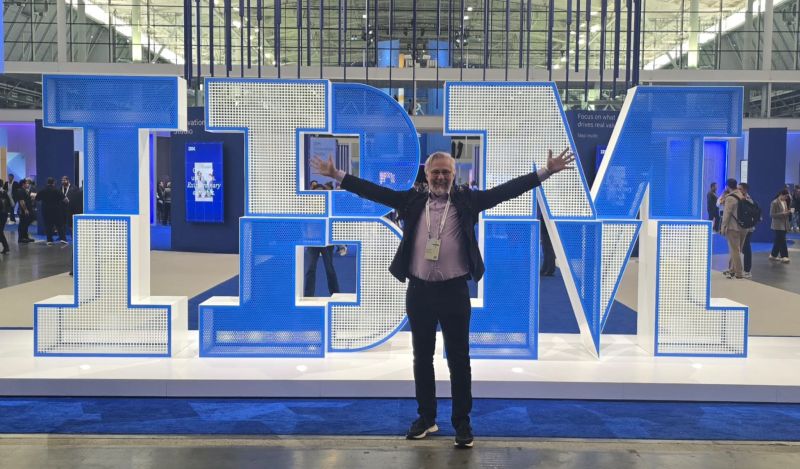
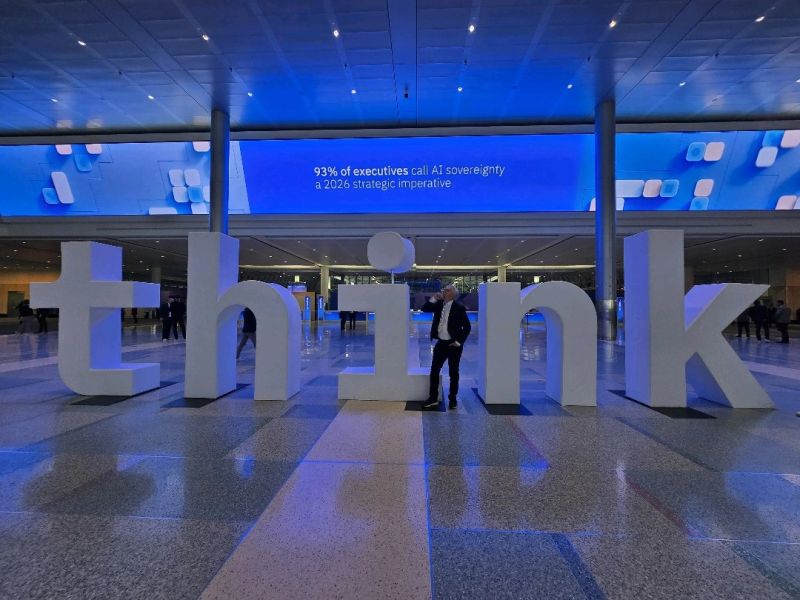
The Multishoring team spent four days on the ground at IBM Think 2026 in Boston – in the keynote rooms, on the Think Forum floor, and in the 1:1 meeting center conversations that never make it into the official recaps. If you want to cut through the announcements and understand what IBM’s agentic AI roadmap actually requires from your data and integration environment – that is exactly the conversation we are ready to have.

From Inspiration to Action: The ROI Evidence IBM Put on the Table
IBM came to Boston with numbers, not just vision. The customer cases presented across the week set a practical benchmark for any enterprise evaluating its AI program right now.
- Aramco reported generating more than $5.2 billion in value from AI across upstream exploration, refining, and corporate operations. The figure that matters most: over 50% of that value came from live production deployments – not pilots. That ratio is the metric worth tracking in your own organization. Getting AI past the 50% production threshold requires organizational commitment that goes well beyond the technology decision.
- Elevance Health committed approximately $1 billion to AI – covering data, platforms, and AI together as a single investment. The result: a virtual assistant handling member benefits queries without a call center agent, a provider-matching engine using 500 data points, and AI monitoring payment integrity in real time. Every one of those systems runs on the same unified data layer. They compound on each other because the infrastructure underneath them is shared.
- Cleveland Clinic brought the week’s most forward-looking case – using quantum simulation to work on large protein complexes in biomedical research. The lesson for enterprise leaders outside healthcare is about sequencing: Cleveland Clinic did not start with quantum. They built a solid data and AI foundation first, then extended toward more advanced computing as the infrastructure matured.
The Context That Puts These Numbers in Perspective
The evidence is encouraging. The broader picture is sobering.
Lopez Research’s 2025 Enterprise AI Benchmark found that 85% of companies are struggling to find AI ROI. The most cited reason is not budget, not talent, and not technology. It is data quality. McKinsey’s research reaches the same conclusion.
IBM addressed this directly from the keynote stage. The message was consistent across all three days: AI value does not appear until organizations stop treating AI as a separate initiative and start treating reliable data as the prerequisite. Aramco and Elevance Health did not get those results because they bought good AI tools. They got those results because they had done the foundational work on data and integration infrastructure first – and then embedded AI into workflows where it changes actual decisions and cycle times.
That is the clearest signal from Think 2026. The platform announcements are real. The ROI is real. But neither is replicable without the less visible work that came before them.
The Multishoring Take: What IBM Got Right – and What’s Harder Than It Looks
We spent four days in Boston pressure-testing IBM’s “agentic leap” narrative against the reality we see inside enterprise IT environments every week. Here is our honest read.
What IBM Got Right
✓ IBM correctly diagnosed the real problem.
For years, the enterprise AI conversation has been dominated by model selection, platform comparisons, and pilot announcements. IBM reframed it:
The question is not which AI tool you buy. The question is whether your data foundation is solid enough to run it on.
That reframe is accurate – and it is one most vendors still avoid because it points the spotlight away from their products and toward the harder infrastructure work.
✓ Governance-as-infrastructure is the right call.
IBM Sovereign Core being generally available signals something important. Governance can no longer be a configuration option bolted on after deployment. Embedding compliance controls at the runtime level – not as a policy layer on top – is how enterprises protect themselves in regulated environments. Boards and regulators are demanding it. IBM built for it.
✓ The ecosystem framing was honest.
IBM was explicit throughout the week: no single vendor builds and runs agentic AI at enterprise scale alone. The implementation partner is the primary delivery vehicle – not a support channel. That is a harder thing to say from a keynote stage than it sounds.
Where the Hard Work Actually Lives
IBM’s roadmap is coherent. What it does not dwell on is how wide the gap is between the announcement stage and the enterprise shop floor.
The typical picture inside a mid-to-large enterprise today:
- Multiple ERPs running in parallel across regions – no unified view
- Critical reporting still held together by manual workflows
- Integrations between systems that fail silently – teams find out from missing data, not alerts
- Legacy middleware nobody dares touch, but everyone knows is under strain
The dependency chain nobody talks about on the keynote stage:
- Before watsonx Orchestrate can coordinate agents – data needs to flow reliably between systems
- Before IBM Sovereign Core can enforce runtime governance – there has to be a clean data layer worth governing
- Before Confluent can stream real-time context to agents – the underlying architecture needs to be coherent enough to stream from
The hardest part of the agentic leap is not adopting the new platforms. It is doing the foundational cleanup that makes those platforms usable.
That work – integrating siloed systems, standardizing data pipelines, establishing a single source of truth – is unglamorous, easy to defer, and the single biggest predictor of whether AI investment pays off. It is also exactly what Multishoring does.
What to Do With This Week
IBM Think 2026 delivered a clear, consistent message across four days. The agentic era is not a roadmap item. It is happening now – and the organizations capturing its value are not the ones with the most advanced AI tools. They are the ones with the cleanest, most integrated data underneath those tools.
The three things worth acting on before your next planning cycle:
- Audit your data foundation before expanding your AI investment. The Aramco, Elevance Health, and Cleveland Clinic results were built on unified, integrated infrastructure. If yours is fragmented, that is where the work starts.
- Track your production-to-pilot ratio. If more than half of your AI activity is still in controlled experiments, the economics will not work at scale. The Aramco benchmark – 50%+ of value from live production – is a useful target.
- Choose your implementation partner as carefully as you choose your platform. The conference was full of compelling announcements. The organizations that will actually realize the ROI are the ones with partners capable of doing the infrastructure work underneath the AI layer.
Ready to make the agentic leap – but not sure your data foundation can support it yet?
That is the conversation Multishoring has every day. We work specifically on the data and integration layer that enterprise AI depends on – fixing fragmented systems, broken integrations, and reporting environments that are holding organizations back from real AI returns.
Talk to our team and let’s map out what your environment needs before the next wave of AI investment lands.