
Content

An integration issue is any problem that prevents connected systems from exchanging data or completing a business process correctly, securely, and on time. It may appear as an API error, a delayed synchronization, duplicate records, missing data, degraded performance, or a complete integration failure.
The fastest way to reduce integration failures is to treat them as end-to-end process risks rather than isolated coding defects. Define the contract and owner, validate data at every boundary, design safe retries, monitor business outcomes as well as infrastructure, and rehearse recovery before production.
Integration issues at a glance
- Most common causes: unclear requirements, incompatible data, API constraints, weak architecture, unsafe error handling, security gaps, and weak operational readiness.
- Early warning signs: rising error or retry rates, queue backlog, latency, reconciliation differences, expired credentials, schema-validation failures, and missing business events.
- First response: stop data corruption, identify the failing boundary, classify the error, replay only safe transactions, reconcile data, and document the root cause.
What do integration issue, integration error, and integration failure mean?
The terms are related but not interchangeable. An integration issue is the broadest category. An integration error is an observable technical or data exception. An integration failure occurs when the integration cannot deliver its intended business outcome or service level.
| Term | Meaning | Example | Typical response |
|---|---|---|---|
| Integration issue | Any condition that reduces the correctness, security, timeliness, or reliability of a connected process. | Customer records arrive 30 minutes late. | Investigate the process, dependency, data, and service-level impact. |
| Integration error | A specific exception or invalid result detected by a system. | An API returns HTTP 429, a token expires, or a payload fails schema validation. | Classify it as transient, permanent, data-related, security-related, or business-rule-related. |
| Integration failure | The integration does not complete its required business outcome. | A paid order never reaches fulfillment. | Contain the impact, restore service, reconcile affected records, and remove the root cause. |
A single error does not always cause a failure. A timeout may be recovered through a safe retry. Conversely, an integration can return no technical error and still fail if it silently maps a field incorrectly or omits a business event.
Why enterprise integration projects fail
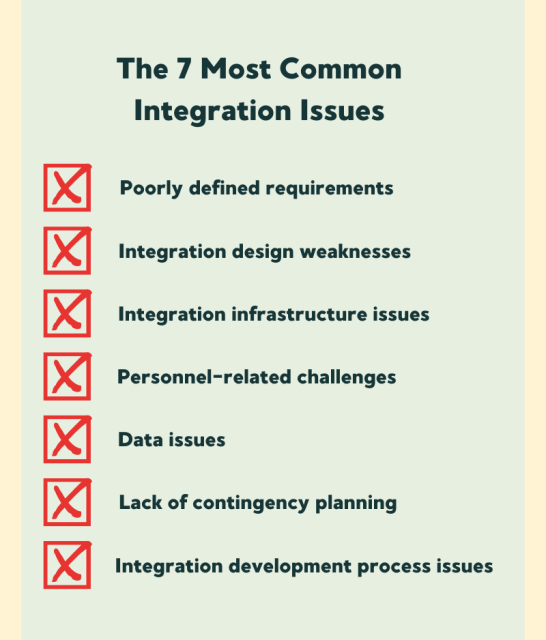
Enterprise integration projects usually fail when several small weaknesses align across requirements, data, architecture, delivery, and operations. Teams may build to an incomplete contract, test only the happy path, release without end-to-end telemetry, and discover too late that nobody owns reconciliation or vendor escalation.
The recurring pattern is a gap between technical success and business success. An endpoint can be available while transactions are delayed, duplicated, or mapped incorrectly. That is why integration health must include both technical signals—such as latency, error rate, and queue depth—and business signals, such as orders processed, employees provisioned, or invoices reconciled.
Common integration failure points: symptoms, causes, and controls
| Failure point | What you may observe | First control to add | Metric to watch |
|---|---|---|---|
| Requirements and ownership | Conflicting expectations, uncovered cases, slow decisions | Versioned interface contract and named owner | Unresolved contract decisions |
| Data and schema | Rejected, missing, duplicated, or misclassified records | Schema validation and reconciliation | Validation and mismatch rate |
| API constraints | HTTP 401/403/429, timeouts, broken clients after an update | Contract tests, token monitoring, throttling | Error rate by status and endpoint |
| Architecture and capacity | Latency spikes, bottlenecks, cascading outages | Load test and dependency isolation | p95/p99 latency, throughput, saturation |
| Error handling | Duplicate transactions, endless retries, stuck messages | Idempotency, bounded backoff, dead-letter queue | Retry and dead-letter rates |
| Security | Unauthorized access, leaked data, sudden access failures | Least privilege, secret rotation, payload validation | Authentication and authorization failures |
| Operations and lifecycle | Silent failures, vendor outages, production-only defects | End-to-end monitoring, recovery runbook, realistic testing | Detection time, dependency availability, escaped defects |
1. Poorly defined requirements and unclear ownership
An integration cannot be reliable if teams disagree about what “complete” means. Requirements should describe the business event, source of truth, data contract, expected volume, latency target, security boundary, error behavior, recovery objective, and owner of each decision.
Before development, document who owns the source, target, integration platform, data quality, incident response, and vendor relationship. Define what happens when a record is late, duplicated, incomplete, or rejected. A RACI chart can help, but a short decision log and a named accountable owner are more important than the format.
How to prevent this issue
- Write acceptance criteria for success, partial success, timeout, duplication, and invalid data.
- Record nonfunctional requirements: peak throughput, maximum latency, availability, retention, recovery time, and recovery point.
- Version the interface contract and define who approves a breaking change.
- Confirm the source of truth and the reconciliation owner for every critical entity.
2. Data quality and schema incompatibility
Data integration fails when connected systems interpret the same record differently. Common causes include missing required values, duplicate identifiers, incompatible formats, different units or time zones, stale reference data, schema drift, and conflicting master-data rules.
IBM identifies poor data quality and incompatible formats among the key data integration challenges. Its recommended controls include profiling, cleansing, standardization, validation, governance, metadata management, and regular audits. These controls are most effective when they run before, during, and after transfer—not only during a one-time migration.
How to prevent this issue
- Profile real production-like data before finalizing mappings.
- Validate required fields, types, formats, ranges, referential integrity, and business rules at the boundary.
- Use stable business keys and explicit deduplication rules.
- Reconcile source, in-flight, accepted, rejected, and target record counts.
- Quarantine invalid records instead of silently dropping or coercing them.
For a deeper assessment, see our data integration consulting services.
3. API limitations, authentication, and version changes
API integrations often break because the consumer assumes the interface is more stable or capable than it is. Rate limits, pagination, payload limits, token expiration, permission changes, unavailable operations, and deprecated versions can all interrupt a previously working flow.
Design against the published contract, not a handful of successful test calls. Monitor deprecation notices and credential expiry. Use consumer-driven contract tests for fields and behaviors your process depends on. Treat HTTP 401/403 as access problems, 429 as throttling, most 4xx responses as permanent request errors, and selected 5xx or timeout conditions as potentially transient.
How to prevent this issue
- Inventory APIs, owners, versions, scopes, quotas, and deprecation dates.
- Test authentication renewal and secret rotation before expiry.
- Respect rate-limit headers and control concurrency instead of retrying immediately.
- Run contract tests in CI and during vendor sandbox validation.
- Define a backward-compatibility and migration window for breaking changes.
Related guidance: API management best practices for system integration.
4. Architecture bottlenecks and single points of failure
An integration becomes a bottleneck when one component cannot absorb peak load or one synchronous dependency controls the availability of the whole process. Warning signs include growing queues, rising p95 or p99 latency, connection-pool exhaustion, database lock contention, timeouts, and throughput that stops scaling as resources increase.
Choose synchronous processing only when the caller truly needs an immediate result. For work that can finish later, a queue can buffer load and isolate temporary dependency failures. Partition high-volume workloads where appropriate, apply backpressure, cap concurrency, and test realistic bursts rather than average traffic alone.
How to avoid integration bottlenecks
- Model peak volume, payload size, processing time, and downstream quotas.
- Load-test the complete path, including the slowest dependency and database writes.
- Use queues, batching, caching, or streaming only where the workload justifies them.
- Set timeouts and concurrency limits at each remote boundary.
- Remove or protect single points of failure and document capacity thresholds.
5. Unsafe retries and incomplete error handling
Retries improve resilience only when the error is transient and the operation is safe to repeat. Blind retries can duplicate orders, payments, or notifications and can overload a dependency that is already recovering.
AWS recommends exponential backoff for transient errors and states that retried operations should be idempotent. Microsoft distinguishes the Retry pattern from the Circuit Breaker pattern: retries expect a temporary fault to clear, while a circuit breaker stops calls that are likely to keep failing. For asynchronous flows, failed messages should move to a dead-letter queue after a bounded number of attempts.
A safe error-handling policy
- Classify the error. Separate transient dependency faults from invalid data, business-rule rejections, security failures, and programming defects.
- Make writes idempotent. Use a stable idempotency key, unique event ID, or conditional write so a repeat has the same effect as the first accepted request.
- Bound retries. Apply exponential backoff with jitter and a maximum attempt or time budget.
- Stop persistent calls. Use a circuit breaker or platform equivalent when a dependency remains unhealthy.
- Preserve failed work. Route unrecoverable messages to a dead-letter or quarantine queue with the payload, error, correlation ID, and attempt history.
- Reconcile after replay. Confirm the intended business result, not merely a successful HTTP response.
Multishoring also provides an integration error handling platform for centralized visibility and control.
6. Security, privacy, and compliance gaps
Every new integration creates another trust boundary, credential lifecycle, and path through which sensitive data can move. Common failures include excessive permissions, unrotated secrets, weak token validation, unencrypted transport, unsafe payload consumption, poor endpoint inventory, and logging that exposes personal or confidential information.
The OWASP API Security Top 10 (2023) highlights risks including broken authentication, unrestricted resource consumption, security misconfiguration, improper inventory management, and unsafe consumption of third-party APIs. Integration teams should therefore validate external data as strictly as user input and apply authorization at every protected API boundary.
How to prevent this issue
- Use least-privilege scopes and separate service identities by environment and purpose.
- Encrypt data in transit and at rest; rotate credentials and certificates before expiry.
- Validate tokens, schemas, payload sizes, content types, destinations, and business permissions.
- Maintain an inventory of active endpoints, versions, owners, and data classifications.
- Redact secrets and regulated data from logs while preserving auditability.
See how to build integration security by design.
7. Weak operational readiness and lifecycle management
Integrations remain reliable only when teams can detect silent failures, withstand vendor outages, and release changes safely. Observability, tested recovery procedures, realistic testing, and clear lifecycle ownership turn a working interface into an operable business service.
Instrument each transaction with a correlation ID that follows it across systems. OpenTelemetry defines a vendor-neutral framework for traces, metrics, and logs; these signals are more useful when combined with business checkpoints and reconciliation counts.
Missing observability and silent failures
- Availability, throughput, p95/p99 latency, error rate, timeout rate, and saturation.
- Queue depth, oldest-message age, retry count, dead-letter count, and consumer lag.
- Authentication failures, token or certificate expiry, and rate-limit consumption.
- Source-to-target record counts, rejected records, duplicates, and reconciliation differences.
- Business outcomes, such as orders handed to fulfillment or employees provisioned within the agreed time.
Vendor outages and third-party dependency changes
When an integration vendor goes down, the impact depends on how tightly the business process is coupled to that dependency. A synchronous dependency may stop a customer transaction immediately. An asynchronous design may continue accepting work but build a backlog. In either case, uncontrolled retries can turn an external outage into an internal capacity incident.
What to do when an integration vendor is unavailable
- Confirm the boundary. Check the vendor status, DNS, authentication, network path, quotas, and recent changes.
- Protect your systems. Stop aggressive retries, open the circuit breaker, cap queues, and preserve failed transactions.
- Degrade deliberately. Queue work, switch to a documented fallback, or pause the affected function with a clear user message.
- Communicate impact. State which processes, customers, and time windows are affected; avoid reporting only that “the API is down.”
- Recover in control. Throttle replay, preserve ordering where required, deduplicate writes, and reconcile source-to-target outcomes.
- Review the dependency. Update escalation contacts, service objectives, capacity assumptions, fallback options, and exit plans.
Inadequate testing, governance, and change management
Integration defects escape into production when testing covers components but not the complete business flow under realistic conditions. Typical gaps include sanitized test data, unrealistic volumes, missing failure injection, untested recovery, environment drift, last-minute scope changes, and no rehearsal of credential or API-version changes.
Use layered tests: schema and mapping tests, contract tests, component tests, end-to-end scenarios, performance tests, security tests, and recovery exercises. Include malformed payloads, duplicates, delayed and out-of-order events, dependency timeouts, partial completion, expired credentials, and replay from a dead-letter queue.
An integration audit can expose ownership, architecture, security, monitoring, and lifecycle gaps before they become incidents.
How to diagnose an integration error
Diagnose an integration error from the business transaction outward. Start with one affected record and its correlation ID, locate the first boundary where the expected state diverges, and classify the failure before changing or replaying anything.
- Define the expected outcome. Record what should have happened, for which entity, and by what time.
- Trace one transaction. Follow its correlation ID across source, middleware, queue, API, and target.
- Find the first divergence. Compare timestamps, payload hashes or IDs, status codes, transformations, and target state.
- Classify the cause. Is it transient, permanent, data-related, security-related, capacity-related, vendor-related, or a business-rule rejection?
- Contain before replay. Fix unsafe configuration or code, make the operation idempotent, and estimate the affected population.
- Recover and verify. Replay in controlled batches, reconcile results, and add a test or alert that would detect the same failure earlier.
Integration failure prevention checklist
- Business outcome, service level, data owner, and technical owner are named.
- Interface and data contracts are versioned and have a breaking-change policy.
- Peak volume, payload size, latency, quotas, and retention assumptions are tested.
- Invalid data is validated, quarantined, and visible; it is never silently dropped.
- Retries are bounded, use backoff, and apply only to safe or idempotent operations.
- Persistent failures are isolated with circuit breaking, queues, or graceful degradation where appropriate.
- Secrets, certificates, permissions, endpoint versions, and vendor limits are inventoried and monitored.
- Technical telemetry is connected to business checkpoints and reconciliation.
- Recovery, replay, rollback, and vendor-escalation procedures are tested.
- Production changes have ownership, rollback criteria, and post-release verification.
Need to reduce integration risk?
Multishoring helps enterprises assess, design, implement, and maintain stable integrations. We can review your architecture and operating model, identify failure points, and create a practical remediation roadmap.
Frequently asked questions about integration issues
What is the meaning of an integration issue?
An integration issue is a problem that prevents connected applications, data sources, or services from exchanging information or completing a business process correctly, securely, reliably, and within the required time.
What is the most common software integration issue?
Data incompatibility is one of the most common issues because systems use different schemas, identifiers, formats, validation rules, and sources of truth. Poorly defined requirements often sit behind it: if ownership and mappings are unclear, data defects appear later as technical errors.
What are common integration errors?
Common integration errors include authentication failures, authorization failures, rate-limit responses, timeouts, connection errors, invalid payloads, schema-validation errors, missing required fields, duplicate messages, mapping failures, and target-system business-rule rejections.
Why do enterprise integration projects fail?
Enterprise integration projects fail when incomplete requirements, weak data governance, unsuitable architecture, unsafe recovery, poor testing, unclear ownership, and missing end-to-end monitoring compound. The final incident is often triggered by one error, but its impact is determined by these earlier design and operating decisions.
How can an enterprise automation stack prevent common integration failure points?
Use versioned contracts, schema validation, idempotent writes, bounded retries with backoff, circuit breakers, dead-letter queues, correlation IDs, dependency monitoring, business-level alerts, and automated reconciliation. Test these controls across the full process under realistic volume and failure conditions.
How do you integrate a library management system without creating bottlenecks?
Define a canonical record and source of truth for patrons, catalog items, loans, and fines; use incremental or event-driven synchronization where supported; batch large imports; cap concurrency to vendor limits; index lookup fields; monitor queue age and reconciliation differences; and load-test peak circulation periods before launch.
What is the impact of an integration vendor going down?
The impact can range from delayed synchronization to a complete stop in customer-facing or back-office processes. It may also create queue backlogs, stale data, duplicate retries, missed service levels, manual work, and revenue or compliance risk. Decoupling, bounded queues, graceful degradation, and a tested recovery runbook reduce the blast radius.
Sources and further reading
- Microsoft Azure Architecture Center: Transient fault handling
- Microsoft Azure Architecture Center: Circuit Breaker pattern
- AWS Prescriptive Guidance: Retry with backoff pattern
- AWS Well-Architected Framework: Make mutating operations idempotent
- OWASP API Security Top 10 – 2023
- OpenTelemetry documentation
- IBM: Top data integration challenges and solutions


