
Content
There is no single best enterprise AI platform – and any guide that names one is selling something. The right platform depends on your data, your governance obligations, your existing stack, and what you are actually trying to build. The same choice that is obvious for one enterprise is wrong for another.
That is inconvenient, because a straight answer is what most buyers want. The vendor shortlists and analyst grids are tempting precisely because they promise a ranking. But a ranking answers the wrong question. The right question is not “which platform is best?” – it is “which platform is best for us, given our constraints?”
This guide is built to help you answer that. It is deliberately vendor-neutral: no winner, no pitch, just the framework a CIO or CTO can use to make – and defend – the decision. We will cover what actually differentiates enterprise AI platforms beneath the marketing, the evaluation criteria that matter, the build-versus-buy question, how the major platforms genuinely compare, and how to match a platform to your specific use case.
One principle runs through all of it: the platform is a means, not the goal. The goal is AI in production, delivering value, safely. Keep that in view and the decision gets clearer, because you stop comparing feature lists and start asking which platform gets your use cases live with the least friction. That is the lens this guide applies.
What actually differentiates enterprise AI platforms
Beneath the marketing, enterprise AI platforms differ less on model quality than on everything around the model – data, integration, governance, and how they are run. The models are increasingly a commodity, often the same handful of foundation models under different badges. Where platforms genuinely diverge is in the plumbing that gets AI into your business.
That reframing matters because most buyers compare the wrong things. A demo of model output tells you little. What separates platforms in production is the parts a demo never shows.
Where the real differences live
- Data gravity and where the platform runs. Some platforms assume your data comes to them; others run where your data already is. If your data sits in a particular cloud, warehouse, or on-premises, a platform that works with that gravity beats one that forces a costly migration. This is often the single biggest practical differentiator.
- Integration with your existing stack. How well the platform connects to your systems – CRM, ERP, data platforms, identity, security – determines how much of your budget goes to building versus fighting. A platform that speaks to your stack natively is worth more than a marginally better model that does not.
- Governance and security built in. Whether controls, access management, audit trails, and compliance features are native or bolted on later. For regulated enterprises this is decisive, and we return to it as a criterion below.
- Openness versus lock-in. How tied you become to one vendor – can you bring your own models, move your data and workloads out, or are you committed to their ecosystem? This is a strategic choice, not just a technical one.
- Operational maturity. The unglamorous parts: monitoring, cost controls, reliability, support, and the tooling to run AI at scale. These decide the total cost of ownership far more than the sticker price.
The commodity-model trap
The most common mistake is choosing on model benchmarks. Benchmarks move monthly, most enterprises can access the leading models through more than one platform, and a two-point benchmark difference rarely survives contact with your real data and workflows. Choosing a platform on today’s best model is optimizing the one variable most likely to change – and ignoring the ones that will actually shape your costs and timelines for years.
Categories, not just products
It also helps to know that “enterprise AI platform” covers a few overlapping categories, and vendors blur the lines. Broadly:
- Cloud AI platforms from the major cloud providers – broad, deeply tied to their cloud.
- Data and analytics platforms that have added AI – strong where your data already lives with them.
- Specialist AI platforms, including agent and orchestration platforms focused on building and running AI applications.
Most enterprises end up using more than one. The question is usually not “which single platform?” but “which platform anchors our AI work, and how do the others fit around it?” With the real differentiators clear, the next step is turning them into criteria you can score.
Weighing up enterprise AI platforms and not sure which fits?
We help enterprises choose – vendor-neutrally – by scoring platforms against your data, governance needs, and use cases, so the decision holds up long after the demo.
A framework, not a sales pitch.

A framework, not a sales pitch.
Evaluation criteria: governance, data, integration, cost, deployment
Turn the differentiators into a scorecard, weight it for your context, and score every platform the same way – that is how you replace opinion with a decision you can defend. The criteria below are the ones that actually predict success in production. What changes between enterprises is not the criteria; it is the weighting.
Score each platform against these, and be honest about weighting: a regulated bank should weight governance far higher than a startup would.
The five criteria that matter
| Criterion | The question to ask | Weight highest when… |
|---|---|---|
| Governance & security | Are controls, access management, audit trails, and compliance features native and mature? | You operate in a regulated sector or handle sensitive data. |
| Data fit | Does the platform work where our data already lives, without a costly migration? | You have significant data gravity in a specific cloud, warehouse, or on-premises. |
| Integration | How natively does it connect to our existing stack – systems, identity, security? | You have a complex, established environment to build into. |
| Total cost of ownership | What is the real cost at scale – usage, engineering, run costs – not the sticker price? | Budgets are tight or usage will scale quickly. |
| Deployment & operations | Can we deploy where we need (cloud, hybrid, on-prem) and run it reliably at scale? | You have residency, latency, or reliability requirements. |

How to use the scorecard
A few rules keep this honest and useful:
- Weight before you score. Decide what matters most for you before looking at any platform, so vendor marketing does not set your priorities. If governance is your top constraint, say so up front.
- Score against your real use cases, not the demo. Bring your own data and a genuine workload to any evaluation. A platform that shines on a vendor demo can struggle on your environment.
- Insist on total cost of ownership. The headline price is the smallest part. Model usage costs at realistic scale, plus the engineering to integrate and the effort to run it. TCO is where “cheap” platforms often turn expensive.
- Treat governance as a gate, not a line item. In regulated sectors, a platform that cannot meet your compliance obligations is disqualified regardless of how it scores elsewhere. Some criteria are pass/fail.
A note on governance as a criterion
Governance deserves its own emphasis because it is where buyers most often defer the hard question. It is not enough that a platform “supports governance.” Ask how it helps you meet specific obligations – model inventory, access control, audit trails, and mapping to frameworks like the NIST AI Risk Management Framework or the EU AI Act. A platform can accelerate your compliance or quietly add to the burden, and that difference rarely shows up in a feature comparison. We cover what good looks like in our guide to AI governance for regulated enterprises.
With criteria and weights set, the next decision sits above the platform choice itself: build, buy, or assemble.
Build vs buy vs assemble
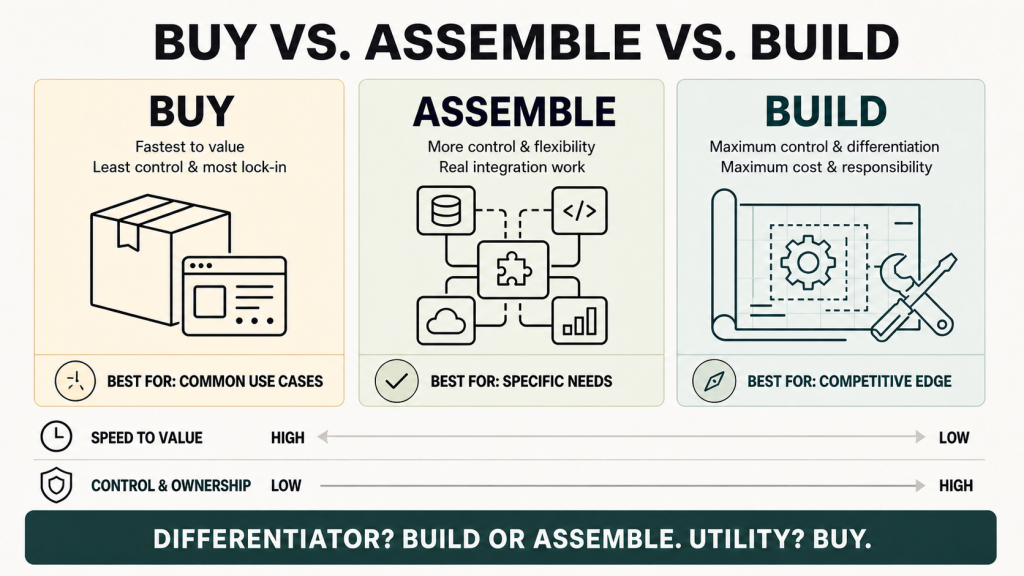
Before you choose a platform, decide how much of your AI stack you want to own – that decision narrows the platform question more than any feature comparison. There are three broad paths, and they are not mutually exclusive: most enterprises buy for some use cases and build for others. The mistake is applying one philosophy to everything.
| Path | What it means | Trade-off | Best when |
|---|---|---|---|
| Buy | Adopt an end-to-end platform or off-the-shelf app, used largely as delivered | Fastest to value, least effort – but least control and most lock-in | The use case is common and a mature product already solves it |
| Assemble | Combine best-of-breed parts – model, data layer, orchestration, governance | More control, less lock-in – but real integration work and in-house skill needed | Your needs are specific and you have the team to run it |
| Build | Develop the capability in-house on foundational infrastructure | Maximum control and differentiation – maximum cost and responsibility | AI is core to your competitive edge and you can sustain the talent |
How to choose between them
Four honest questions settle it:
- Differentiator or utility? Build or assemble where AI is central to your edge; buy where it is a commodity everyone needs.
- What can your team realistically run? Assemble and build assume in-house capability to integrate, operate, and maintain – be honest about capacity.
- How much lock-in can you accept? A strategic call for leadership, not just an engineering preference.
- What is the real cost over time? Buying looks cheaper up front and can cost more at scale; building is the reverse. Judge over years, not the first invoice.
Why this comes before the platform choice
Each path reshapes the platform question. Buy, and you are choosing a product – a narrow evaluation. Assemble, and the platform is one component, so openness and integration matter most. Build, and you are choosing infrastructure, where data fit and operational control dominate.
Get this right and the shortlist often writes itself – you compare options within a defined approach, not everything against everything. Because the answer differs by use case, the realistic end state is a mix, anchored by one or two primary platforms. That leads to the question buyers actually face: how do the major platforms compare?
How the major platforms compare (neutral)
Do not compare platforms product-by-product – compare them by archetype, because the archetype tells you where a platform is naturally strong and where it will fight your requirements. Specific features change every quarter; the underlying shape of each platform is stable, and that shape is what predicts fit.
The major enterprise AI platforms fall into three archetypes. Each is strong for a reason and weak for the same reason.
| Archetype | Examples (illustrative, not exhaustive) | Naturally strong at | Watch out for |
|---|---|---|---|
| Cloud AI platforms | Microsoft Azure AI, AWS (Bedrock), Google Cloud (Vertex AI) | Breadth, scale, deep integration with their own cloud and services | Strongest when your data and stack already live in that cloud; can mean lock-in and cost at scale |
| Data & analytics platforms | Databricks, Snowflake, and similar | Working where your data already sits; strong data governance and lineage | AI application and agent tooling may be less mature than pure-play AI platforms |
| Specialist AI platforms | IBM watsonx, Salesforce Einstein, agent/orchestration platforms | Focused capabilities – governance, agents, or a specific domain | Narrower than a full cloud stack; check how they integrate with your other systems |
How to read any “X vs Y” comparison
Buyers often search for head-to-head matchups – one platform versus another. The useful way to read them:
- The honest answer is almost always “it depends on your data and stack.” A comparison that declares a universal winner is ignoring the variable that actually decides it – your environment.
- Cloud gravity usually breaks the tie. For many enterprises, the platform aligned with their primary cloud and data wins on integration and cost before any feature is compared.
- Match the platform’s strength to your priority. If governance is your top criterion, weight the platforms built around it. If data gravity dominates, start with where your data lives. The scorecard from Section 2 is how you turn a vague “X vs Y” into a scored answer.
A caution on comparisons
Two things to keep in mind. First, capabilities move fast – any specific feature claim should be verified against the platform’s current state, not a comparison written months ago. Second, most enterprises are not making a single either/or choice; they run more than one platform and the real question is which one anchors their AI work. The goal of a comparison is not to crown a winner – it is to find the platform whose natural strengths line up with your weighted criteria. That is a decision only your context can make, which is exactly what the final section is about.
Matching platform to use case
The final step is the simplest: stop asking which platform is best, and ask which fits the use case in front of you. The right choice for a customer-facing agent is not the right choice for internal analytics. Match the platform’s natural strengths to what the use case actually demands.
A few common patterns:
- Regulated, high-stakes use cases (credit, claims, healthcare) – lead with governance and auditability. The platform that makes compliance easier wins, even if it scores lower elsewhere.
- Data-heavy analytics and BI – start where your data already lives. Data gravity and lineage matter more than model choice.
- AI agents and automation – weight integration, orchestration, and control, since the value is in acting across your systems. (See our guide to enterprise AI agents.)
- Broad, general-purpose adoption – breadth and alignment with your primary cloud usually win on cost and integration.
Two rules keep this grounded. Let each significant use case pull its platform, not the other way around – a platform chosen in the abstract tends to fit nothing well. And accept that the end state is usually a mix: one or two primary platforms, with others where a use case genuinely needs them. That is not a failure to standardize – it is matching tools to jobs.
Summary: a decision only your context can make
There is no best enterprise AI platform – only the best fit for your data, your governance needs, and what you are building. The buyers who choose well are not the ones who found the top-ranked product; they are the ones who defined their own criteria first and scored honestly against them.
The path in short: look past commodity model benchmarks to the real differentiators (data gravity, integration, governance, lock-in, operations); build a weighted scorecard and test it on your own workloads; settle build-versus-buy-versus-assemble before shortlisting; compare platforms by archetype, not this month’s features; and let each use case pull the platform that fits it. The realistic end state is a mix, anchored by one or two primary platforms.
Keep the one principle in view: the platform is a means, not the goal. What matters is AI in production, delivering value, safely – and the right platform is simply the one that gets your use cases there with the least friction.
Frequently asked questions about choosing an Enterprise AI Platform
What is the best enterprise AI platform?
There is no single best one. The right platform depends on where your data lives, your governance and compliance needs, your existing stack, and what you are building. A platform that is ideal for a data-heavy analytics use case in one enterprise can be the wrong choice for a regulated, customer-facing use case in another. Define your weighted criteria first, then score platforms against them.
How do I choose an enterprise AI platform?
Score candidates on five criteria – governance and security, data fit, integration, total cost of ownership, and deployment and operations – weighted for your context. Test each on your own data and a real workload rather than a vendor demo, insist on total cost of ownership rather than sticker price, and treat governance as a pass/fail gate if you are regulated.
Should we build, buy, or assemble our AI platform?
Buy where the use case is a common utility and a mature product solves it; build or assemble where AI is a competitive differentiator and you have the team to sustain it. The decision differs by use case, so most enterprises end up with a mix. Settle this before shortlisting platforms – it narrows the field significantly.
How do the major enterprise AI platforms compare?
It is most useful to compare them by archetype: cloud AI platforms (broad, tied to their cloud), data and analytics platforms (strong where your data already sits), and specialist AI platforms (focused on governance, agents, or a domain). Each is strong and weak for the same reason, so the fit depends on your priorities and where your data lives – not a universal ranking.
Does the choice of foundation model decide the platform?
Usually not. Leading models are increasingly available through more than one platform, and benchmark differences move constantly. Choosing a platform on today’s best model optimizes the variable most likely to change while ignoring data fit, integration, and cost – the factors that shape your outcomes for years.