
Content
AI governance is what turns a promising pilot into a production system you can defend – to your board, your regulator, and your own risk team. It is not a policy document that sits in a shared drive. It is an operating model: the roles, controls, and evidence that let you run AI openly, at scale, without waiting for something to go wrong.
Most enterprises have the opposite problem. Pilots multiply, but few reach production. In regulated sectors – banking, insurance, healthcare, the public sector – the stall is worse, because no one wants to put a model in front of customers or examiners without knowing who approved it, what it was tested against, and how it is monitored.
That gap is usually read as a technology problem. It is a governance problem. Treated well, governance is the thing that gets AI shipped, not the thing that holds it back.
This guide is written for the people accountable for that call – the Chief AI Officer, the Chief Risk Officer, and compliance and data leaders. It covers what enterprise AI governance actually means in practice, the operating model behind it, how to map controls to the EU AI Act and the NIST AI Risk Management Framework, and how the right approach moves you from pilot to production. If you are weighing up AI governance consulting, it will also help you tell a serious partner from a slide deck.
What AI governance actually means in practice
AI governance is the set of controls that answers one question for any model or agent you run: who is accountable for this, and can you prove it behaves as intended? Everything else – the policies, the tooling, the committees – exists to make that answer fast and defensible.
In practice, that means governance is not a single artifact. It is a working system with a few concrete parts:
- An inventory of models and agents. A live register of every AI system in use or in development – what it does, what data it touches, who owns it, and its risk level. You cannot govern what you cannot see, and most organizations are surprised by how much is already running.
- Approvals and gates. Clear decision points before a system moves from pilot to production, and before any material change ships. Someone signs off, and that sign-off is recorded.
- Testing and evaluation. Checks for accuracy, bias, robustness, and – for generative systems – hallucination and prompt injection. Tested against defined thresholds, not vibes.
- Monitoring in production. Ongoing checks on performance, drift, and misuse once the system is live. A model that passed at launch can quietly degrade.
- An audit trail. The evidence that ties it all together: what was approved, by whom, tested how, and changed when. This is what you hand to a regulator or an internal auditor.
A useful way to see it: governance is the difference between “we built an AI system” and “we can account for an AI system.” The first is an engineering result. The second is what lets you operate in a regulated market.
It is worth being clear about what AI governance is not. It is not the same as data governance, though the two are close cousins – data governance controls the information feeding your models, while AI governance controls the models and agents themselves. It is also not a compliance checkbox you complete once. Systems change, regulations tighten, and new use cases appear, so governance has to run continuously.
Emerging standards are converging on this view. The NIST AI Risk Management Framework organizes the work into four functions – govern, map, measure, and manage – and ISO/IEC 42001 defines a certifiable management system for AI. You do not need to adopt either wholesale to start, but they confirm the direction: repeatable controls and evidence, not one-off reviews.
The practical takeaway for a regulated enterprise is simple. If you cannot produce your model inventory, your approval records, and your test results on request, you do not yet have AI governance – you have AI. The next section covers the operating model that closes that gap.
How many of your AI pilots have actually reached production?
We help regulated enterprises turn stalled AI pilots into production systems – with the governance, controls, and clear ROI case to move forward with confidence.
Stop paying for pilots that never ship.

Stop paying for pilots that never ship.
The operating model: roles, accountability, and the inventory that anchors it
A governance operating model works when three things are clear: who decides, who reviews, and who runs the day-to-day – all anchored to a single inventory that everyone trusts. Get those right and the rest is detail. Get them fuzzy and governance becomes a bottleneck people route around.
Most regulated enterprises already know this pattern from model risk management or data governance. AI governance borrows the same structure, usually across three lines.
Three lines of accountability
- First line – the builders and owners. The teams that develop and deploy AI own the risk of their systems. They register each model, run the required tests, and operate it in production. Accountability sits here first, not with a central team.
- Second line – governance and risk oversight. A dedicated function (often reporting to the Chief AI Officer or Chief Risk Officer) sets policy, defines the risk tiers, reviews higher-risk systems, and challenges the first line. It owns the framework, not the models.
- Third line – independent assurance. Internal audit tests whether the whole thing actually works, on a cycle. This is the line regulators care about most, because it is the one that has no stake in shipping.
The point is not to build a bureaucracy. It is to make sure the person approving a high-risk system is not the same person whose bonus depends on launching it.
Who owns what
Roles matter more than committees. A few that need a named owner:
| Role | Owns | Typical fit |
|---|---|---|
| Executive accountability | The organization’s AI risk appetite and the buck for major decisions | Chief AI Officer / Chief Risk Officer |
| System ownership | A specific model or agent, end to end | Product or business line owner |
| Governance operations | Inventory, gates, policy, reporting | AI governance lead |
| Independent review | Assurance that controls are followed | Internal audit / model validation |
A common failure is leaving executive accountability unassigned. If no single leader owns the AI risk appetite, every hard call escalates and nothing ships. Name that person early.
The inventory is the anchor
Everything above depends on one artifact: a complete, current inventory of models and agents. It is the spine of the operating model, and it is where most programs are weakest.
A workable inventory captures, for each system: its purpose and business owner, the data it uses, its risk tier, its approval status, its last evaluation, and its monitoring state. Keep it live – a spreadsheet updated quarterly is not an inventory, it is a snapshot that is already wrong.
Two things make the inventory earn its place:
- It sets the workload. Risk tier decides how much governance a system gets. A low-risk internal tool needs a light touch; a customer-facing credit or claims model gets the full treatment. Tiering stops you from governing everything at the same heavy weight, which is how programs stall.
- It is your evidence base. When a regulator or auditor asks what AI you run and how it is controlled, the inventory is the answer. If you can produce it in an afternoon, you are in good shape. If it takes a fire drill, that is the finding.
The operating model is what makes governance repeatable. But repeatable against what standard? That is the next question – mapping these controls to the regulations you actually answer to.
Controls mapped to regulation: the EU AI Act and NIST AI RMF
You do not need a separate control set for every regulation – you need one operating model that maps cleanly to each. The EU AI Act tells you what you must do and by when. The NIST AI Risk Management Framework tells you how to do it. Run your controls against both and most other obligations fall into place.
Here is the practical relationship. The EU AI Act is law, and it is risk-tiered – obligations scale with how much harm a system can do. NIST AI RMF is voluntary guidance, but it is the most widely used blueprint for building the controls the Act demands. One is the requirement; the other is the method.
Start with the EU AI Act’s risk tiers
The Act sorts AI systems into four levels, and your obligations follow the tier:
- Unacceptable risk – banned outright (for example, social scoring). If you have any, the decision is to stop, not to govern.
- High risk – permitted but heavily regulated. This is the tier that matters most for regulated enterprises, and it covers common cases like credit scoring, insurance pricing and eligibility, and AI used in employment or essential services.
- Limited risk – transparency obligations, such as telling people they are dealing with an AI system.
- Minimal risk – most other applications, with no specific obligations.
For high-risk systems, the Act requires a defined set of controls: a risk management system, data governance, technical documentation, record-keeping, human oversight, and accuracy, robustness, and cybersecurity. Read that list again – it is nearly identical to the operating model from the previous section. That is not a coincidence. Good governance and Act compliance are the same work.
Map NIST AI RMF to those obligations
NIST organizes the work into four functions, and each maps directly onto what the Act asks for:
| NIST AI RMF function | What it means | Covers which EU AI Act obligation |
|---|---|---|
| Govern | Roles, accountability, policy, culture | Risk management system, human oversight |
| Map | Context and risk of each system | Risk classification, intended purpose |
| Measure | Testing, evaluation, metrics | Accuracy, robustness, bias testing |
| Manage | Prioritize, monitor, respond | Ongoing monitoring, incident response |
The value of the mapping is leverage. Build the control once – say, a testing and evaluation process – and it satisfies the NIST “measure” function and the Act’s accuracy and robustness requirements and your internal model validation standard. One control, three obligations answered. That is how you avoid a compliance program that reinvents itself for every new rule.
Watch the timeline
The Act is phased, and the dates are real. Prohibited-use bans applied first, obligations for general-purpose AI models followed, and the bulk of the high-risk requirements land after that. The exact deadlines shift as guidance is issued, so confirm the current schedule against the official text rather than a summary – but the direction is fixed, and “we will deal with it later” is not a position that survives an examiner’s question.
The bottom line for a regulated enterprise: treat the EU AI Act as your requirements list and NIST AI RMF as your build guide, and you get a single control set that serves compliance, risk, and delivery at once. That efficiency is exactly what turns governance from a cost center into the thing that lets you ship. The next section shows how.
From governance to production – the unlock
The fastest way to get more AI into production is to build the governance that lets you say yes with confidence. It sounds backwards. Teams assume controls slow delivery. In practice, the absence of controls is what freezes it – because no one will approve a system they cannot stand behind.
Think about why a pilot stalls. The model works in the demo. Then someone asks: what data does it touch, who signed off, how was it tested, what happens when it drifts? With no governance, those questions have no answers, so the safe move is to wait. The pilot sits in limbo. Multiply that across a portfolio and you get the pattern every regulated enterprise knows – lots of pilots, almost nothing live.
Governance breaks the logjam by turning “we’re not sure” into a defined path.
Governance as a production gate, not a roadblock
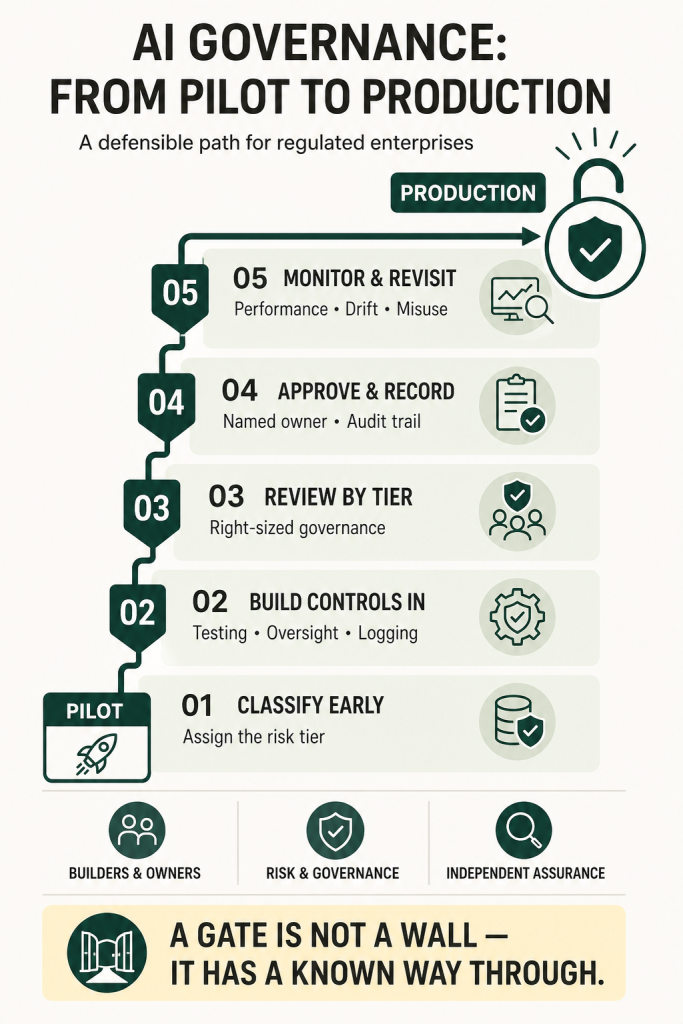
The mechanism is a clear gate between pilot and production. To pass, a system has to clear its tier’s requirements – registered in the inventory, tested against thresholds, human oversight defined, monitoring in place, approval recorded. Once those are met, the system ships. No case-by-case anxiety, no escalation to the top for every launch.
That is the reframe worth internalizing: a gate is not a wall. A wall stops everything. A gate has a known way through. When teams know exactly what production readiness looks like, they build toward it from day one, and approvals stop being a negotiation.
What the unlock looks like in practice
- Predictable launches. Teams design for the gate from the start, so systems arrive production-ready instead of being sent back.
- Faster approvals. Reviewers assess against a standard, not their gut. The tenth high-risk model is quicker than the first because the process is known.
- Confidence to scale. With an inventory and monitoring live, running fifty systems is a managed operation, not fifty separate leaps of faith.
- A defensible position. When the regulator or board asks, the evidence already exists. That confidence is what lets leaders greenlight ambitious use cases.
The move from pilot to production, staged
A workable path through the gate looks like this:
- Classify early. Assign the risk tier at the pilot stage, so the team knows the bar before they build, not after.
- Build controls in, not on. Testing, oversight, and logging are part of development – retrofitting them later is what causes delay.
- Review against the tier. Governance checks the system against its tier’s requirements. Right-sized: light for low risk, thorough for high.
- Approve and record. A named owner signs off, and the decision is logged. This is the gate.
- Monitor and revisit. Once live, monitoring runs and the system returns for review on a cycle or after any material change.
None of this requires a year-long program before you ship anything. The sensible approach is to stand up the operating model on your highest-value, highest-risk use case first, prove the gate works, then extend the same controls across the portfolio.
The payoff is the whole point of governance. Done well, it is not the tax you pay to use AI – it is the capability that lets you use more of it, safely, faster than competitors still stuck in pilot limbo. The last question is who you build it with.
What to look for in a governance partner
The test of a governance partner is simple: do they leave you with a working operating model, or a document? A slide deck and a policy template do not govern anything. What you need is the inventory, the gates, and the controls running – and your team able to keep them running.
A few things separate a serious partner from the rest:
- An operating model, not just a policy. They deliver roles, gates, and a live inventory – the working system from the sections above – not a framework PDF.
- Regulated-sector fluency. They can map controls to the EU AI Act and NIST AI RMF, and they understand your examiners. Generic “AI strategy” is not the same as governance for a bank or insurer.
- A path to production. The goal is shipping AI safely. A partner focused only on risk paperwork, with no view on getting systems live, is solving half the problem.
- Knowledge transfer. Governance is ongoing. If the model collapses when the consultants leave, it was never really built.
One practical filter: ask a prospective partner to walk you through the pilot-to-production gate they would put in place, using one of your real use cases. The answer tells you quickly whether they think in operating models or in deliverables.
Summary: governance is how AI gets to production
AI governance is not the brake on your AI ambitions – it is the mechanism that lets you act on them. For a regulated enterprise, it is the difference between a portfolio of stalled pilots and a set of systems you can run, scale, and defend.
The essentials, in one place:
- Governance is an operating model, not a document. An inventory of models and agents, approval gates, testing, monitoring, and an audit trail – running continuously, not filed once.
- Accountability has to be named. Three lines – builders, oversight, independent assurance – with a single executive owning the AI risk appetite.
- The inventory is the anchor. If you can produce it, with approvals and test results, on request, you have governance. If you cannot, you have AI.
- One control set serves every rule. Map controls to the EU AI Act (the requirement) and NIST AI RMF (the method), and you answer compliance, risk, and delivery at once.
- Governance is the production unlock. A clear pilot-to-production gate turns “we’re not sure” into a known path, so systems ship faster, not slower.
Where to start: don’t attempt to govern everything at once. Stand up the operating model on your highest-value, highest-risk use case, prove the gate works, then extend the same controls across the portfolio. That first cycle is usually the best place a governance assessment can focus.
Next step: If you are deciding how to move AI from pilot to production without tripping over risk or regulation, a short governance assessment will map your current systems, pinpoint the gaps, and give you a right-sized operating model to build from. Book a governance assessment to get a clear, defensible path to production.
AI governance – Frequently asked questions
What is AI governance?
AI governance is the operating model – the roles, controls, and evidence – that lets an organization run AI systems accountably. In practice it means a live inventory of models and agents, approval gates before production, testing and monitoring, and an audit trail that shows who approved what, tested how, and changed when.
How is AI governance different from data governance?
Data governance controls the information that feeds your models – its quality, lineage, and access. AI governance controls the models and agents themselves – how they are approved, tested, monitored, and held accountable. They are closely linked and work best together, but they are not the same discipline.
Do we need AI governance to comply with the EU AI Act?
Effectively, yes. The Act’s requirements for high-risk systems – risk management, data governance, documentation, human oversight, and accuracy and robustness – are the core components of a governance operating model. Building governance is how you meet those obligations rather than scrambling for each one separately.
What is the difference between the EU AI Act and the NIST AI Risk Management Framework?
The EU AI Act is law and tells you what you must do, tiered by risk. NIST AI RMF is voluntary guidance and tells you how to do it, through its govern, map, measure, and manage functions. Most enterprises use the Act as the requirements list and NIST as the build guide.
Does AI governance slow down AI deployment?
It does the opposite when done well. The main reason pilots stall is that no one can confidently approve them. A clear pilot-to-production gate gives teams a known standard to build toward, so approvals get faster and more systems reach production, not fewer.
Where should we start with AI governance?
Start with an inventory of the AI systems you already run, then apply the full operating model to your highest-value, highest-risk use case first. Prove the gate works there, then extend the same controls across the portfolio. A governance assessment is a common way to scope that first cycle.