
Content
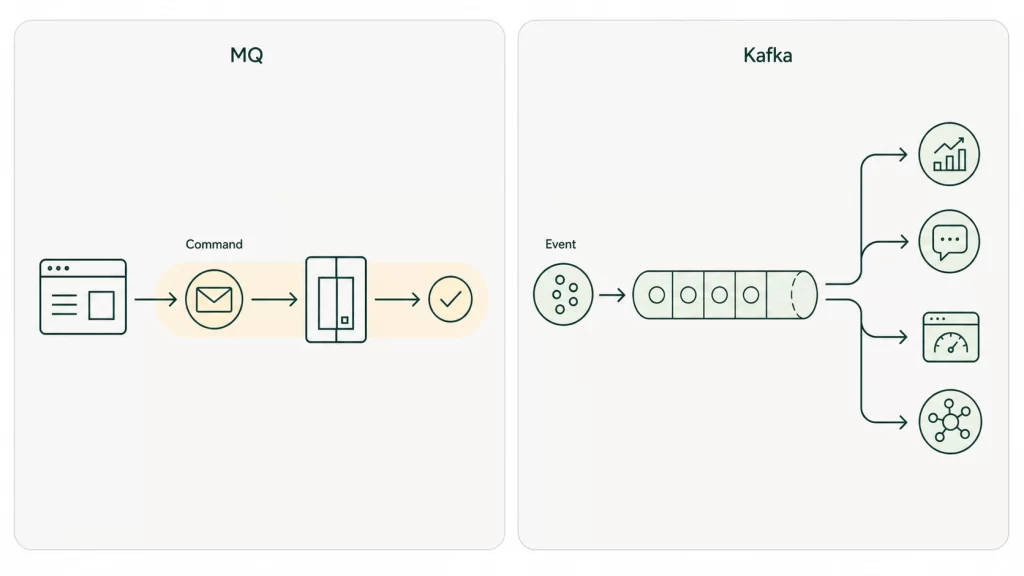
IBM MQ and Apache Kafka are not interchangeable platforms. IBM MQ is designed to get a message from one application to the right destination with an assured, decoupled delivery model. Apache Kafka is designed to publish, retain, process, and distribute streams of events that many independent consumers may use. Both can be durable and reliable. They solve different delivery problems.
For an architect, the decision is rarely “IBM MQ vs Kafka” across the whole estate. It is which role each platform should play in a specific flow. Keep MQ where a critical instruction must be handled safely, use Kafka where an event needs a durable audience, and connect them where one business action creates useful downstream events.
IBM MQ and Kafka serve different delivery contracts
The difference becomes clearer when you start with the business meaning of the message. A command asks a known system to do something: reserve stock, post a payment, create a shipment, or update an account. An event records that something has happened: stock was reserved, a payment was posted, a shipment was created, or an account changed.
IBM MQ is built around applications exchanging messages through queue managers. IBM describes its delivery as assured and decoupled from the application, with transactional options for messages. Apache Kafka is an event streaming platform: applications can publish and subscribe to event streams, retain them, and process them as they occur or later.
| Architectural question | IBM MQ | Apache Kafka |
|---|---|---|
| What is normally being moved? | A message or instruction for a defined processing path | A record that an event occurred |
| Who needs it? | Usually a known receiving application or controlled set of receivers | Potentially many independent consumer applications |
| What happens after consumption? | Handling follows the queue and application delivery pattern | Events can remain available for later consumers and replay, subject to retention settings |
| What does success look like? | The intended business action was handed to the right system safely | The right consumers can discover, process, and reuse the event stream |
| Common architectural question | “Did this instruction reach the system that must act on it?” | “Who needs to react to this event now or later?” |
This is a useful distinction, not a hard product boundary. IBM MQ can support publish and subscribe patterns. Kafka can support reliable processing patterns. The choice turns on the contract the flow needs, not on a claim that one platform is modern and the other is legacy.
Keep IBM MQ where a critical command or transaction must arrive
MQ is often the better fit when an application has a specific instruction for another system and failure to handle it would interrupt a business process. Think of a payment instruction sent to a core platform, a booking request sent to a partner system, or an update that a system of record must process in a controlled way.
The attraction is not only persistence. MQ gives teams an established way to separate applications from the timing and availability of the other side. The sending application does not have to wait for every downstream system to be online before it can hand over the message. That is particularly valuable around established core systems and partner integrations.
IBM MQ documentation explains that the strongest quality-of-service option can provide once-and-once-only delivery even when failures occur. That does not remove application responsibility. A delivery guarantee does not by itself prove that a business action happened exactly once. Teams still need a way to handle a repeated message without repeating the business action, alongside error handling, reconciliation, and recovery.
Keep MQ when these conditions apply:
- one system has a clear responsibility to process the command;
- the transaction needs a controlled handoff to a core or partner application;
- existing operational procedures, support agreements, and recovery paths are proven;
- converting the flow to an event does not add a useful new consumer or business outcome.
Do not keep a flow on MQ simply because it has always been there. If the message is really a domain event that several teams need to use, an MQ-only design can make each new consumer another point-to-point integration to build and maintain.
Use Kafka when an event needs to be retained and reused
Kafka is a stronger fit when the organisation needs an ongoing record of events that different applications can consume independently. One event can support operational services, reporting, customer notifications, fraud detection, data products, and later analysis without the originating application having to know every consumer in advance.
For example, an order-management system may publish an “order placed” event. A warehouse service, customer-communication service, analytics pipeline, and revenue dashboard can each use it for their own purpose. They do not need to receive the same instruction or complete work in the same time window.
Kafka’s model is useful here because events can be retained and read again by separate consuming applications according to the platform’s configuration. That supports fan-out, replay, and stream processing. Use Kafka when the event itself is a reusable business asset, not merely a transport envelope around a command.
When event streams will feed analytics, a lakehouse, or AI use cases, the event design also needs to fit the wider storage, quality, and access model. Our guide to watsonx.data lakehouse architecture decisions covers the questions that arise when operational events need to become governed, reusable data.
Kafka is not an automatic answer for every asynchronous interface. It can be an awkward fit when the business expectation is a known recipient, a direct response, and a tightly controlled transaction. Publishing “please update this account” as a general event does not make the responsibility for the update clearer. It can make it less clear.
Not sure where MQ should end and Kafka should begin?
An integration architecture review maps message flows, dependencies, and migration risk before you redirect an interface.
Modernize the flow without weakening its delivery contract.

Modernize the flow without weakening its delivery contract.
Integrate MQ and Kafka when a transaction becomes an event
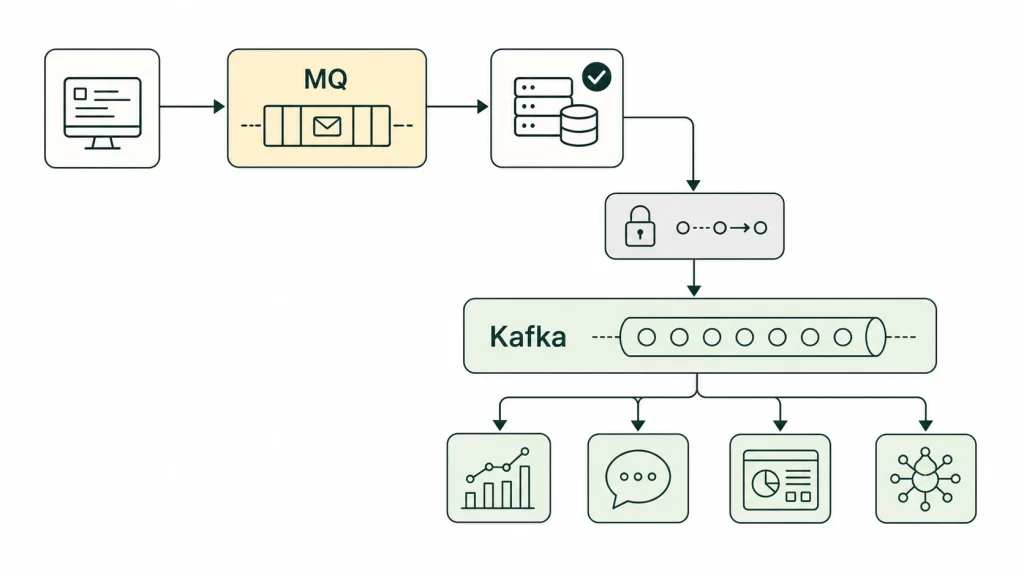
Many enterprises need both patterns. A core application may continue to receive a critical instruction through MQ, while the outcome of that transaction becomes an event that other teams can use through Kafka. This lets the estate modernise around stable systems instead of forcing a platform replacement before the business case exists.
Let MQ handle the system-facing transaction
In this pattern, MQ remains close to the system that must process the command. The application receives the message, applies the required business rules, and confirms or rejects the action through its normal process. This protects the contract that already supports the core workflow.
The event should represent a meaningful state change, not every technical step inside the application. “Payment posted” may be a useful event. “A queue message was received” usually is not. The first helps other teams understand the business. The second mostly exposes internal plumbing.
Let Kafka distribute the resulting business event
Once the business action has happened, Kafka can distribute the resulting event to the people and systems that need it. The same event may feed a data platform, trigger a notification service, update a customer view, or support a new digital product later.
IBM maintains Kafka Connect source and sink connectors for moving data between MQ and Kafka. They are useful implementation options, but they are not an architecture on their own. A connector moves records. It does not decide whether the record is a command or an event, who owns it, or how the business handles a duplicate.
Treat the bridge as a product, not a pipe
The bridge between MQ and Kafka needs an owner, support model, and clear failure behaviour. Otherwise it becomes a new hidden dependency in the middle of two important platforms.
At a minimum, define:
- the event name and business meaning, including the data it must carry;
- when the event is emitted in relation to the underlying transaction;
- how duplicates, retries, late messages, and failed consumers are handled;
- where teams can trace a message from source to consumer;
- how access, sensitive fields, and data retention are controlled;
- who is responsible when the bridge or one consumer falls behind.
An MQ and Kafka bridge should reduce point-to-point complexity, not hide it behind another connector. If it only copies technical messages from one place to another, the organisation has added operational work without creating an event-driven architecture.
The same applies to control of the data moving through the bridge. Event ownership, retention, access, and business meaning need to be explicit, as they do in enterprise data governance. A stream is easier to distribute than to take back once it reaches the wrong consumer.
Retire legacy flows only when you can retire their contract
An old MQ flow may be a good candidate for retirement. That is not the same as moving it blindly to Kafka. The first question is whether the business capability is still needed, and the second is whether another interface already provides the same result with a clearer owner and service level.
Before retiring a flow, identify its producers, consumers, error queues, support teams, monitoring, and recovery procedures. Some interfaces look inactive because nobody owns their documentation. They may still be used during a month-end process, a partner exception, or a recovery scenario.
Legacy modernisation works best when teams remove a dependency and its operating burden, not when they reproduce it in a newer broker. If the flow is still valuable but fragile, legacy modernization services can help establish a maintainable target pattern before the existing interface is switched off.
Make the decision flow by flow, not platform by platform
Use the questions below to make a first placement decision. A flow can later change category as the application, its consumers, or its business value changes.
| If the flow looks like this | Likely direction | First thing to prove |
|---|---|---|
| A named system must handle a high-value command, with a known recovery process | Keep MQ | The delivery, reconciliation, and exception path still meet the business requirement |
| Several independent systems need the same business event, including future consumers | Use Kafka | The event has a stable business meaning, owner, schema, and retention policy |
| A core transaction must remain controlled, but its result has wider downstream value | Bridge MQ and Kafka | The point at which the event becomes true and the bridge’s duplicate and failure behaviour |
| No active business owner or consumer can justify the interface | Retire or redesign | The inventory is complete, including exception and recovery use cases |
The practical next step is an inventory that looks beyond broker names. Map the business purpose, owner, consumers, failure handling, data sensitivity, support cost, and likely future demand for each important flow. An integration audit provides the right discipline for exposing those dependencies before a platform decision is made. It also gives data integration consulting a stronger starting point than a platform-wide migration target.
If MQ and Kafka will coexist for a period, give the combined environment an explicit operating model. Integration maintenance becomes important when the goal is to keep critical flows observable and supported while teams change the architecture around them.
For a neutral view of where MQ should end, where Kafka should begin, and which interfaces should be left alone, book an integration architecture review. The recommendation should include the option to retain MQ when that is the lower-risk decision.
Our Data & IBM Services You Might Find Interesting

Data Integration Consulting
Design reliable integration flows that connect applications, events, data, and operational responsibilities.

Integration Maintenance
Support and monitor critical integration flows while teams modernize platforms without disrupting operations.

IBM Planning Analytics & watsonx Consulting
Translate AI-ready data controls into a practical IBM architecture roadmap and delivery plan.
Frequently asked questions
Can Kafka replace IBM MQ?
Kafka can replace some MQ-based flows, but it is not a one-for-one replacement. It is strongest where an event needs durable distribution and reuse by independent consumers. MQ can remain the better fit for a critical command with a known destination and established transaction handling.
Can IBM MQ and Kafka coexist?
Yes. A common pattern keeps MQ for a system-facing transaction and publishes the resulting business event to Kafka for downstream consumers. The bridge needs clear ownership, observability, and a defined approach to duplicates and failures.
Does Kafka guarantee delivery?
Kafka provides durable event storage and reliable processing capabilities, but an end-to-end business outcome still depends on producer behaviour, consumer handling, retries, safe treatment of repeat events, and the surrounding application design. The same principle applies to MQ: platform delivery features are part of a wider business process.
What should move first from MQ to Kafka?
Start with a flow that produces a well-defined business event with more than one useful consumer, but is not so critical that it becomes a risky first test. Avoid beginning with an undocumented core transaction simply because it is technically possible to copy its messages into Kafka.


