
Content

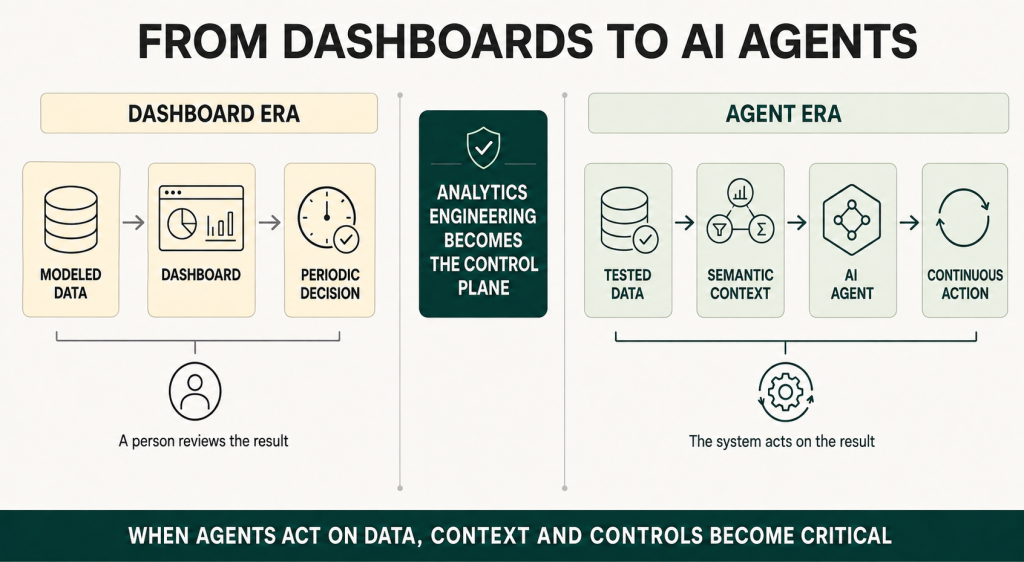
The real news from dbt Summit 2026 is not the rename from Coalesce. It is who consumes your data now. The person reading a dashboard is being replaced by an AI agent that acts on data continuously. That shift puts analytics engineering on the critical path to production AI.
For years, analytics engineering worked in the background. It cleaned, tested, and modeled data so people could trust a report. dbt Summit 2026 (September 15-18 in Las Vegas, the event formerly known as Coalesce) makes a sharper case. When an agent reads your data and acts on it, the tests, definitions, lineage, and governance behind that data stop being hygiene. They decide whether AI can be trusted in production at all.
This is a read on what the agenda signals for enterprise data and AI leaders, not a recap. We use dbt on client projects, so here is where the real story is.
What dbt Summit 2026 Is, and What the Name Change Signals
Same event, new name, bigger ambition: dbt Summit is now framed around data and AI, not just data transformation.
dbt Labs rebranded Coalesce as dbt Summit and calls it “the world’s largest gathering of dbt users.” The agenda is built around three tracks: level up the product, level up your craft, and level up together as a community.
| Detail | What to know |
|---|---|
| Dates | September 15-18, 2026 |
| Location | The Cosmopolitan, Las Vegas |
| Format | In-person, plus free online access to keynotes |
| Scale | 100+ sessions: keynotes, breakouts, labs, peer exchanges, a hackathon |
| Cost | In-person $1,895 (training and certification included); online free |
| Audience | dbt users, analytics and data engineers, and data and AI leaders |
From transformation tool to data-for-AI foundation
The rename tells you where dbt sees the market going. Coalesce was named for the moment scattered data comes together. dbt Summit points at what that unified data now has to do: feed AI agents that need context, not just clean tables. The keynotes make it explicit: product news is framed around getting data teams ready for the agent era.
Why AI Can’t Skip Analytics Engineering
An AI agent is only as reliable as the data underneath it. Give it messy, undefined, stale data and it will answer with confidence and be wrong.
A model can generate SQL in seconds. What it cannot do is know what your business means by “active customer,” or whether last night’s pipeline actually ran. That knowledge lives in analytics engineering: the models, tests, definitions, and lineage that turn raw tables into data people, and now agents, can trust.
An agent that knows the column name, not the meaning
This is the gap most AI pilots hit. An agent can read your schema, but it cannot read your intent. Without a shared definition of each metric it guesses, and a plausible guess in a board report is worse than no answer.
That is why the semantic layer keeps coming up at dbt Summit. It gives agents one governed definition of every metric, so the answer matches how the company actually counts.
Analytics engineering becomes the control plane for AI
Once agents act on data, a handful of questions decide whether you can let them:
- Does the agent understand the metric, or just the column name?
- Does lineage run from source through transformation to the agent’s answer?
- Do tests, freshness, and data contracts hold before the agent reads?
- Who owns a definition change, and how does it reach every agent?
Those are the answers that make data AI-ready. Without them, most AI work never gets past the pilot stage.
What the Agenda Signals: Building Blocks Leaders Should Watch
The product news at dbt Summit 2026 splits into four moves: a faster and cheaper runtime, managed context for agents, AI that helps data teams, and open data infrastructure.
| Building block | What it is | Why it matters to leaders |
|---|---|---|
| dbt State | Rebuilds only what actually changed | dbt reports around 30% average compute savings (its own figure, not an independent benchmark). Directly cuts cloud cost |
| dbt Core v2.0 / Fusion | A faster engine and a single framework, still on the roadmap | Signals that the transformation layer is becoming critical infrastructure |
| Semantic Layer, MetricFlow, MCP | One governed definition of metrics, exposed to agents | The context that lets an agent answer in your company’s terms |
| dbt Wizard | An AI coding agent for data work | Speeds up analytics engineers, but still leans on good models and tests |
| Open Data Infrastructure, Apache Iceberg | Open storage formats, your choice of compute | Portability and less vendor lock-in for hybrid and multi-cloud estates |
For a CIO, the last row carries weight. Open formats and a portable semantic layer mean you can swap an engine, a model, or a tool without rebuilding the pipeline or losing context. That is risk control, not just architecture.
Evidence from the field
The customer sessions show this is already happening. Okta describes moving AI from experiment to production on a managed semantic layer. Nordstrom treats governance, tests, and lineage as an AI advantage. ING is operationalizing dbt inside a regulated global bank. Different maturity levels, same lesson: the data operating model comes first.
What It Means for Enterprise Data and AI Leaders
Before you buy another AI tool, check the data operating model underneath it. That is what decides whether AI ships.
The pattern at dbt Summit matches what we see on projects. As Anna Pojawis, PMO Specialist at Multishoring puts it: “Teams ask us to add AI on top of their data. The real work is almost always underneath: definitions, tests, and lineage nobody agreed on yet.”
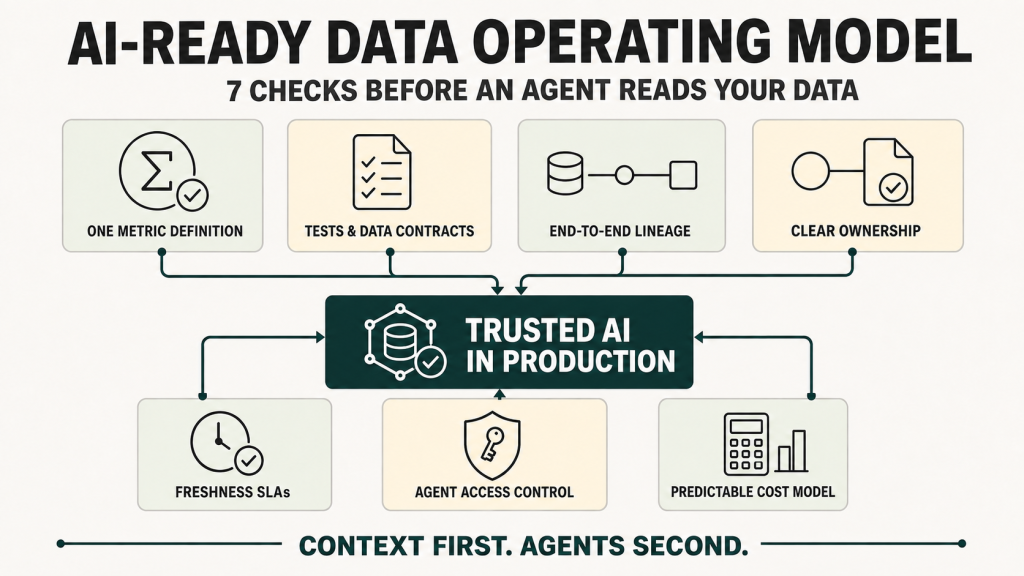
Use this as a readiness check before you point an agent at your data:
- One definition of each core metric, shared across teams
- Tests and data contracts that run before anything downstream reads the data
- Lineage from source through transformation to the agent’s answer
- Clear ownership of every definition and who can change it
- Freshness SLAs treated as an AI service level, not a nice-to-have
- Access control over what each agent can see and do
- A cost model so compute stays predictable as usage grows
Architecture matters here too. Keeping data in open formats keeps you portable. The same principle shows up beyond dbt’s own stack: IBM watsonx.data integrates with dbt for transformation, testing, and lineage on an open, hybrid platform, so context is not locked to one vendor.
Key Takeaways
- dbt Summit 2026 (formerly Coalesce) reframes dbt around data and AI, not just transformation.
- AI agents need context (definitions, lineage, tests, freshness), not just access to tables.
- Analytics engineering is becoming the control plane that decides whether AI can be trusted in production.
- The building blocks to watch: a faster, cheaper runtime, a managed semantic layer, and open, portable infrastructure.
- The critical path to AI starts with the quality and context of your data, not the prompt.
Is your data foundation ready for AI agents?
We fix the definitions, tests, lineage, and governance underneath your data – so analytics and AI run on numbers people actually trust.
Context first. Agents second.

Context first. Agents second.
dbt Summit 2026 – FAQ
Is dbt Summit the same as Coalesce?
Yes. dbt Summit 2026 is the new name for the conference previously known as Coalesce, running September 15-18, 2026 at The Cosmopolitan in Las Vegas, with keynotes free online.
What is analytics engineering, and why does it matter for AI?
Analytics engineering is the discipline of turning raw data into tested and modeled data that people can trust. It matters for AI because agents need those same definitions, tests, and lineage to answer reliably.
What is a semantic layer, and why do AI agents need it?
A semantic layer is a single, governed set of metric definitions. It lets an AI agent answer in your company’s terms, so “active customer” or “net revenue” means the same thing to the agent as it does to your board.


