
Content
IBM Dev Day: Bob in Action was a convincing demo of AI-driven legacy modernization. The question for enterprise leaders is not whether the demos looked good. It is whether one or two of them have a credible path to governed, integrated production.
On August 27, 2026, IBM ran Dev Day: Bob in Action, a free virtual event and the warm-up for the IBM Dev Day + Hackathon 2026, the TechXchange pre-conference hackathon that followed on August 28-30. We did not attend. We watched it the way most enterprise buyers will: from the outside, working through the agenda, the announcements, and the independent coverage that came after.
It is a read on what the event proved for the people who actually make the technology calls, meaning CIOs, enterprise architects, and integration leads. It also covers what has to be tested before a hackathon demo becomes something you can run in production.
Here is the honest summary. The demo was real. So is the engine underneath it. But the gaps are real too, and whether you get value out of any of this depends far less on the tool than on the data, integration, and governance sitting beneath it.
What Dev Day Actually Proved
The headline was not a new model. It was a repositioning: IBM Bob has moved from a general coding assistant to a governed modernization engine aimed at the most expensive work in the enterprise.
The event narrowed its focus to legacy modernization on IBM i and IBM Z, with tracks on RPG, COBOL, and PL/I. That focus is the point. IBM frames 60-80% of enterprise development budgets as going to modernization, the kind of work that usually drags on for weeks or months.
The hackathon prompt made the pitch concrete. Teams had to take a real workflow pain point, such as onboarding, debugging, code review, testing, maintenance, or release, and ship a working prototype that measurably cut time, effort, or errors. Winners could earn up to $2,000 and a trip to TechXchange in Atlanta.
It is a good test to set. It is also the exact spot where a demo and a production use case start to part ways.
The Announcements That Matter
A handful of Bob updates from the July 2026 cycle are the ones enterprise buyers should actually track.
| Capability | What it does | Why it matters |
|---|---|---|
| Bob V2 architecture | Single agent, three modes (Agent, Plan, Ask) across IDE and CLI | Consistent behavior and a simpler model for teams |
| Subagents | Focused subagents with isolated 270K-token context | Keeps large legacy codebases manageable and enables parallel work |
| Parallel tool calling | Multiple tools in a single turn; roughly 30-second tasks in under 10 | Faster iteration on modernization work |
| Bobalytics | Usage, cost, and adoption dashboard | Per-team cost attribution, the answer to unpredictable token spend |
| Premium Packages (IBM i, Z, Java) | Pre-built modernization workflows; IBM i at a $40/month add-on | Aimed at COBOL, RPG, and PL/I, where general model training data is thin |
The V2 architecture and the Premium Packages do most of the heavy lifting here, and Bobalytics answers a boardroom question about where the AI budget goes.
For an IBM i or mainframe shop, the RPG and COBOL features are the ones to watch: fixed-format-to-free-form RPG conversion and RPGII-to-ILE transformation, driven by natural language against the source files. IBM points to results such as a 30-day Java upgrade finished in 3 days at one customer, plus 70% and 69% internal time savings on selected tasks. Useful as a signal of direction. Not a promise you can bank on.
Enterprise Impact: Agentic AI Use Cases and Enterprise Automation
The real bet is not greenfield coding. It is pointing agentic AI at the modernization backlog that already eats most transformation budgets.
The agentic AI use cases shown at Dev Day fall into a few practical patterns for enterprise automation:
- Legacy code transformation – converting fixed-format RPG and modernizing COBOL while the business logic stays intact.
- Full-SDLC orchestration – coordinating role-based agents across planning, coding, testing, and deployment, instead of just autocompleting inside the IDE.
- Governed automation – approval checkpoints, sensitive-data scanning, and policy enforcement built into the agent’s actions rather than bolted on later.
- Auditability – BobShell keeps a traceable record of every action, which matters in banking, insurance, and government, where change control is not optional.
Look at what each one quietly assumes. Clean source. Systems that talk to each other. Someone who owns the data. An agent that rewrites RPG still needs the surrounding API integration to hold up, otherwise it just produces faster code against a broken data flow.
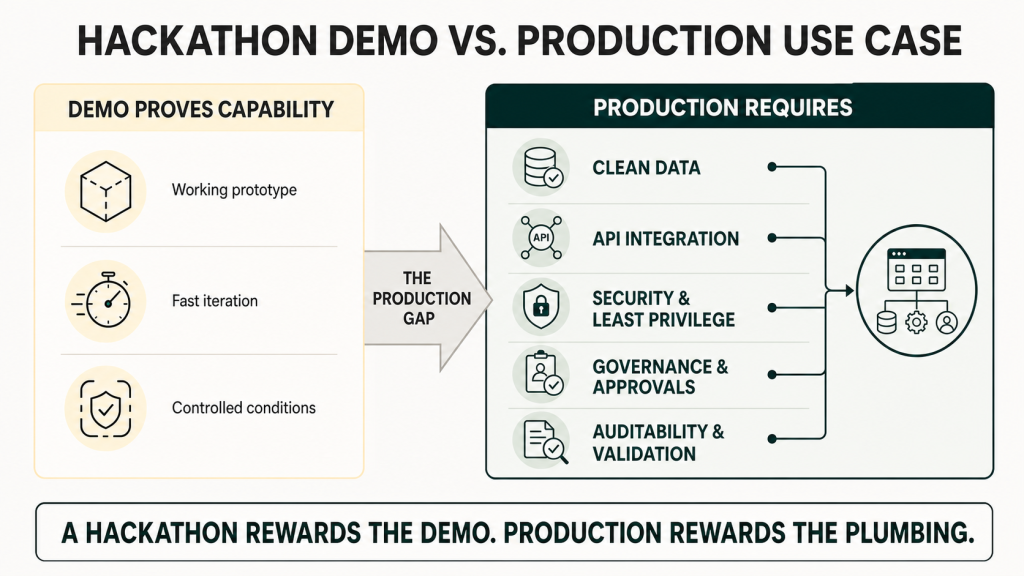
“A hackathon rewards the demo. Production rewards the plumbing. The teams that get value from Bob will be the ones whose data, integrations, and governance were already in order before the agent showed up.”
Justyna Łukaszuk, PMO Manager at Multishoring
The Gaps – and What to Do Next
The event’s own coverage surfaces real friction. Treat these four points as the checklist before you commit.
- Security is a live concern. In January 2026, researchers showed Bob’s CLI could be tricked by prompt injection into running malware, and a later bulletin patched several CVEs. Agents with broad file and network access inside legacy systems are a large attack surface.
- Pricing creates friction. Bob is metered through “Bob Coins,” and the IBM i Premium Package needs a paid base subscription before you can properly trial it. The free trial does not cover the RPG and COBOL capability the Dev Day showcased.
- Metrics are self-reported. The headline productivity and cost-savings numbers are IBM’s own. No independent audit backs them yet.
- Modernization is broader than code. Independent analysis is blunt on this: AI speeds up code translation, but it does not do your data migration, behavioral validation, or change management for you.
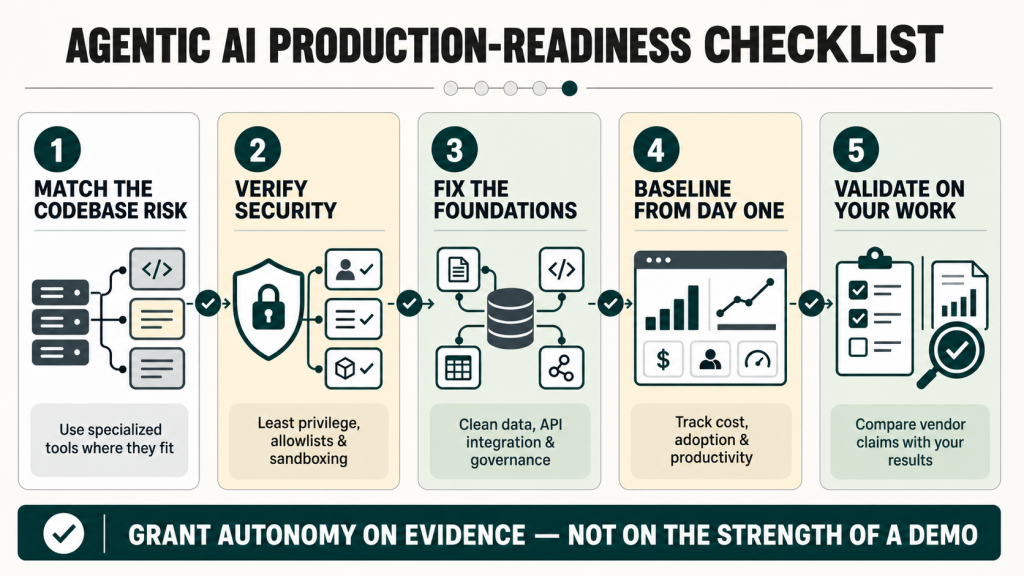
A practical sequence for enterprise leaders looks like this:
- Match the tool to codebase risk. Keep a horizontal assistant for general development, and evaluate Bob specifically for COBOL, RPG, and PL/I.
- Verify security before broad access. Least-privilege allowlists, no wildcard auto-approvals, and sandboxing for long agent sessions.
- Fix the foundations first. Clean master data, working integration, and agreed governance are what decide whether any of this reaches production. This is where we spend most of our time on client work with enterprise AI agents and enterprise AI in production.
- Baseline with Bobalytics from day one so you can confirm or contradict the vendor’s numbers against your own work.
- Watch TechXchange, Atlanta, October 26-29. The hackathon winners and customer case studies there will be the first outside-IBM proof points on Bob 2.0.
Five Takeaways
- IBM Dev Day + Hackathon 2026 repositioned IBM Bob as a governed modernization engine for IBM i and IBM Z, not a general coding assistant.
- The updates worth tracking are subagents, parallel tool calling, Bobalytics cost analytics, and the RPG and COBOL Premium Packages.
- The strongest agentic AI use cases live in the modernization backlog, and each one leans on clean data and solid API integration.
- Real gaps remain around security history, Bob Coin pricing, and self-reported metrics.
- A demo is not a use case. Data, integration, and governance decide what survives contact with production.
Ready to turn an AI demo into a production use case?
We get the data, integration, and governance under your systems in order, so agentic AI and modernization run on foundations that hold up in production.
A demo is not a use case.

A demo is not a use case.
IBM Dev Day 2026 – FAQ
What was IBM Dev Day: Bob in Action?
It was a free virtual IBM event on August 27, 2026, and the kickoff for the IBM Dev Day + Hackathon 2026, the TechXchange pre-conference hackathon that ran August 28-30. It focused on modernizing IBM i and IBM Z applications with IBM Bob, IBM’s agentic development platform.
What is IBM Bob?
IBM Bob is IBM’s agentic software development platform. It has moved from a general AI coding assistant to a governed, full-SDLC partner aimed at legacy modernization, including RPG, COBOL, and PL/I workloads on IBM i and IBM Z.
What should enterprise leaders do with the announcements?
Match the tool to your riskiest codebases, check its security posture before granting broad access, and fix data, integration, and governance first. The agentic AI use cases only pay off when the foundation underneath them is clean and connected.