
Content

IBM Think 2026 opened today in Boston. CEO Arvind Krishna delivered the keynote at 8:30 AM ET with one central message: most companies have invested in AI – and most aren’t seeing the returns. Day 1 was built around fixing that.
IBM is shifting the conversation from “AI strategy” to “AI operating model” – and the gap between companies that get this right and those that don’t is widening fast
-
- When & where: Tuesday, May 5, Thomas M. Menino Convention Center, Boston – the first full day open to all attendees
-
- Opening keynote: Arvind Krishna, 8:30 AM ET – IBM’s biggest enterprise AI announcement package to date
-
- Key themes: Agentic AI at scale, real-time data foundations, hybrid cloud governance, quantum as a near-term strategic bet
-
- New products announced: watsonx Orchestrate (next-gen), IBM Confluent, IBM Concert, IBM Sovereign Core, IBM Bob (GA)
Over 5,000 senior business and technology leaders from more than 80 countries gathered to discuss one thing: how to move AI from pilot projects into real business operations.
Here’s what happened – and what it means for your organization.
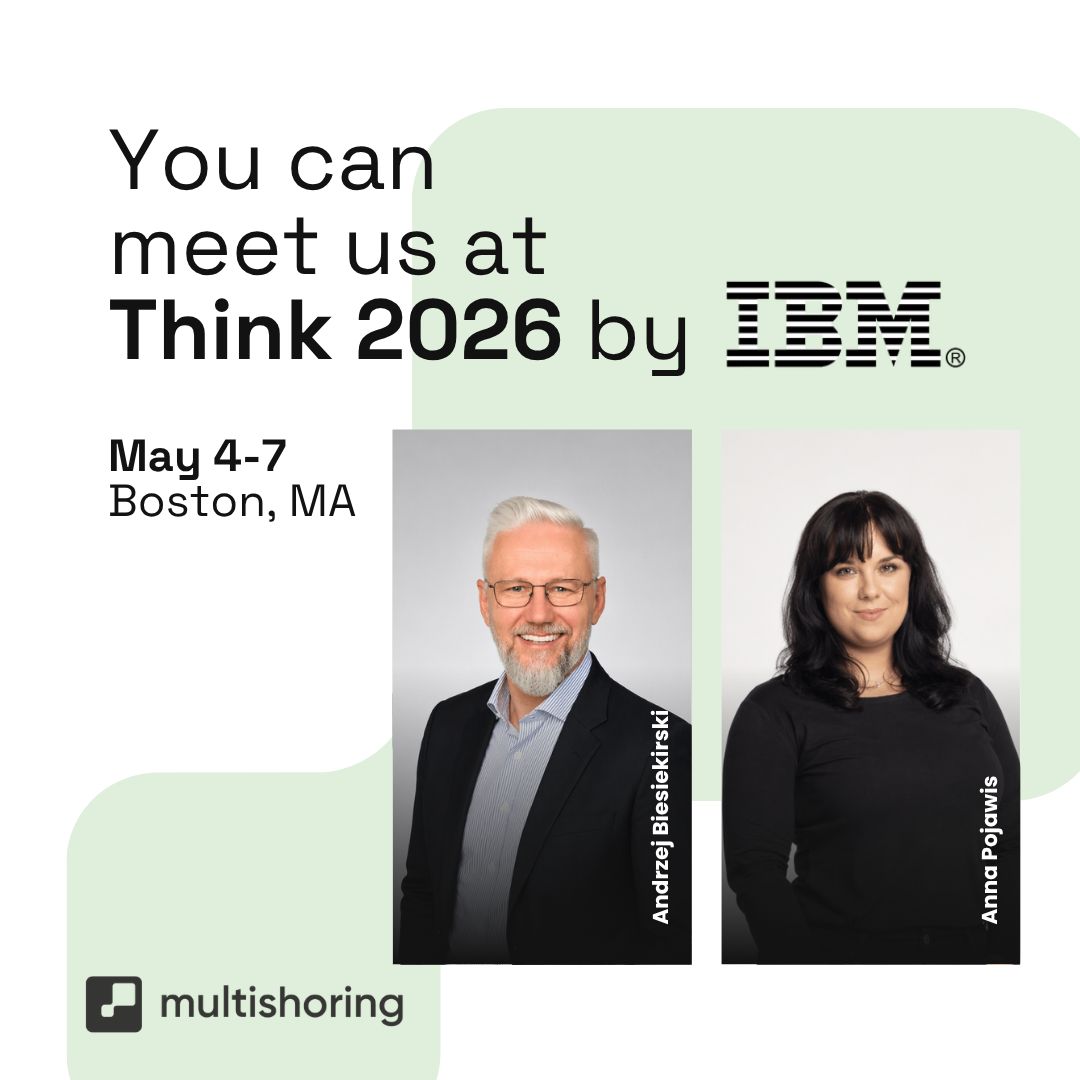
Multishoring is on the ground in Boston this week. We’ll be sharing first-hand insights, key announcements, and takeaways from IBM Think 2026 directly on our LinkedIn – so you don’t have to sift through the noise.
Follow our LinkedIn for live updates →What Arvind Krishna Actually Said – and Why It Matters
Krishna didn’t open with a product demo. He opened with a problem statement.
Most large organizations have spent the last two years running AI pilots. Some have dozens of them. But the core challenge facing enterprises now is clear: many have invested heavily in AI, but only a few believe it is paying off. That’s not a technology failure – it’s an architecture and integration failure. And that’s exactly what IBM used Day 1 to address.
The Three Pillars Krishna Put on the Table
Krishna outlined how AI, quantum, and hybrid cloud are converging into a new source of competitive advantage – not as three separate bets, but as a single, interconnected operating model. For enterprise leaders, the practical framing is straightforward:
- AI is no longer a tool you add to existing processes. It’s the new operating layer your entire business runs on top of.
- Hybrid cloud is the infrastructure that makes this possible across complex, multi-system environments – the reality most large organizations actually live in.
- Quantum is no longer a “watch this space” topic. IBM Research presented it as a near-term competitive differentiator worth building into your three-to-five year architecture planning now.
The Announcements Behind the Vision
IBM unveiled its most comprehensive expansion of enterprise AI capabilities to date, including the next generation of watsonx Orchestrate for multi-agent orchestration, IBM Confluent for real-time data streaming, the IBM Concert platform for intelligent operations, and IBM Sovereign Core for operational independence.
In plain terms, here’s what each one means for a large organization:
| Product | What it solves |
|---|---|
| watsonx Orchestrate (private preview) | Governs and audits thousands of AI agents running across different teams and platforms |
| IBM Confluent | Breaks data silos – gives AI agents live, real-time data to act on instead of stale batch information |
| IBM Concert | Connects infrastructure, security, and operations so problems get resolved, not just flagged |
| IBM Sovereign Core | Lets regulated industries run AI at scale without compromising data residency or compliance |
| IBM Bob (generally available) | Helps technical teams build and deploy agents faster, with cost and security controls built in |
Krishna drew on IBM’s own internal transformation to show how enterprises can embed AI across operations, data, and decision-making processes. The message to the room was direct: this isn’t theoretical. IBM has done it internally, their clients are doing it now, and the window for catching up is not unlimited.
Think 2026 Day 1 Is More Than a Keynote – Here’s the Full Picture
One keynote doesn’t define a conference day. What made Day 1 significant was what happened across the full 10 hours that followed.
The Day’s Structure at a Glance
Think Day 1 ran three separate keynote slots – not one. Most coverage focuses on Krishna’s morning session, but the full day looked like this:
- 7:00 AM – Breakfast and networking. Informal, but valuable – first real face time for 5,000 attendees from 80+ countries
- 8:30 AM – Opening keynote: Arvind Krishna sets the strategic vision
- 9:30 AM – Think Forum opens alongside breakout sessions and the 1:1 meeting center
- 11:30 AM – Second keynote: agentic AI in practice, featuring client stories from organizations like Aramco, Cleveland Clinic, and Elevance Health
- 3:00 PM – Third keynote: industry-specific deep dives – how agentic AI, data, and hybrid cloud are reshaping specific sectors including finance, healthcare, and manufacturing
- 4:30 PM – Forum Networking Reception: the first open networking moment for the full Think community
For executives attending in person, this structure matters. The morning gives you the “why.” The afternoon gives you the “how” – through real deployments, live demos, and direct conversations with IBM teams and partners.
The Think Forum – Where Strategy Meets Reality
The Think Forum is the main expo floor, and it’s where the day’s announcements get pressure-tested. Attendees described it as a place to concretely see new solutions – with curated tours through themed zones covering agentic AI, trusted data, automation, and hybrid cloud.
What’s worth noting for enterprise decision-makers: this isn’t a typical vendor floor. The format includes:
- Live demos of agentic AI managing real enterprise workflows – not slides, not concepts
- Forum tours – curated walks through specific solution areas, designed for executives who need signal, not noise
- 1:1 meeting center – scheduled conversations with IBM product teams, consultants, and partners
If you’re evaluating IBM’s direction for your organization, the Forum is where you get answers that keynotes don’t provide.
The midday and afternoon keynote slots featured organizations that have already moved past pilots. The common thread across Aramco, Cleveland Clinic, and Elevance Health wasn’t the technology – it was the foundation underneath it. The focus was squarely on capturing real enterprise demand – not experimenting with AI pilots, but moving clients from proof-of-concept to production-scale impact.
That’s the pattern IBM reinforced all day: trusted data, clean integrations, and a governed architecture are what separate organizations that get ROI from AI from those that don’t.
The Real Day 1 Takeaway for Enterprise Leaders: AI Only Works If Your Data Does
IBM’s Day 1 announcements were ambitious. But there’s a practical question every C-level in that room was asking quietly: do we actually have the foundation to run any of this?
For most large organizations, the honest answer is: not yet.
The Gap IBM Didn’t Fully Name
Krishna’s keynote was clear on where enterprises need to get to. What it didn’t dwell on is what’s blocking most of them from getting there. For most enterprises, data is siloed and without meaning – and that’s not a problem watsonx Orchestrate solves on its own. You can’t govern a thousand AI agents running on real-time data if your data isn’t integrated, clean, or trusted in the first place.
This is the part of the AI conversation that gets skipped at conferences – and it’s the part that determines whether your AI investment pays off or becomes another expensive pilot.
The organizations that got the most out of Day 1 weren’t the ones taking notes on IBM’s newest products. They were the ones who already knew their data foundation was solid enough to actually use them.
What “Agentic AI at Scale” Requires in Practice
Before any organization can seriously pursue what IBM outlined at Think 2026, three things need to be in place:
- A single source of truth – AI agents can’t act reliably on data that exists in ten different versions across five systems. Consolidation isn’t optional, it’s the prerequisite.
- Working integrations – Real-time data streaming via IBM Confluent only delivers value if your ERP, CRM, and operational systems are actually connected. Silent integration failures don’t announce themselves – they just quietly corrupt your outputs.
- Reporting you can trust – The client keynotes from Aramco, Cleveland Clinic, and Elevance Health all had one thing in common: leadership teams that trusted their numbers before they automated decisions based on them.
The Vendor-Partner Equation IBM Got Right
One thing IBM was explicit about at Think 2026: the ecosystem isn’t a support channel – it’s the primary delivery vehicle for agentic AI at enterprise scale. No single vendor builds and runs this alone. The organizations seeing results are the ones that chose implementation partners who understand their specific environment – not just the technology stack.
That distinction matters more than it sounds. Buying the right platform and having the right partner to implement it are two completely separate decisions. The first is visible on a product page. The second only becomes visible six months into a project.
Key Takeaways from IBM Think 2026 Day 1
Day 1 set the strategic direction for the rest of the week – and for how serious enterprises should be thinking about AI investment in 2026. Here’s what matters most:
- The AI divide is real. Companies that move from pilots to production this year will be structurally ahead. Those that don’t will feel it.
- Data foundation first. No AI operating model works on top of broken integrations and siloed reporting. That work comes before the platform decision – not after.
- Agentic AI needs governance, not just ambition. Deploying agents at scale without clean data and reliable integrations creates risk, not efficiency.
- Partners matter as much as products. IBM said it directly – the ecosystem is the delivery vehicle. Choose implementation partners as carefully as you choose platforms.
- Quantum is worth watching now. It belongs in your three-to-five year planning conversations, not just your research reading list.
Think Day 2 continues tomorrow. We’ll be covering the next wave of announcements and sessions as they happen.