
Content
Netezza end of life is a mandatory decision point for data leaders. Compare IBM NPS, cloud data warehouse and coexistence options, then use a parity-first framework to plan migration and cutover.
Netezza end of life is not merely an infrastructure refresh. It is a mandatory decision about where critical analytics workloads should run, how long the existing estate can remain operational, and what evidence will be required before the old platform can be switched off.
For most data leaders, the practical options are to move to a supported IBM Netezza Performance Server platform, migrate to a cloud data warehouse, or operate a temporary coexistence model. The safest decision depends on workload behavior, data gravity, application dependencies, team capability, cost and the time available—not on a generic platform scorecard.
The central principle is straightforward: migration is not complete when data has moved. It is complete when agreed business results, controls and service levels have been reproduced on the target platform.
What “Netezza end of life” means in practice
“End of life” is often used as a catch-all phrase, but data leaders need to distinguish several different lifecycle events. A product can stop being marketed before standard support ends. Hardware maintenance, software fixes and extended support can also follow separate timelines.
The relevant question is therefore not simply, “Is Netezza dead?” It is: what exact appliance, software release and support agreement are we operating, and what coverage remains for each component?
IBM’s newer Netezza Performance Server generations remain part of IBM’s data platform portfolio. The urgency usually concerns organizations operating older TwinFin, Striper or N3001 appliances, unsupported software releases, or hardware whose remaining serviceability no longer matches the importance of the workloads it supports.
The exposure is broader than vendor support
- Security exposure: unsupported components may no longer receive fixes or may require compensating controls that increase operational overhead.
- Parts and hardware risk: an appliance can continue running while the probability and impact of an unrecoverable hardware event steadily increase.
- Skills concentration: operational knowledge often sits with a shrinking number of administrators, developers and external specialists.
- Recovery risk: a backup is not the same as a proven recovery path. Teams need to know whether the platform, configuration and dependent workloads can be restored within the required recovery objective.
- Change paralysis: teams become reluctant to modify an aging platform, which increases the backlog of reporting, analytics and regulatory requirements.
- Commercial leverage: urgent action after a failure usually provides fewer platform, partner and contract choices than a planned migration.
A defensible lifecycle assessment should record the appliance generation, NPS version, firmware, support entitlement, spare-parts position, backup and restore evidence, workload criticality, data classification and the people required to recover the service.
Three realistic landing options
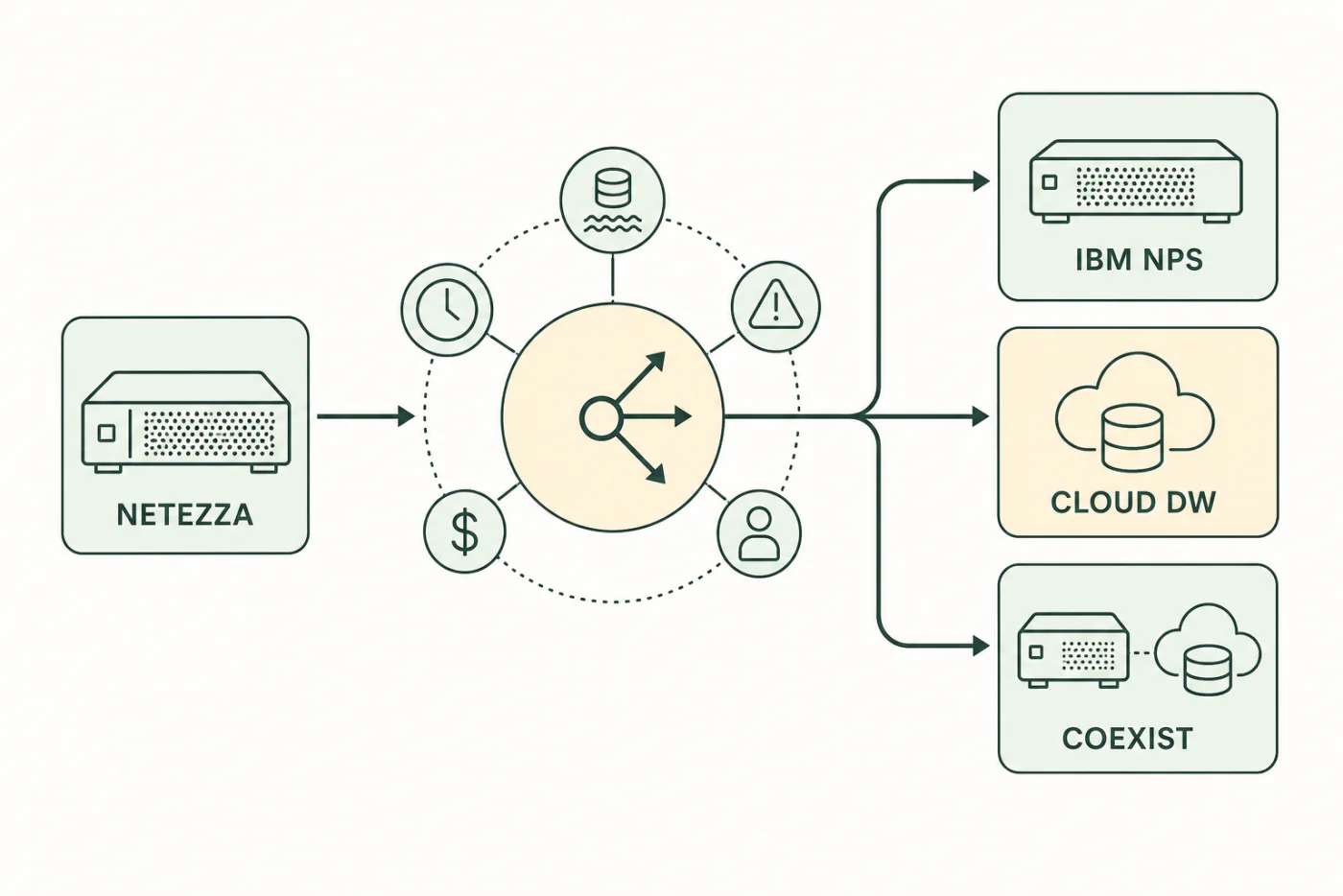
The target decision is usually more nuanced than “stay with IBM” or “move to the cloud.” Enterprises typically choose one of three landing patterns.
1. Move to a supported IBM Netezza Performance Server
A newer IBM Netezza Performance Server can reduce transformation risk because it preserves more of the appliance model, SQL behavior and operational familiarity. This route may suit organizations that have stable Netezza workloads, a skilled support team, strong IBM alignment, predictable performance requirements or limited appetite for application change.
However, familiarity should not be mistaken for zero migration effort. Compatibility must still be tested across SQL, stored procedures, external tables, loaders, orchestration, security integrations, backup processes, monitoring and downstream reporting. Commercial terms, infrastructure dependencies and the target platform’s long-term strategic fit also require scrutiny.
2. Migrate to a cloud data warehouse
Platforms such as Snowflake, Amazon Redshift, Google BigQuery, Microsoft Fabric or Azure data services can provide elastic capacity, managed infrastructure and closer integration with modern data engineering and AI ecosystems. The strongest case is usually broader than replacing database hardware: the migration becomes the foundation for a new data platform operating model.
The main risk is treating a cloud warehouse as a drop-in Netezza appliance. Architectural differences affect distribution, partitioning, workload management, SQL functions, concurrency, data loading and cost behavior. A technically successful translation can still create higher run costs or weaker performance if Netezza-specific patterns are reproduced without redesign.
3. Use coexistence as a controlled transition state
Coexistence allows selected workloads to move while others remain temporarily on Netezza. It is often the safest choice when the estate is large, dependencies are poorly documented, business change windows are limited, or the target architecture is still evolving.
Coexistence is useful only when it has boundaries. Without explicit exit criteria, it creates duplicated data, reconciliation work, split ownership and permanent integration cost. Define which platform is authoritative for each dataset, how changes propagate, how reports are reconciled and what milestone ends the coexistence period.
| Landing option | Strongest fit | Primary risk to test |
|---|---|---|
| Supported IBM NPS | Stable Netezza workloads, limited transformation appetite, strong IBM operating capability | Assuming compatibility without testing integrations and operational processes |
| Cloud data warehouse | Strategic cloud adoption, elastic workloads, modernization and AI roadmap | Recreating appliance-era design and producing unexpected performance or cost |
| Coexistence | Large dependency estate, phased delivery, constrained cutover windows | Allowing a transition architecture to become permanent |
A decision framework for data leaders
Platform selection should begin with workload evidence. A weighted decision framework makes trade-offs visible and prevents one attractive feature—or one stakeholder preference—from deciding the entire program.
1. Data gravity and movement constraints
Map where source data is generated, where it is consumed and which datasets are too large, sensitive or time-critical to move repeatedly. Include inbound feeds, downstream marts, extracts, file transfers, BI tools, machine-learning workflows and regulatory residency requirements.
2. Workload shape and performance
Separate steady batch processing from highly concurrent BI, ad hoc exploration, data science and near-real-time workloads. Use observed query history, not recollection. Capture peak windows, queueing, scan volumes, data skew, temporary space, failed queries and service-level expectations.
3. SQL and application compatibility
Inventory Netezza SQL extensions, procedural logic, user-defined functions, external tables, loading utilities, drivers and embedded queries in applications. Classify each object as directly portable, automatically convertible, manually remediated or redesigned.
4. Security, governance and compliance
Compare identity integration, role design, encryption, masking, row- and column-level controls, auditing, lineage, retention and data-residency capabilities. The target must reproduce required controls before regulated data is moved—not after production cutover.
5. Operating model and skills
Determine who will own platform engineering, cost management, data reliability, security and incident response. A managed cloud service removes some infrastructure tasks, but it introduces capacity governance, consumption monitoring and new engineering practices.
6. Cost and commercial model
Compare more than license or compute prices. Include migration delivery, dual running, network transfer, storage, backup, monitoring, support, refactoring, training, contractual commitments and decommissioning. Model at least the base, growth and peak scenarios.
7. Timeline and reversibility
Estimate the time available before support, hardware or capacity risk becomes unacceptable. Then test whether the proposed migration can produce usable increments inside that window. Prefer sequencing that preserves rollback until the most important parity evidence has been collected.
| Decision dimension | Evidence to collect | Decision question |
|---|---|---|
| Data gravity | Sources, consumers, volumes, transfer windows, residency | Where can data operate without avoidable movement? |
| Workload behavior | Query history, concurrency, peaks, failures, SLAs | Which platform best fits actual workload patterns? |
| Compatibility | SQL objects, utilities, drivers, embedded queries | How much translation or redesign is required? |
| Risk and compliance | Controls, audit evidence, recovery requirements | Can the target meet obligations before cutover? |
| Economics | Migration, dual run and steady-state cost scenarios | What is the cost per business outcome, not only per terabyte? |
| Timeline | Support dates, delivery capacity, change windows | Can the transition finish before exposure becomes unacceptable? |
Need a safe path off your legacy Netezza platform?
A Netezza migration assessment maps lifecycle exposure, workload dependencies, target-platform options, and the parity evidence required before cutover.
Choose the landing platform from workload evidence—not vendor promises.

Choose the landing platform from workload evidence—not vendor promises.
What to migrate first
A “largest database first” sequence is rarely optimal. The first wave should be meaningful enough to validate the target architecture but contained enough to recover without disrupting the business.
Start by grouping workloads into migration waves
- Foundation wave: connectivity, identity, landing zones, deployment automation, monitoring, metadata and reconciliation tooling.
- Pilot workload: moderate complexity, known owners, representative data and visible business value, but limited blast radius.
- Repeatable workload families: reports, marts or pipelines that share sources and transformation patterns.
- Complex and critical workloads: high-volume processing, tight batch windows, regulated data and heavily embedded application dependencies.
- Residual estate: low-use objects, historical data, temporary integrations and workloads that can be retired instead of migrated.
The pilot should prove more than connectivity. It must exercise ingestion, transformation, security, orchestration, BI consumption, operational monitoring and the parity process that later waves will reuse.
Result-parity validation: the gate before cutover
Row counts are useful, but they do not prove that a migrated warehouse produces the same business outcome. Differences in data types, rounding, null handling, timestamps, collation, implicit casting and execution order can change results even when the source data appears complete.
Define parity at several levels
- Structural parity: required tables, columns, views, constraints and metadata exist on the target.
- Data parity: counts, aggregates, hashes, null distributions and exception records reconcile within agreed tolerances.
- Business-result parity: financial totals, customer metrics, regulatory outputs, operational KPIs and executive reports match.
- Performance parity: critical workloads finish inside agreed batch and interactive-response windows.
- Security parity: users, roles, policies, masking, audit trails and privileged access behave as approved.
- Operational parity: scheduling, alerting, recovery, support and incident procedures function on the target.
Not every result requires exact byte-for-byte equality. A parity contract should define which outputs must match exactly, which allow a numerical or timing tolerance, who approves exceptions and how evidence is retained.
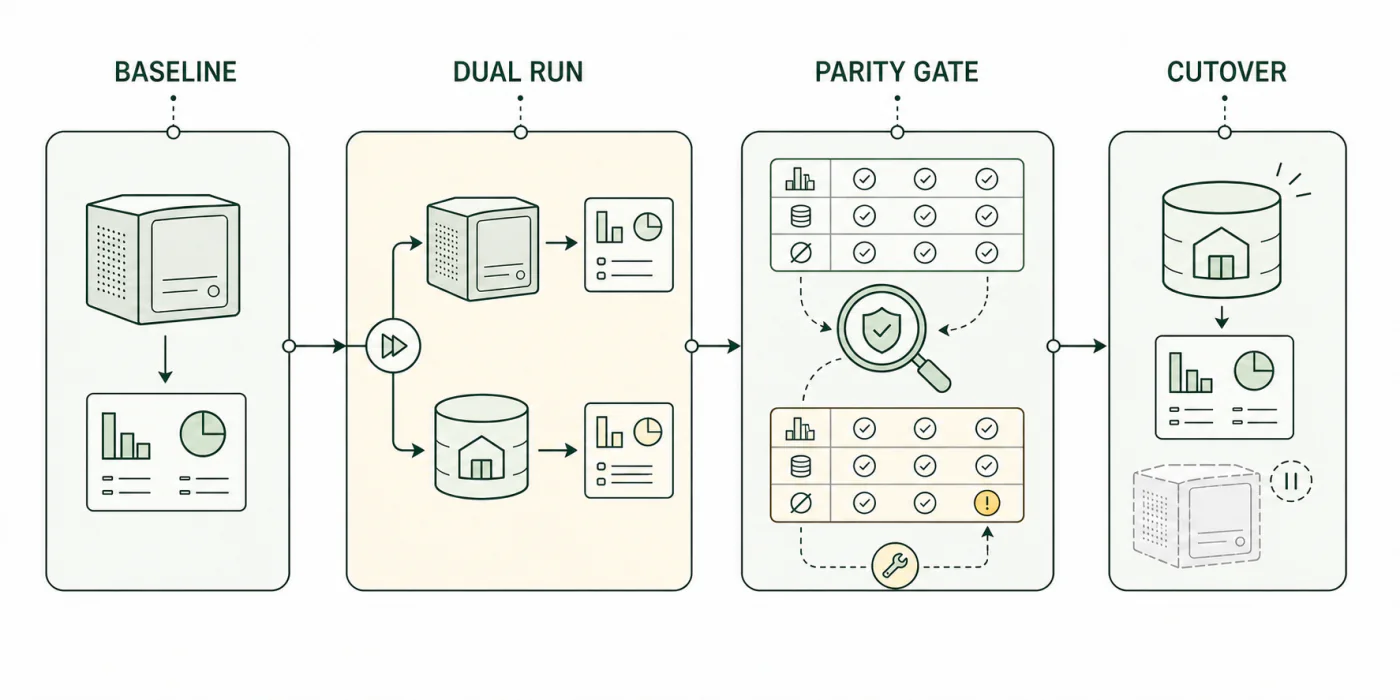
Use a baseline, dual run and parity gate
- Baseline: capture representative source results, performance and business totals before migration.
- Dual run: process the same controlled input on Netezza and the target for an agreed period.
- Reconcile: compare technical outputs and business measures, investigate differences and document accepted tolerances.
- Parity gate: business owners, data owners, security and operations sign off against predefined exit criteria.
- Cutover: redirect production consumption while maintaining a time-bound rollback path.
How to avoid reporting downtime during cutover
Reporting downtime is usually caused by unmanaged dependencies rather than the database copy itself. A report may depend on a semantic layer, extract schedule, service account, driver, hard-coded connection, file delivery or downstream spreadsheet that was absent from the original inventory.
- Create a dependency graph from query logs, BI metadata, scheduler definitions, code repositories and interviews.
- Separate data cutover from consumer cutover where possible, allowing reports to be redirected in controlled groups.
- Use repeatable incremental synchronization rather than relying on a single final bulk copy.
- Freeze or tightly govern source changes during the final migration window.
- Pre-stage identities, roles, drivers, network rules and connection configuration.
- Run critical reports and extracts on both platforms before switching business users.
- Define measurable rollback triggers, an accountable decision-maker and a latest safe rollback time.
- Keep the legacy platform available only for the approved stabilization period, then revoke write access and execute the decommission plan.
The rollback plan should identify what will be restored, how data written after cutover will be handled, which integrations must be reversed and how users will be notified. “We can point the reports back” is not a complete rollback procedure.
Common Netezza migration mistakes
- Selecting the target before profiling workloads: vendor comparisons cannot replace query, dependency and operating-model evidence.
- Moving everything: unused tables, duplicate marts and obsolete reports increase cost and validation scope. Retire them when evidence supports retirement.
- Translating SQL without redesign: Netezza distribution and appliance-era optimization patterns may be inefficient on the target platform.
- Validating only row counts: technical completeness can coexist with incorrect business outputs.
- Leaving BI and applications until the end: embedded dependencies often determine the real cutover timeline.
- Ignoring cloud consumption controls: elasticity without workload governance can create unpredictable cost.
- Keeping coexistence open-ended: every temporary integration needs an owner and retirement date.
- Decommissioning too early: preserve a controlled rollback path until production stability and parity are demonstrated.
A practical Netezza EOL checklist
- Confirm appliance, software and support status directly against IBM lifecycle information and your support contract.
- Document hardware, security, recovery, skills and capacity exposure.
- Inventory databases, objects, workloads, integrations, users and business owners.
- Capture representative query and performance history.
- Identify data and workloads that can be retired, archived or consolidated.
- Compare supported IBM NPS, cloud warehouse and coexistence options against weighted criteria.
- Model migration, dual-running and steady-state costs.
- Select a representative but recoverable pilot.
- Define technical, business, security, performance and operational parity.
- Agree cutover, rollback and decommission exit criteria before production migration begins.
Netezza end of life is the trigger—not the entire business case
An approaching support or hardware deadline creates urgency, but the program should not be framed only as escaping an old appliance. It is an opportunity to simplify the data estate, remove unused workloads, improve ownership and lineage, modernize delivery practices and create a platform suitable for analytics and AI.
The strongest roadmap therefore separates the mandatory outcome—removing unacceptable Netezza lifecycle risk—from the strategic outcomes the organization wants to unlock. That distinction protects the critical migration path while allowing modernization to continue in measurable stages.
Frequently asked questions
Is IBM Netezza discontinued?
Older Netezza appliance generations and software releases have reached lifecycle milestones, but IBM continues to offer newer Netezza Performance Server products. Organizations should verify the exact status of their appliance, software version and support agreement rather than relying on a general statement about the Netezza brand.
What is the best replacement for Netezza?
There is no universal replacement. A supported IBM NPS platform may minimize transformation for stable appliance workloads. A cloud data warehouse may offer stronger alignment with a broader cloud, analytics and AI strategy. Coexistence may be appropriate when dependencies or delivery constraints require a phased transition.
How long does a Netezza migration take?
The duration depends less on raw database size than on SQL complexity, integrations, reporting dependencies, data-transfer windows, validation requirements and available business owners. A discovery phase should establish the workload inventory and delivery waves before a reliable timetable is committed.
Can Netezza be migrated without reporting downtime?
Many workloads can be moved with little or no user-visible interruption by using incremental synchronization, dual running, pre-staged access and phased consumer cutover. The achievable result depends on source-change rates, architecture, integration design and the organization’s rollback requirements.
How do you validate a Netezza migration?
Validation should combine structural checks, data reconciliation, business-result comparisons, performance testing, security verification and operational readiness. Critical workloads should pass an agreed parity gate before Netezza is decommissioned.
Plan the next step
A useful first engagement is not a platform implementation proposal. It is a time-boxed assessment that establishes lifecycle exposure, workload and dependency facts, realistic landing options, migration waves, parity criteria and the decisions executives must fund.
Netezza end of life creates a mandatory decision about support exposure, the target data platform and the evidence required for safe decommissioning. Compare supported IBM NPS, cloud data warehouse and coexistence options using workload facts, then migrate in controlled waves with business-result parity as the cutover gate.


