
Content
A NATO Commercial and Government Entity (NCAGE) code is a standardized five-character identifier assigned to commercial businesses, government bodies, and service providers that supply organizations within the NATO alliance and allied nations. Managed under the NATO Codification System (NCS), the code verifies an organization’s legal identity, physical location, and corporate status.
For IT consulting firms, system integrators, and software engineering partners, an NCAGE code acts as a recognized baseline for procurement eligibility. It confirms that a company has passed formal institutional validation, allowing defense agencies, allied public sector bodies, and risk-conscious enterprise buyers to identify and vet the vendor across international procurement systems.
What is an NCAGE code and how does the NATO Codification System work?
The NATO Codification System (NCS) was created to establish a common supply language across member nations. Under the supervision of the Allied Committee 135 (AC/135), the framework ensures that every item of supply and every commercial supplier has a single, unambiguous record shared by all participating countries.
Within this framework, the NCAGE code serves as the primary organizational identifier (recorded in NATO data dictionaries as Data Record Number 9250). The code itself consists of five alphanumeric characters.
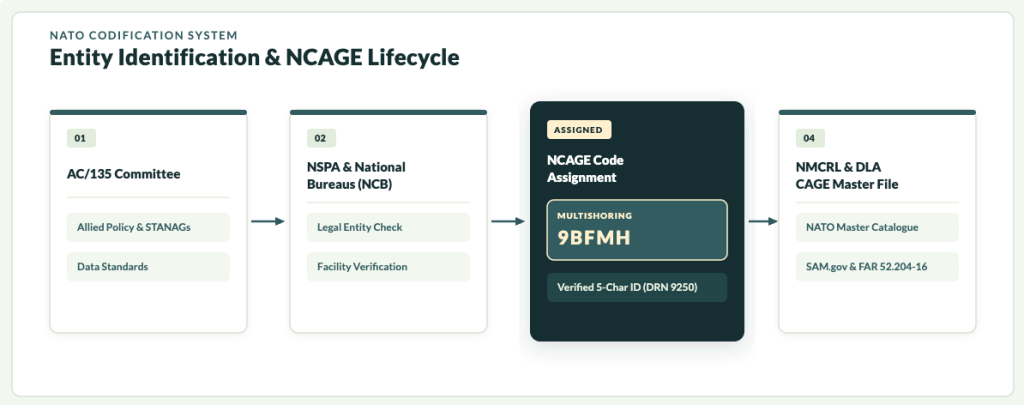
The assignment process is strictly managed:
- National verification: For companies located in NATO or partner nations, the code is reviewed and issued by that country’s National Codification Bureau (NCB) or through the NATO Support and Procurement Agency (NSPA).
- Entity validation: The codification authority confirms that the company is an active, registered legal entity at a verified physical facility.
- Central indexing: Once approved, the record is published in the NATO Master Catalogue of References for Logistics (NMCRL) and synced with allied databases.
The system prevents duplicate registrations, misidentified vendors, and unverified entities from entering defense and allied logistics networks.
CAGE vs. NCAGE vs. SAM.gov: Navigating procurement frameworks
Organizations working across North American and European procurement often encounter three related identifiers: CAGE, NCAGE, and SAM.gov Unique Entity Identifiers (UEI). While they serve similar verification purposes, their geographic scope and issuing bodies differ.
| Identifier | Issuing Authority | Geographic Scope | Primary Role in Procurement |
|---|---|---|---|
| CAGE Code | Defense Logistics Agency (DLA) | United States and its territories | Required for US federal contracting and defense supplier databases |
| NCAGE Code | NSPA / National Codification Bureaus | Non-US entities (NATO & global) | Prerequisite for international vendors entering NATO and US defense frameworks |
| SAM.gov UEI | General Services Administration (GSA) | Global (US & international registrants) | Universal entity identifier for US federal awards, grants, and direct contracts |
The transatlantic link under US Federal Acquisition Regulations
Under the US Federal Acquisition Regulation, international companies cannot complete a registration in the US System for Award Management (SAM.gov) without first obtaining a verified NCAGE code.
When a non-US technology company applies for an NCAGE code, the NATO Support and Procurement Agency or the local NCB validates the company details and passes the approved record directly to the US Defense Logistics Agency (DLA) CAGE Branch. This data exchange ensures that US federal agencies and NATO commands rely on the exact same verified vendor information.
Why enterprise IT and data consulting vendors hold NCAGE registration
While the NATO Codification System originated around hardware and equipment logistics, modern defense and public sector operations depend heavily on digital infrastructure, secure software, and complex data environments.
Technology companies register in the NCAGE system for three main reasons:
1. Direct participation in allied defense and agency tenders
NATO procurement operates through specialized agencies. The NATO Communications and Information Agency (NCIA) procures software engineering, cloud integration, data platforms, and cybersecurity capabilities, often using framework vehicles like Basic Ordering Agreements (BOA). The NATO Support and Procurement Agency (NSPA) manages maintenance and life-cycle operational systems. In both cases, an active NCAGE code is a mandatory prerequisite for supplier registration and bidding.
2. Supply chain risk management for regulated enterprises
Commercial enterprises in banking, insurance, defense manufacturing, and utilities face increasingly strict vendor qualification rules. Working with an IT vendor that holds an active NCAGE code gives risk and compliance teams confidence that the partner’s corporate structure, operating jurisdiction, and facility locations have undergone independent institutional vetting.
3. High-stakes systems integration and data governance
Complex initiatives such as legacy modernization, cross-border system consolidation, and enterprise data governance require partners that respect formal procedures and data integrity. NCAGE registration reflects a commitment to structural compliance and transparent business operations. You can review how structured governance protects critical data assets in our overview of strategic data governance services.
How procurement teams verify an entity in the NATO portal
Procurement specialists and compliance officers can verify an organization’s NCAGE status in minutes using public NATO and DLA tools:
- Access the NSPA ePortal: Open the public NATO Codification Tool (CageTool) at the official NSPA portal (eportal.nspa.nato.int).
- Search by code or legal name: Enter the 5-character NCAGE code or the company’s full legal name into the search form.
- Inspect the record details: Review the returned record to confirm that:
- the status is listed as active;
- the legal company name matches the vendor’s submitted documentation;
- the physical address corresponds to the vendor’s declared operating office;
- the assigning National Codification Bureau (NCB) matches the home country of the entity.
Multishoring’s NATO registration: NCAGE code 9BFMH
Multishoring is registered in the NATO Codification System under NCAGE code 9BFMH.
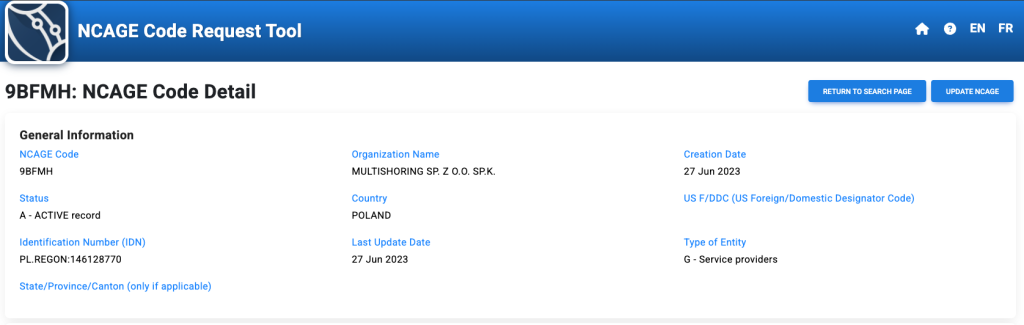
This registration confirms Multishoring’s eligibility to support public sector organizations, allied defense initiatives, and multinational commercial enterprises with specialized technology services.
Our teams deliver senior-led engineering across high-consequence enterprise environments:
- Mission-critical legacy modernization: Supporting and migrating core enterprise platforms, including IBM Z and IBM i environments, without business disruption. Learn more about our approach in our guide to legacy modernization services.
- Data integration and pipeline engineering: Building dependable data pipelines, enterprise middleware, and data migration workflows that eliminate reporting inconsistencies. Explore our data integration consulting.
- Nearshore delivery with embedded accountability: Providing dedicated engineering teams that take co-ownership of project outcomes from day one through long-term operation.
Frequently asked questions about NATO NCAGE
Does an NCAGE code mean a company holds a security clearance?
No. An NCAGE code is an organizational identifier confirming a company’s legal existence, physical location, and registration in NATO logistics systems. It does not replace facility security clearances (FSC) or personnel security clearances (PSC), which are separate qualifications required for contracts involving classified information.
How long does an NCAGE registration remain valid?
NCAGE records remain active as long as the organization maintains accurate corporate information with its assigning National Codification Bureau or NSPA. Companies must update their record whenever their legal name, ownership structure, or physical address changes, with periodic reviews typically required every five years.
Why should commercial enterprise clients care about a vendor’s NCAGE code?
For commercial clients in finance, retail, or manufacturing, an NCAGE code serves as third-party proof of vendor legitimacy. It indicates that the technology provider meets the identity and operational criteria required by international defense and public procurement authorities.


