InBetween automatically turns approved product data into catalogs, price lists, datasheets and marketing materials. We implement and integrate the platform with PIM, ERP, DAM and commerce systems so enterprise teams can publish faster, across more markets and languages, with consistent product data.

How InBetween Automates Product Publishing
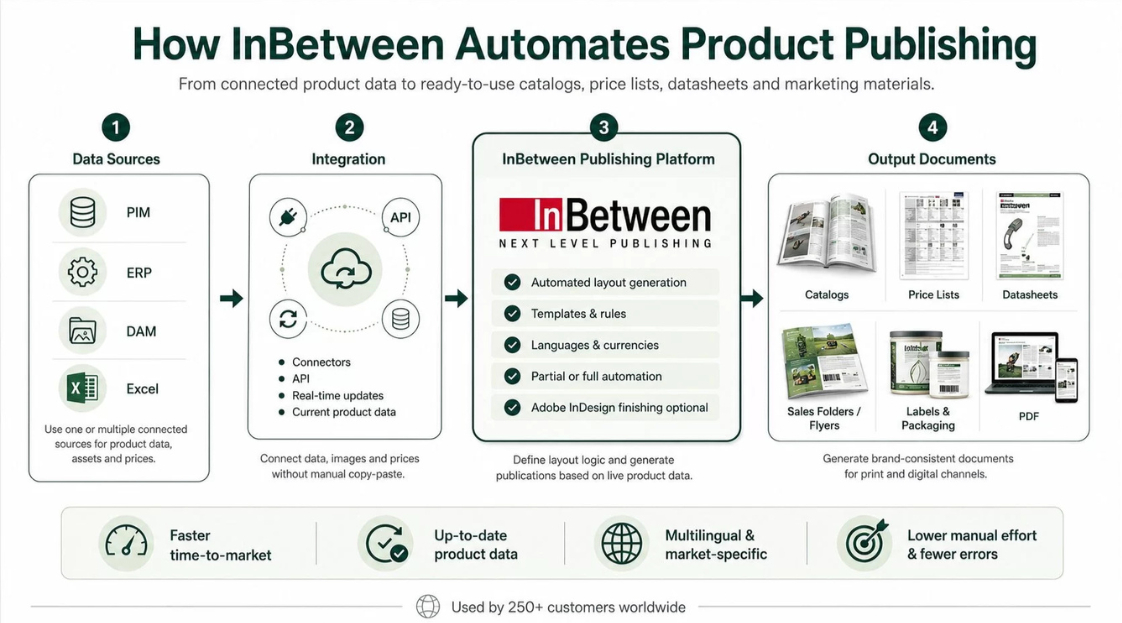
InBetween connects to existing product data sources, applies publication templates and business rules, then generates ready-to-use documents for print and digital channels. The result is a controlled publishing process instead of repeated manual layout work.
Catalogs
Structured product catalogs generated from current product data for specific assortments, markets and brands.
Price Lists
Price and assortment documents that can reflect source data changes without manual copy-paste.
Datasheets
Technical product sheets based on controlled attributes, images, specifications and translations.
Marketing Materials
Sales folders, flyers, PDFs and localized materials for digital and print channels.
Is Manual Product Publishing Slowing Down Your Commercial Teams?

Catalogs Still Depend on Manual Copy-Paste
Product data, images, prices and technical specifications are copied between PIM, ERP, spreadsheets, design files and approval documents. Every manual transfer adds time, cost and risk of inconsistency.

Every Market Version Reopens the Same Work
Language variants, currencies, country-specific assortments, customer segments and brand versions require repeated layout changes. What should be scalable product communication becomes a new production project every time.

Publishing Teams Get Stuck in Correction Loops
Marketing, product management, sales teams and agencies spend weeks exchanging proofs, comments and corrections. High-value specialists end up checking layouts and data instead of improving product experience.

Documents Can Be Outdated Before They Go Live
When source data changes after a catalog, datasheet or brochure has already entered production, teams need to find and correct every affected layout manually. That makes accuracy hard to prove and time-to-market hard to control.
Turn Product Data into Market-Ready Publications
We connect source systems, define publication logic and automate output generation without losing control over layout, localization, approvals or brand consistency.
Connect Your Product Data Sources
We integrate InBetween with the systems that already hold your product data – PIM, ERP, DAM, Excel, APIs and digital commerce platforms. Publications are generated from current, approved source data instead of manually maintained copies.
Define Templates and Automation Level
We map dynamic fields, layout rules, product selections and localization logic into reusable templates. InBetween can support fully automated generation, partially automated workflows, and Adobe InDesign finishing when creative control is required.
Publish, Localize and Scale
Generate catalogs, datasheets, price lists, brochures and other materials for print and digital channels. Country versions, language variants and market-specific assortments can be produced faster, with better control over data accuracy and corporate design.
From InBetween Setup to Production Publishing Workflows

Publishing Process Assessment
We review your current catalog, datasheet and brochure production process: document types, source systems, product data ownership, language variants, approval loops, agency dependencies and recurring bottlenecks. Output: a realistic automation roadmap.

PIM, ERP, DAM and Commerce Integration
We connect InBetween to the systems that provide product attributes, pricing, images, technical specifications, translations and channel logic. Data can flow from one or several sources, depending on your enterprise architecture.

Template, Layout and Data Mapping
We translate publication requirements into reusable templates, mapped dynamic fields, layout rules and product selection logic. The goal is simple: accurate, on-brand output without rebuilding the same pages by hand.

Workflow, Roles and Approval Design
We configure publishing workflows around real teams: marketing, product management, local markets, sales and external agencies. Review, annotation, approval and exception handling are designed into the process rather than handled by email chains.

Automated Generation and Localization
We help generate market-ready documents for different countries, product ranges, brands, formats and languages. Updates in source data can be reflected in publications without restarting the entire production cycle.
Go-Live, Training and Continuous Improvement
We support rollout, user enablement and operating model handover so publishing teams can run InBetween confidently. After go-live, we help refine templates, integrations and KPIs as new markets, languages and document types are added.
A Clear Path to Automated Product Publishing
InBetween Software, Implemented for Your Enterprise Environment
InBetween brings the publishing automation platform. We make it work inside the client’s real data, integration and publishing environment – with the right source systems, templates, workflows and adoption model.
About InBetween

InBetween Deutschland GmbH is a digital publishing and database publishing software provider with more than 20 years of experience. Its platform automatically creates catalogs, datasheets, price lists, sales folders and other print or digital publications based on current product data, supporting both fully and partially automated workflows across formats, languages and customer segments.

Plan Your InBetween Publishing Automation with Multishoring
Let’s talk about your product data landscape, current publication process, target document types, markets and languages. You will walk away with a clear picture of where InBetween can reduce manual work, how it should integrate with your PIM and ERP, and what the first automation roadmap should look like.
Thank you for your interest in Multishoring.
We’d like to ask you a few questions to better understand your IT needs.

Signed, sealed, delivered!
Await our messenger pigeon with possible dates for the meet-up.


Related PIM and Digital Commerce Services

PIM Integration and Consulting
Enterprise PIM integration, data flows and product information architecture for multi-market digital commerce.
IT Integration Services
Architecture and implementation of integrations between enterprise systems, APIs, middleware and business applications.

Data Quality Consulting
Data profiling, cleansing and quality rules that keep product information accurate across systems and channels.
Frequently Asked Questions about InBetween Publishing Automation
What does InBetween automate?
InBetween automates the creation of product materials such as catalogs, datasheets, price lists, brochures, sales folders and other print or digital publications. Documents are generated from product data held in systems such as PIM, ERP, DAM, Excel or connected APIs, using predefined templates and publication rules.
Does publishing automation mean we lose creative control?
No. InBetween supports both fully automated and partially automated workflows. Standardized materials can be generated with minimal manual interaction, while high-end publications can still include review, creative finishing and Adobe InDesign work where the business needs more control.
Can InBetween work with our existing PIM or ERP?
Yes. InBetween is designed to connect with data sources such as PIM, ERP, DAM, Excel and APIs. Our role is to design and implement those integrations so product attributes, prices, images, translations and market-specific rules reach the publishing workflow reliably.
Which companies benefit most from InBetween?
InBetween is especially relevant for enterprise manufacturers, distributors and retailers that manage complex product data, operate across many markets or languages, and regularly produce catalogs, datasheets, brochures, price lists or technical product documentation.
What business results should we expect from automated publishing?
The main outcomes are shorter time-to-market, lower manual publishing effort, reduced agency dependency, fewer copy-paste errors, more consistent product data and easier scaling across languages, currencies, brands and markets. Exact ROI depends on document volume, data complexity and the current level of manual work.
What does Multishoring deliver in an InBetween project?
We assess the publishing process, design integrations, configure InBetween, map data and templates, implement workflows, validate generated documents, train users and support production rollout. The goal is not only to install the platform, but to make automated publishing work inside your real enterprise environment.