
Content

IBM has revealed a processor designed to run Arm and IBM instructions on the same cores in future IBM Z and LinuxONE systems. This is a statement of direction, not a product you can buy today. For most enterprises, the useful response starts now and has little to do with hardware: getting integration and data in order.
On August 24, 2026, IBM unveiled what it calls the first dual-architecture mainframe processor, built for future IBM Z and LinuxONE systems. The announcement is easy to over-read. It does not mean your applications migrate to IBM Z, and nothing ships this quarter. It does mean IBM wants to bring the Arm software ecosystem onto its most critical platforms. For the people who run them, that turns into one practical question: what belongs in the core, and what should connect to it through modern services.
What IBM Actually Announced
IBM described a design and a direction, not a release. The official IBM announcement lays out a clear set of facts:
- It is designed for future IBM Z and LinuxONE systems, not current models.
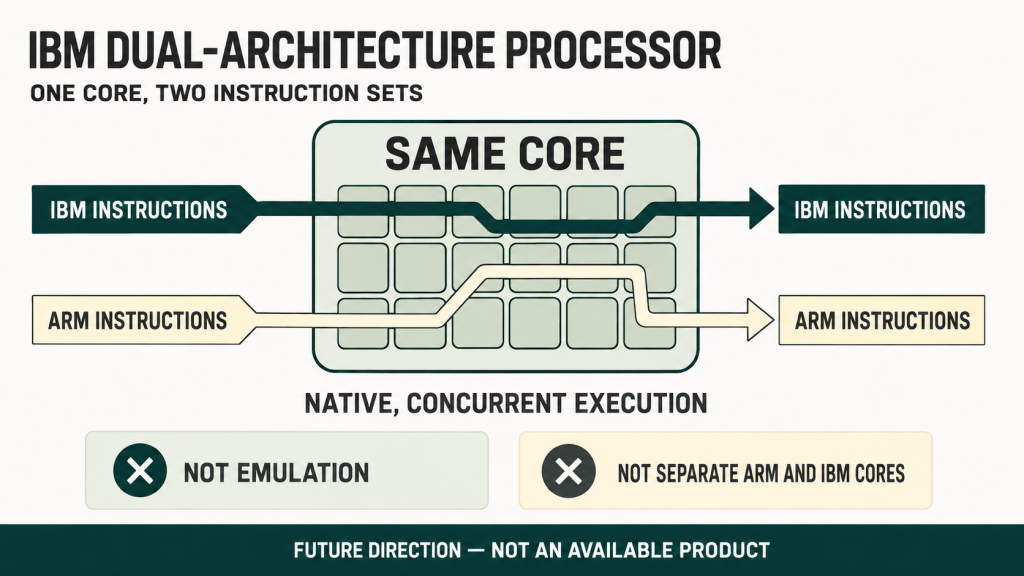
- Each core can natively execute Arm and IBM Z, or Arm and LinuxONE, instructions concurrently. IBM is explicit that this is not a design with separate Arm and IBM cores.
- Arm-native Linux is meant to run alongside z/OS and Linux on IBM Z.
- The platform keeps the traits enterprises expect from Z and LinuxONE: reliability, hardware-level fault detection and recovery, encryption, secure key management, and scaling to hundreds of cores and tens of terabytes of memory.
- Technical detail from the release: 2 nanometer process, 11 high-performance cores running above 5.7 GHz, AI inference accelerators, an on-chip data processing unit for I/O, and a large cache.
IBM also attached its own caution: statements about future direction and intent are subject to change or withdrawal. So this is a roadmap signal, not a launch.
What IBM did not say
Just as important is what the announcement leaves open:
- No availability date, product name, or specific IBM Z / LinuxONE model.
- No pricing, licensing, or sales model.
- No full support matrix for Linux distributions, hypervisors, containers, or OpenShift.
- No list of certified applications or independent software vendors.
- No production benchmarks or TCO comparisons.
- No stated relationship to Telum II, IBM z17, or the Spyre Accelerator.
This gap matters for planning. Native Arm support at the chip level is not the same as running any Arm application in production. Operating system, libraries, drivers, containers, licenses, and performance still need verification once the product details arrive.
Why IBM Is Bringing Arm to Z and LinuxONE
The point is software reach, not just a faster chip.
This is the first processor milestone from the strategic collaboration IBM and Arm announced in April 2026, and Arm describes the same direction from its side.
Dual architecture, in plain terms, means cores that natively run both instruction sets. It is not an x86 server with emulation, and it is not two separate processors wired together. For enterprises, the appeal is access to the broad Arm software ecosystem next to systems of record, while keeping the security and resilience of the Z and LinuxONE platform. That is the opportunity. It is not a promise that every Arm workload will run unchanged.
What Could Change in Enterprise Architecture
If this ships as described, the value is architectural, not just hardware.
Read the news as a possible pattern: transactional systems stay close to the data, while new services, AI components, and cloud-native apps get more choice of where they run. Companies on IBM Z and LinuxONE may reach a wider set of Arm applications without a separate server for each. Systems of record can stay put while new capability is built as APIs, events, or analytics. AI may sit closer to transactions too, if IBM’s inference acceleration delivers. How big those gains are will depend on data, latency, security, and software availability, none of which the announcement settles.
A quick read on each piece:
| Technology or area | How to read it |
|---|---|
| IBM Z | Platform for transactional and critical systems. The announcement targets future models, so do not assume a specific model or date. |
| LinuxONE | Natural home for Linux-native and cloud-native workloads. Wider app choice is possible, not confirmed compatibility. |
| z/OS | Can keep acting as a system of record, running alongside Arm-native Linux. z/OS is not moving to Arm. |
| Arm-native Linux | A new, distinct environment. Details of how it is run and managed wait on product documentation. |
| AI acceleration | IBM cites inference accelerators for fraud detection. Do not equate this with Telum II or Spyre; the release does not describe that relationship. |
| Red Hat / OpenShift | A likely layer for cloud-native workloads, but IBM has not published a support matrix. Treat it as a point to verify. |
The common thread: value comes from how you split workloads and manage data flow, APIs, events, identity, observability, and governance. That makes this as much an enterprise architecture topic as a hardware one.
How to Prepare Without Waiting for the Hardware
You do not need the chip to start. The groundwork is integration and data, and it pays off no matter what IBM ships.
To be clear about scope: Multishoring is not implementing IBM’s future processor. We work on the layer around these systems: integration, data modernization, and analytics across IBM, mainframe, and AS/400 environments. That is exactly what any dual-architecture future would depend on, and it is useful today.
Practical, low-risk moves that hold their value either way:
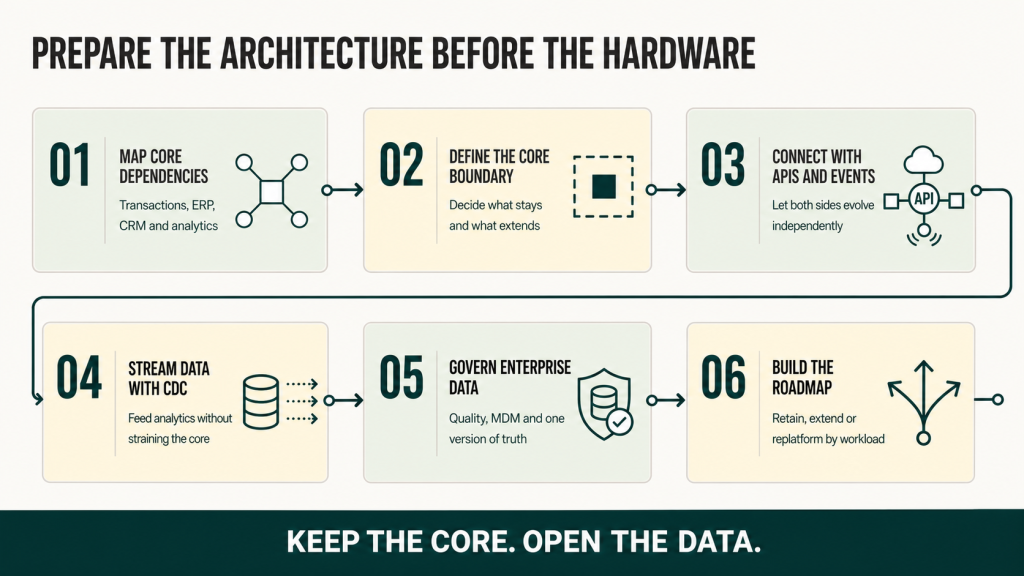
- Audit your integration landscape. Map the dependencies between ERP, CRM, transactional systems, and analytics platforms before you plan any change to core systems.
- Design the boundary between core and modern services. Put APIs and event flows between systems of record and cloud-native applications, so each side can evolve on its own. See Mainframe & AS/400 integration.
- Feed analytics without straining the core. Non-invasive, log-based Change Data Capture and Apache Kafka can stream events into Snowflake, Databricks, or Microsoft Fabric without polling large transactional tables or adding mainframe MIPS. This is core to our IBM & Red Hat enterprise modernization work.
- Modernize reporting with the logic intact. Move IBM Cognos to Power BI and modernize IBM Planning Analytics / TM1, validating business rules before the switch.
- Fix the data foundation. Governance, data quality, MDM, and a single version of the truth through data management and data integration.
- Build a modernization roadmap. Separate what stays in the core from what can be replatformed or extended, on a modern data warehouse.
None of this depends on a specific IBM product. It holds its value whenever IBM’s details land, and it makes your current systems easier to run in the meantime.
Arm on IBM Z and LinuxONE – Key Takeaways
- IBM announced a dual-architecture processor for future IBM Z and LinuxONE. It is a direction, not an available product.
- Each core is designed to run Arm and IBM instructions natively, so Arm-native Linux can coexist with z/OS and Linux on IBM Z.
- Many commercial details are still unknown: availability, models, pricing, support matrix, certified apps, and benchmarks.
- Native Arm at the chip level is not portability of every Arm app. Plan for verification, not automatic migration.
- The work that pays off now is architectural: integration, APIs, events, CDC, governance, and a clear split between core and modern services.
IBM, mainframe, or AS/400 systems you can’t afford to destabilize?
We design the safe layer around your core systems: integration, CDC, APIs, event streaming, and data modernization, so analytics and modern apps get the data without touching what works.
Keep the core. Open the data.

Keep the core. Open the data.
Dual-Architecture Processor for IBM Z and LinuxONE – FAQ
What did IBM announce about the dual-architecture processor?
A processor design for future IBM Z and LinuxONE systems. Each core is meant to run Arm and IBM instructions natively at the same time, letting Arm-native Linux coexist with z/OS and Linux on IBM Z. IBM described it as future direction, not a shipping product.
Is the IBM Arm processor available now?
No. IBM has not published an availability date, product name, model, price, or support matrix. The announcement is a roadmap signal, and IBM notes its future direction can change.
Does this mean z/OS is moving to Arm?
No. IBM describes z/OS and Linux on IBM Z running alongside Arm-native Linux, not z/OS being ported to Arm. The processor is designed to execute both instruction sets natively on the same cores.
What should enterprises do now?
Focus on groundwork that pays off regardless of the hardware: audit your integrations, define API and event boundaries between core and modern services, use CDC and streaming to feed analytics, and get data governance in order.
Sources
- IBM – Next-generation dual-architecture processor for IBM Z and LinuxONE (August 24, 2026)
- IBM – Strategic collaboration with Arm (April 2, 2026)
- Arm – Expanding the Arm ecosystem for IBM Z and LinuxONE