
Content
Ask any CIO running three or four AI pilots where the budget goes, and much of the answer is plumbing. Each project connects SharePoint again, rebuilds a Power BI feed and writes its own rules about what finance numbers mean. Of all the Microsoft Ignite 2026 announcements, Microsoft IQ is the one aimed at that duplicated work, and we expect it to shape enterprise AI spending in 2027.
Microsoft IQ takes the context Copilot already uses (documents, business data, meetings, permissions and web results) and makes it available to any agent, including ones built in ChatGPT, Claude or Microsoft Foundry. According to the Book of News, it requires no new SKU or subscription.
We think Microsoft has the direction right. Getting value from it is another matter, and most companies will spend 2027 on that. The pieces that save the most effort are still in preview or limited to the Frontier early-access program, usage lands on several separate meters, and every connected agent will see your data exactly as clean or as messy as it is today. In our Ignite preview we said we would judge the news on governed data, production cost and integration, and that is the lens we use below.
The confirmed announcement: Microsoft IQ
On November 17, Microsoft introduced Microsoft IQ as a platform for capturing and reusing what an organization knows, so that a new agent does not need a new grounding pipeline. Four layers sit underneath it, together with more than 350 third-party connectors:
| Layer | What it gives agents | Status at Ignite |
|---|---|---|
| Work IQ | Microsoft 365 context such as email, Teams, SharePoint and meetings, plus Dynamics 365 and Power Platform records | Generally available; ERP data in preview |
| Fabric IQ | OneLake data, Power BI semantic models and business ontologies | Semantic models in Copilot GA; ontologies in preview |
| Foundry IQ | Knowledge bases over documents and files, running on Azure AI Search | Partly GA; knowledge graphs in preview |
| Web IQ | Public web grounding | Open to every Azure customer, from $1 per 1,000 calls |
Business Plugins are the layer above. A domain expert packages context, approved data sources, skills and tools once, and every agent in the company inherits that package instead of carrying its own copy of the rules. If it works as described, it removes most of the prompt copying we see between projects. For now, Business Plugins are available only in the Frontier program.
Microsoft’s lead customer story comes from the Australian Energy Market Operator, which used Microsoft IQ to help grid operators filter thousands of control-room signals during incidents while operators keep the final say.
What changed and what did not
Most enterprise AI risk sits in the gap between what a vendor announces and what you can run in production next quarter. At Ignite that gap is wide, so it helps to separate the two.
What changed
Microsoft has opened its context engine to assistants it does not own. Work IQ plugins for ChatGPT and Claude are generally available, and Business and Enterprise customers can find the Work IQ plugin in the ChatGPT directory. Employees who prefer a non-Microsoft assistant can therefore work with the same Microsoft 365 content and permissions.
Fabric IQ lets agents answer with governed numbers. When someone asks for quarterly revenue, the answer can come from the certified Power BI measure rather than from SQL the model improvises against raw tables, which matters to any CFO who has sat through a meeting about why two dashboards disagree.
Work IQ also separates reading from acting. An administrator sets a ceiling for the whole tenant, for instance reads, creates and updates allowed and deletes blocked, and no individual agent policy can go above it. Content headed for an acting agent first passes through an isolated model with no tool access, which rewrites it to lower the risk of prompt injection.
What did not change
The features that would make the biggest difference are mostly not ready for production:
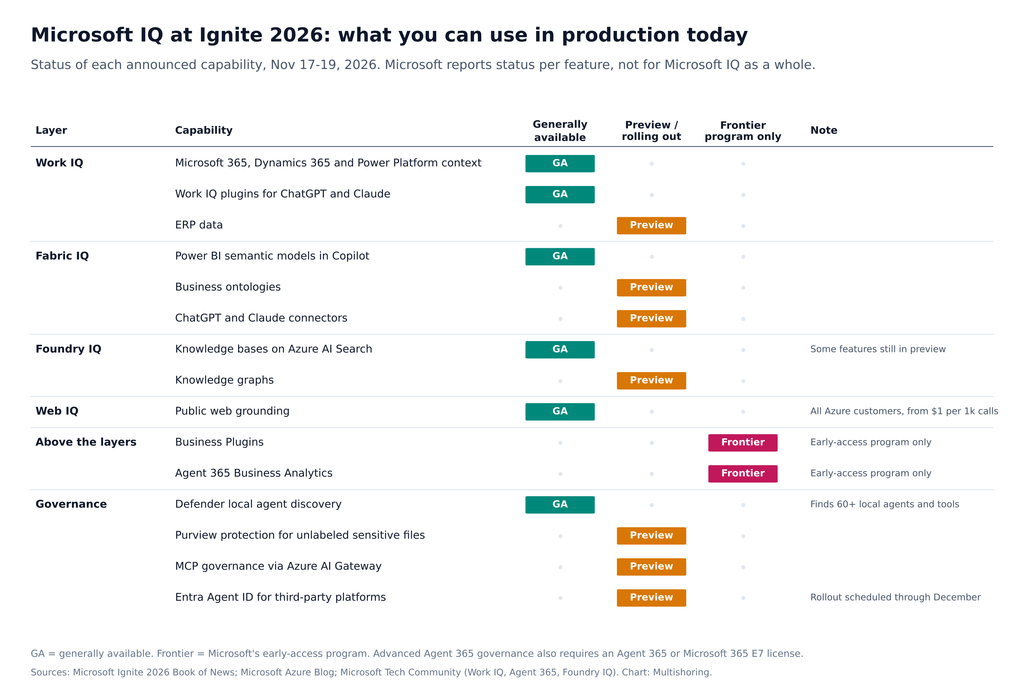
- Business Plugins and Agent 365 Business Analytics remain Frontier only.
- Fabric IQ ontologies, along with its ChatGPT and Claude connectors, are in preview.
- Foundry IQ knowledge graphs are in preview, and so is Purview protection that stops Copilot from using unlabeled sensitive files.
Microsoft has tried to solve knowledge management several times before. Directions on Microsoft names the earlier attempts, from SharePoint search, FAST, Yammer and Delve to Project Cortex and Viva Topics. Most ran into a problem software alone cannot fix: content that nobody owned or kept current.
Two questions from our preview also remain unanswered. We found nothing in the Book of News about closing the OneLake catalog gaps before Purview Data Governance support ends in November 2027, and MCP governance through Azure AI Gateway is still in preview.
Enterprise impact: data, integration, governance and cost
Data: the semantic layer becomes a production dependency
Microsoft’s most quotable result comes from its own Foundry team. Tested on SEC filings, Foundry IQ knowledge graphs answered 93.5% of multi-document questions correctly, compared with 26.1% for standard retrieval, and used 64.3% fewer tokens per query. Standard retrieval got none of the questions asking which clause does not apply.
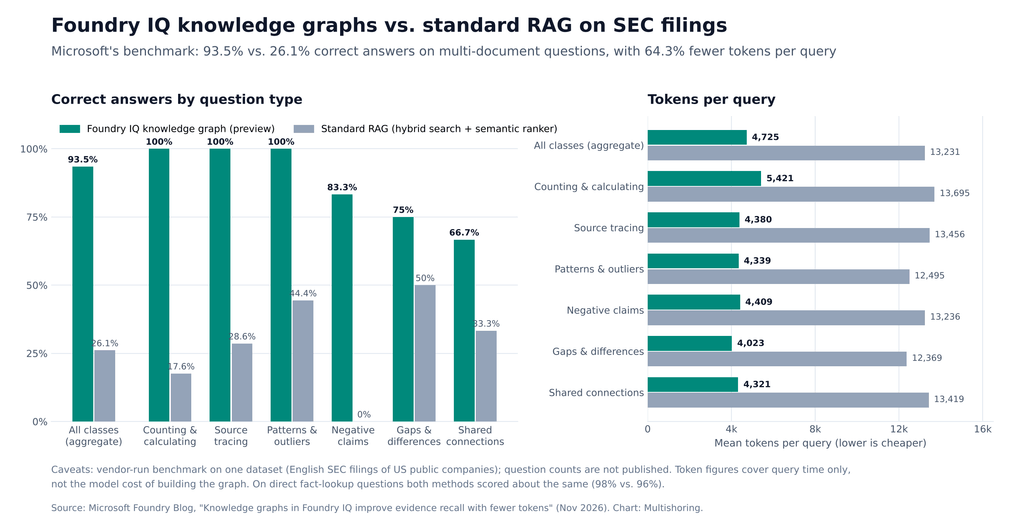
Read those numbers with care. Microsoft ran the test itself, on clean and consistently structured filings, and the token figure leaves out the model cost of building the graph in the first place. A SharePoint estate full of scanned PDFs and five drafts of every policy will score lower. Even so, the result supports a point we made about the semantic layer as AI infrastructure: agents get far more reliable when they work from defined entities and measures instead of loose text.
Integration: fewer custom connectors, more Microsoft gravity
More than 350 connectors, MCP access and partnerships with Salesforce and Oracle will cut a good share of point-to-point integration work. The cost is that more of your agent traffic runs through Microsoft’s context layer, which is a reasonable trade for many estates as long as someone decides it deliberately.
Integration teams should draw a line between reading and writing. Microsoft IQ is good at gathering context across Microsoft 365, Fabric and connected apps. A write into an ERP, finance or warehouse system still needs what an integration platform provides, including idempotent calls, retries that cannot post twice, error queues and an audit trail. Agree up front which actions agents may take through Microsoft IQ directly and which must go through an API or workflow your team already monitors.
Governance: the useful controls carry a license
Basic usage insights for Microsoft’s own agents come with qualifying Microsoft 365 subscriptions. To see non-Microsoft agents and use the advanced governance and security features, you need an Agent 365 or Microsoft 365 E7 license. One control is generally available now and costs nothing extra to switch on: local agent discovery in Microsoft Defender, which finds more than 60 local agents and tools, Claude Code among them, on managed Windows and Mac devices.
Cost: one product, several meters
Directions on Microsoft says plainly that Microsoft IQ is not cheap, particularly when several IQ layers run at once. Work IQ calls from custom agents consume Copilot Credits, Fabric IQ uses Fabric capacity, and Foundry IQ and Web IQ bill through Azure.
Two defaults are worth checking this month. Microsoft documents that the “Auto-apply new services” setting is on by default in spending policies, which means newly launched metered services are added to your budget automatically. The Copilot cost management API also reports usage only in credits, with no currency amounts, invoices or forecasts, so finance has to do the conversion itself.
Multi-step agents make this harder to track. One request might pull context from Work IQ, query a Fabric IQ model, run a Foundry IQ retrieval and write back through a connector, with each step billed on a different meter. Before approving a rollout, measure one real workflow from start to finish and give every agent a named budget owner.
Who should act now
| Team | Timing | What to do |
|---|---|---|
| Data and BI leaders | Next 30-60 days | Give your core Power BI semantic models named owners and certification before Copilot and other assistants query them |
| FinOps and licensing | Before year-end | Review Copilot spending policies, decide on “Auto-apply new services” and set per-user caps |
| Security and identity | Next 30-60 days | Set Work IQ action ceilings, turn on Defender local agent discovery and fix SharePoint oversharing before indexing |
| AI platform and architecture | Q1 2027, in a sandbox | Test Business Plugins, Fabric IQ ontologies and knowledge graphs on one bounded workflow |
| Owners of regulated or customer-facing apps | Wait for GA | Keep preview features such as unlabeled-file protection out of production |
None of the first three rows requires a new purchase. This is cleanup that Microsoft IQ moves up the list, and it overlaps with the steps in is your data AI-ready? and data governance for AI.
What to verify next
These five checks over the next six months will show whether Microsoft IQ is ready for core processes:
- Release dates. Watch for Business Plugins leaving Frontier, Fabric IQ ontologies reaching GA, and Entra Agent ID finishing its December rollout to third-party platforms.
- Accuracy on your own content. Repeat a knowledge-graph test on your documents and record what indexing costs.
- Cost per workflow. Track credits and Azure spend for one agent that chains Work IQ, Fabric IQ and Foundry IQ calls.
- Protection for unlabeled data. Confirm when Purview’s control for unlabeled sensitive files leaves preview.
- Resilience. Every agent built on Microsoft IQ depends on it at runtime, so ask how outages are handled and what the SLA covers.
For a wider vendor comparison, see our enterprise AI platform buyer’s guide.
Key takeaways
- Microsoft IQ has the widest enterprise reach of the Ignite 2026 announcements because it makes company context shared infrastructure for every agent.
- Business Plugins, ontologies and knowledge graphs, the parts that remove the most duplicated work, are still in Frontier or preview.
- Agents will rely on governed Power BI measures and clean SharePoint permissions, so that cleanup belongs on this quarter’s plan.
- Microsoft IQ has no new SKU, yet it draws on Copilot Credits, Fabric capacity and Azure meters. Review spending defaults now.
- Advanced agent governance requires Agent 365 or Microsoft 365 E7, which matters if third-party agents are part of your plans.
Is your data ready for Microsoft IQ?
In a 30-minute call we look at your Power BI models, SharePoint permissions and Copilot spending settings, and tell you what to fix before agents start using them.
One call, no commitment.

One call, no commitment.
FAQ
What were the biggest Microsoft Ignite 2026 announcements?
For data and AI leaders, the most important was Microsoft IQ, which makes company context available to any AI agent. Other notable announcements included Azure HorizonDB, Microsoft’s distributed PostgreSQL database, expanded Agent 365 governance and new models in Microsoft Foundry.
What is Microsoft IQ?
Microsoft IQ combines Work IQ, Fabric IQ, Foundry IQ and Web IQ to give AI agents governed access to an organization’s documents, business data, collaboration history and web results. Agents built in Microsoft Copilot, Microsoft Foundry, GitHub Copilot, ChatGPT or Claude can use it.
Does Microsoft IQ cost extra?
Microsoft IQ has no new SKU or subscription, according to Microsoft. Usage is billed through meters many companies already pay: Copilot Credits for Work IQ calls from custom agents, Fabric capacity for Fabric IQ, and Azure pricing for Foundry IQ and Web IQ.


