
Content

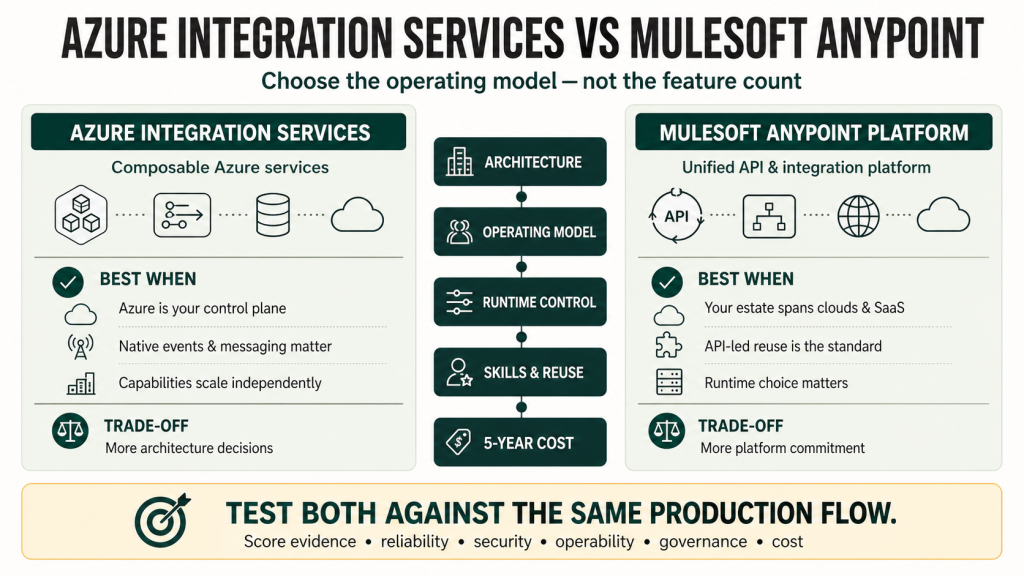
Choose Azure Integration Services when Azure is already your enterprise control plane and you want modular, event-driven integration with native Microsoft operations. Choose MuleSoft Anypoint Platform when a consistent API-led operating model across multiple clouds, SaaS platforms, and customer-managed runtimes matters more than deep alignment with one cloud.
Neither platform wins by feature count. The right choice depends on architecture, operating model, existing skills, deployment constraints, and the five-year cost of running the platform—not the price of the first integration.
Azure Integration Services is an all-encompassing collection of cloud-based tools and services offered by Microsoft as part of its Azure cloud platform. It allows organizations to smoothly link applications, data, and processes across on-premises and cloud settings. This potent integration platform provides a spectrum of functions crafted to optimize business operations, boost productivity, and propel digital evolution initiatives.
MuleSoft vs Azure Integration Services at a glance
Azure Integration Services (AIS) is a portfolio of Azure services assembled into an integration architecture. Its core building blocks are Azure Logic Apps, API Management, Service Bus, and Event Grid; Azure Functions and Data Factory often support the wider solution. Microsoft’s own enterprise integration reference architecture shows these services working together rather than as one monolithic runtime.
MuleSoft Anypoint Platform is a more unified integration and API management platform. It combines design, runtime management, API governance, reusable assets, monitoring, and deployment options under the Anypoint operating model. Mule applications can run in MuleSoft-managed CloudHub 2.0, on Runtime Fabric, or in other supported customer-managed configurations.
| Decision area | Azure Integration Services | MuleSoft Anypoint Platform |
|---|---|---|
| Architectural center | Composable Azure services | Unified integration and API platform |
| Best-fit estate | Microsoft- and Azure-centered | Heterogeneous, multi-cloud, and API-led |
| Workflow and orchestration | Logic Apps, with Functions for code-heavy steps | Mule flows and Mule runtime |
| API management | Azure API Management | Anypoint API Manager and gateways |
| Messaging and events | Native Service Bus and Event Grid services | Mule flows connected to messaging/event systems |
| Hybrid deployment | Azure services with private networking and hybrid connectivity | Managed cloud plus customer-managed runtime options |
| Reuse model | Azure templates, connectors, APIs, policies, and platform standards | Anypoint Exchange, APIs, connectors, templates, and policies |
| Commercial model | Separate consumption- or capacity-based Azure services | Subscription and capacity entitlements; quote-based configuration |
| Main tradeoff | More architecture and operations decisions across services | More platform standardization and licensing commitment |
Need help choosing and implementing the right integration platform?
We provide expert guidance for selecting and implementing integration platforms like Azure, tailored to your enterprise’s unique needs.
Explore tailored integration solutions for seamless connectivity.

Explore tailored integration solutions for seamless connectivity.
What is Azure Integration Services in 2026?
Azure Integration Services is a set of managed Azure capabilities for workflows, APIs, reliable messaging, and events. It is not one product with one runtime, one invoice line, or one scaling model.
The core services divide responsibilities clearly:
- Azure Logic Apps orchestrates workflows and connects applications through built-in and managed connectors.
- Azure API Management publishes, secures, governs, and observes APIs.
- Azure Service Bus provides queues and topics for reliable asynchronous messaging.
- Azure Event Grid routes events for reactive, event-driven architectures.
- Azure Functions adds code-first serverless processing where a workflow action is not enough.
- Azure Data Factory handles data movement and transformation workloads that belong in a data pipeline rather than an application workflow.
This separation is valuable when teams need to scale, secure, and operate capabilities independently. It also creates responsibility: the enterprise must define reference architectures, naming standards, network patterns, monitoring, deployment pipelines, and cost controls across several services.
For a deeper view of the orchestration layer, see our Azure Logic Apps overview. For event-driven designs, see how Event Grid and Logic Apps work together.
What is MuleSoft Anypoint Platform in 2026?
MuleSoft Anypoint Platform provides a common environment for designing integrations and APIs, running Mule applications, applying policies, publishing reusable assets, and managing operations. Its central promise is consistency across a mixed technology estate.
The platform includes Mule runtime, Anypoint Studio and other design capabilities, API management, Runtime Manager, monitoring, and Anypoint Exchange. CloudHub 2.0 provides MuleSoft-managed runtime infrastructure, while Runtime Fabric supports deployments where the customer needs more control over the runtime environment.
One 2026 terminology change deserves attention: MuleSoft documentation now calls Flex Gateway Omni Gateway. The product remains an Envoy-based API gateway designed to manage and secure APIs across environments, but procurement documents and architecture diagrams should use the current name. The official Omni Gateway overview documents the rename and deployment options.
MuleSoft’s API-led model organizes connectivity into reusable system, process, and experience APIs. That discipline can reduce duplication across large portfolios, but only when architecture governance prevents teams from creating layers that add no reuse or business value.
Which platform is stronger for enterprise integration architecture?
AIS is stronger when Azure-native services are already the enterprise default; MuleSoft is stronger when one integration operating model must span many infrastructure environments.
Choose Azure Integration Services for an Azure-centered estate
AIS fits organizations that already standardize identity, networking, monitoring, security, and delivery pipelines on Azure. The platform works with existing Azure controls instead of introducing a separate integration control plane.
It is especially compelling when:
- the portfolio includes BizTalk modernization or other Microsoft integration workloads;
- teams already operate Azure landing zones, Microsoft Entra ID, Azure Monitor, and Azure DevOps or GitHub pipelines;
- event-driven architecture is central, with Service Bus and Event Grid treated as first-class platform services;
- integration workloads must work closely with Dynamics 365, Power Platform, Azure data services, and Microsoft-hosted applications;
- the organization wants to buy and scale workflow, API, messaging, and event capabilities independently.
That modularity also creates a governance burden. Without an integration platform team, separate Azure subscriptions can accumulate inconsistent workflows, policies, identities, and monitoring. Start with an enterprise system integration strategy before selecting individual services.
Choose MuleSoft for a heterogeneous, API-led estate
MuleSoft fits organizations that need a shared integration discipline across several clouds, packaged applications, business units, and customer-managed environments. Its value comes from standardization and reuse, not from being native to any single infrastructure provider.
It is especially compelling when:
- API product management is the primary integration operating model;
- integrations span Salesforce and a broad mix of non-Microsoft platforms;
- the enterprise requires consistent runtime and gateway management across cloud and customer-controlled environments;
- Anypoint Exchange will function as an actively governed catalog, not a passive asset repository;
- the organization already has MuleSoft skills, delivery standards, and reusable assets that would be expensive to replace.
MuleSoft is not automatically the better multi-cloud option. The decision only holds when deployment portability, common governance, and asset reuse produce measurable operating value.
Our Services

Microsoft Azure Services
Our team is here to be your reliable partner, ensuring a hassle-free transition to Azure excellence.
Azure Logic Apps Integration
Our experts can speed up Azure Logic Apps integration projects and ensure seamless data connectivity across systems.

Azure Service Bus Integration
Find out how our expertise can help you leverage this potent tool for efficient integration in your integration projects.
API management and governance: APIM vs Anypoint
Both platforms can secure, publish, throttle, transform, and observe APIs. The difference is where API management sits in the wider architecture.
Azure API Management is an independent Azure service. It can front Logic Apps, Functions, Kubernetes workloads, SaaS endpoints, and services hosted outside Azure. This lets architects adopt APIM without moving every integration onto one runtime.
MuleSoft embeds API management more tightly into the Anypoint lifecycle. Design, discovery, implementation, policies, deployment, and monitoring sit within a common platform model. That consistency helps federated teams, provided governance rules and ownership are explicit.
Do not compare gateways in isolation. Evaluate the full lifecycle: API discovery, design review, policy automation, deployment promotion, consumer onboarding, analytics, incident ownership, and retirement. Our 10-step system integration process shows why platform selection must follow operating-model design.
Hybrid integration and runtime control
MuleSoft offers the clearer runtime portability story; AIS offers strong hybrid connectivity while keeping its core managed services in Azure.
AIS connects private and on-premises systems through established Azure networking and connector patterns. Logic Apps Standard supports dedicated hosting and virtual network integration, while APIM provides deployment choices for controlled API access. The core managed services still remain Azure services, so data residency, latency, failover, and network egress must be designed accordingly.
MuleSoft can place Mule runtimes closer to systems that cannot move, while retaining centralized management through Anypoint. CloudHub 2.0 is the managed option; Runtime Fabric addresses environments that require greater infrastructure control. That flexibility adds operational work because the customer remains responsible for parts of the underlying environment in customer-managed deployments.
The decisive question is not “Does it support hybrid?” Both do. Ask which team owns the runtime, network, patching, scaling, observability, and incident response for every deployment pattern.
Event-driven integration and asynchronous messaging
AIS has a structural advantage when Azure messaging and event routing are central to the target architecture. Service Bus and Event Grid are distinct managed services with different delivery semantics, and Logic Apps or Functions can react to them without forcing all event handling through one integration runtime.
MuleSoft supports event-driven patterns by connecting Mule flows to queues, topics, event brokers, and streaming platforms. The result can be effective, but the external broker remains a separate architecture decision. Teams should test ordering, replay, dead-letter handling, idempotency, throughput, and back-pressure instead of treating “event-driven” as a checkbox.
B2B and EDI integration
Both platforms support B2B scenarios, but the implementation model differs. Azure delivers enterprise integration and B2B capabilities through Logic Apps resources and connectors. MuleSoft combines B2B transaction management with the wider Anypoint model.
Do not award this category based on protocol names alone. Run a proof of concept using real trading-partner onboarding, X12 or EDIFACT validation, AS2 certificates, acknowledgments, exception handling, replay, and partner-specific maps. Existing agreements and operational procedures often matter more than feature parity.
Developer productivity, reuse, and operations
AIS favors teams that combine low-code workflows with Azure engineering practices. MuleSoft favors teams that want one integration development model and one reusable asset catalog.
For AIS, test source control, infrastructure as code, environment promotion, connection references, secrets, policy reuse, and telemetry correlation across services. Visual workflow design does not remove the need for engineering discipline. Our guide to CI/CD for Azure integration projects covers the operating practices that turn workflows into maintainable production assets.
For MuleSoft, test API specification governance, Anypoint Exchange reuse, dependency management, automated tests, runtime promotion, and gateway policy automation. A centralized platform accelerates delivery only when reusable assets are maintained like products.
How should you compare cost?
Compare five-year workload economics, not list prices. AIS separates charges across workflows, API capacity, messages, events, compute, networking, logs, support, and adjacent services. MuleSoft commercial terms are typically packaged around subscription and capacity entitlements, with the final configuration established during procurement.
Build the same cost model for both platforms:
- Define transaction volumes, payload sizes, workflow actions, APIs, environments, regions, and availability targets.
- Add non-production, disaster recovery, private networking, logging retention, and premium support.
- Price platform engineering, upgrades, deployment automation, monitoring, and on-call coverage.
- Include migration, parallel run, regression testing, training, and the value of existing reusable assets.
- Model growth and peak demand rather than using average monthly traffic alone.
AIS often looks inexpensive when only workflow executions are counted. MuleSoft often looks expensive when its platform subscription is compared with one Azure service. Both comparisons are incomplete.
A practical proof-of-concept scorecard
A useful proof of concept tests production constraints with one representative business flow. A polished demo with sample data proves very little.
| Test | Evidence to collect | Weight |
|---|---|---|
| Delivery speed | Time from approved design to repeatable deployment | 15% |
| Runtime reliability | Failure handling, retry, idempotency, and recovery results | 20% |
| Security | Identity, secrets, network isolation, audit trail, and policy enforcement | 15% |
| Operability | End-to-end trace, alert quality, replay, and support handoff | 20% |
| Governance and reuse | Policy automation, catalog quality, and reuse across a second flow | 10% |
| Performance | Throughput and latency under representative peaks | 10% |
| Cost predictability | Modeled steady state, peak, and growth scenarios | 10% |
Use the same acceptance criteria, payloads, failure injections, and team composition for both platforms. Score evidence, not vendor presentations.
Can an enterprise use both AIS and MuleSoft?
A mixed estate is rational when platform boundaries are explicit. For example, MuleSoft can govern enterprise APIs across business domains while AIS handles Azure-native workflows, events, and messaging inside the Microsoft estate.
The model fails when both platforms implement the same patterns without ownership rules. Define which platform owns API gateways, orchestration, B2B, event routing, canonical models, observability, and reusable assets. Duplicate capability creates duplicate cost and slower incident resolution.
Final recommendation
Select AIS when Microsoft alignment, native Azure messaging, and composable consumption are strategic advantages. Select MuleSoft when API-led standardization, runtime choice, and cross-estate governance justify a unified platform commitment.
Before procurement, inventory the integration estate, define the target operating model, and run a scored proof of concept against a real production scenario. Multishoring’s data integration consulting services help enterprise teams build that architecture, validate the platform decision, and execute migration without turning platform change into business disruption.
Frequently asked questions
Is Azure Integration Services cheaper than MuleSoft?
There is no universal cost winner. AIS uses separate service-level consumption and capacity charges, while MuleSoft is commonly purchased through subscription and capacity entitlements. A valid comparison includes production and non-production environments, networking, observability, support, platform operations, and migration—not just runtime transactions.
Is MuleSoft better than Azure Integration Services for multi-cloud integration?
MuleSoft has a stronger case when one runtime and API governance model must span several clouds and customer-managed environments. AIS can integrate across clouds, but its core services and operational model remain Azure-centered. The better choice depends on where workloads run and which team owns the platform.
Can Azure Integration Services replace MuleSoft?
Yes, when AIS covers the required workflows, APIs, messaging, events, B2B patterns, and operational controls. Replacement still requires asset discovery, architecture redesign, regression testing, parallel operation, and retraining. It is a migration program, not a license swap.
What should an enterprise test before choosing an integration platform?
Test one representative end-to-end flow under realistic security, volume, failure, and support conditions. Measure deployment repeatability, recovery, traceability, governance, reuse, performance, and total operating cost using identical acceptance criteria.
Sources
- Microsoft: Basic enterprise integration on Azure
- Microsoft: Azure Logic Apps overview
- Microsoft: Built-in connectors in Azure Logic Apps
- MuleSoft: Anypoint Platform documentation
- MuleSoft: CloudHub 2.0 overview
- MuleSoft: Omni Gateway overview


