
Content

Claims process automation works best when it removes repetitive handling from predictable claims and sends uncertainty to the right person. Documents can be read, defined rules applied and work routed automatically. Missing evidence, conflicting information or a high-impact decision may still require human judgement.
The goal is not a process without people. It is a process in which people spend less time moving information and more time resolving claims that need their attention. Start by identifying predictable work, defining where automation must stop and agreeing how success will be measured.
A claim is not one process to automate
The claims journey is a chain of different jobs. It may include receiving a notification, collecting evidence, checking completeness, applying business rules, assigning an owner, approving a payment and updating the claims system. Each job has a different tolerance for error.
Reading a policy number from a standard form is not the same as assessing unusual damage. Routing a complete claim is not the same as resolving a disputed case. A broad instruction to “automate claims” hides these differences.
For each stage, the process map should show:
- what information enters the step and where it comes from;
- whether the decision follows a stable rule or requires judgement;
- what a valid output looks like;
- which conditions should stop automation;
- which system records the result;
- who owns the exception when the step cannot complete.
Automation should be designed task by task, with a visible handoff between routine processing and human review. That is a safer basis for scope than choosing a percentage of claims to automate.
Where insurance claims automation can work safely
Start with repetitive tasks that have consistent inputs, a clear result and an exception that is easy to recognise. Registering documents, checking required information, matching material to a case and routing a complete submission may fit this profile. High-value or complex claims are rarely the best first test because the consequences of a wrong decision are greater.
Intake and document handling
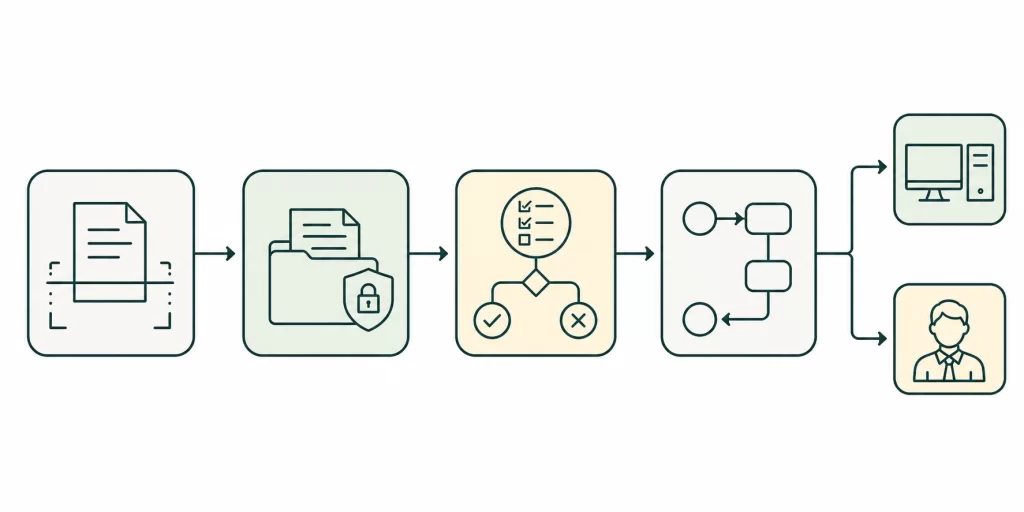
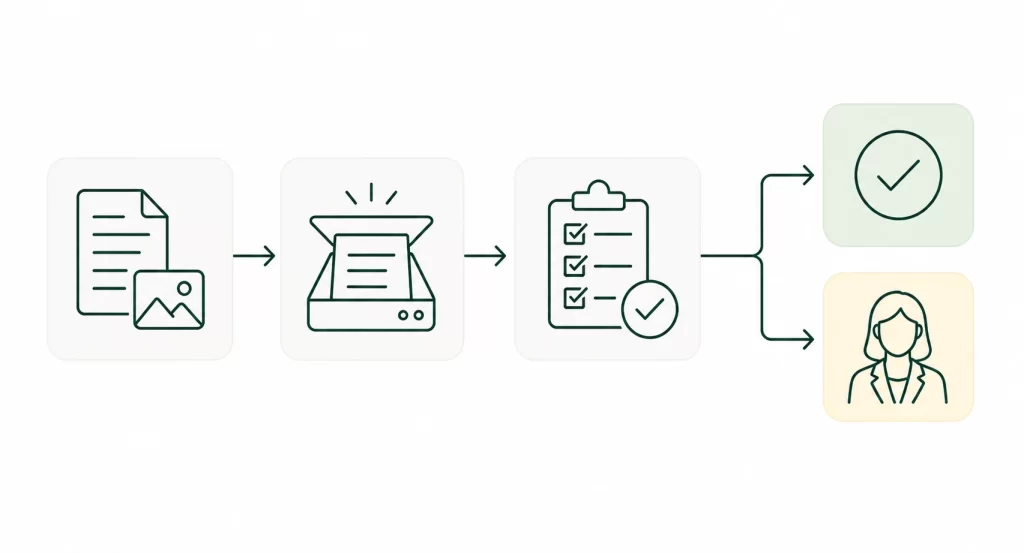
Claims often begin with information arriving through several channels and formats. Document automation can import files, classify them, extract selected fields and associate them with a case. It can also flag missing information or an uncertain result.
That last step is essential. A low-confidence extraction should not quietly become a fact in the claims system. It should trigger validation or a request for better information. Document capture is useful when uncertainty has a defined route, not when the software is expected to guess its way through poor input.
Rules-based checks and routing
Stable business rules can support completeness checks, thresholds, eligibility conditions and routing decisions. Keeping such rules separate from the surrounding process also makes them easier to test, govern and update than logic scattered across forms, scripts and individual applications.
Rules still need owners and boundaries. Teams should be able to explain which rule was applied, which information it used and when its current version took effect. A rules engine executes a defined decision consistently; it does not decide which business policy is appropriate.
Case coordination and exception handling
Workflow automation can assign work, manage due dates, request approvals and keep a claim moving between teams. It also makes stalled cases easier to spot than work left in personal inboxes.
A good workflow makes exceptions visible and owned. When a case leaves the automated route, the handler should receive the documents, completed checks, reason for referral and next action.
Where should claims automation start?
A focused assessment maps the tasks, exceptions, measures and system dependencies before the first pilot begins.
Build the business case around one measurable claim segment.

Build the business case around one measurable claim segment.
Straight-through processing needs a clear exit ramp
Straight-through processing means that a qualifying claim moves through defined stages without manual handoffs. It is appropriate only when the organisation can recognise a suitable case, validate the information and stop the automated path when a condition is not met.
Potential candidates have complete, standardised inputs, low ambiguity, stable rules and an outcome that can be checked. They must also sit within the insurer’s risk tolerance. Two claims in the same product line may therefore take different routes.
Human review may be needed when:
- information is missing, inconsistent or difficult to verify;
- document extraction returns low confidence;
- circumstances fall outside the expected scenario;
- potential fraud or another risk indicator requires investigation;
- the value or impact of the decision exceeds an agreed threshold;
- the case requires interpretation, negotiation or sensitive communication.
The thresholds depend on the insurer’s products, controls, portfolio and regulatory context. The straight-through path is only as credible as the rule that removes an unsuitable claim from it.
What to measure before choosing claims automation software
Claims automation software should be evaluated against an operational baseline, not a feature list or a general target such as “more automation.” For one claim segment, record how long work takes, how often people touch the case, where rework occurs and what happens when information is incomplete.
Cycle time does not tell the whole story
A shorter time from notification to closure can hide problems. A fast process may generate more corrections, reopen cases or move unresolved work to another team. The average can also conceal an exception backlog while simple cases finish quickly.
Measure stages separately where possible. Time waiting for information, time in a queue and active handling time point to different causes.
Measure cost, leakage and exceptions together
A balanced scorecard for a pilot may include:
- cycle time for the selected segment and its main stages;
- handling effort or cost per claim;
- number of manual touches and handoffs;
- rework, corrections and reopened cases;
- percentage and reason for exceptions;
- document classification and extraction accuracy;
- leakage associated with inconsistent or incorrect handling;
- customer contacts caused by missing information or unclear status.
The Business Intelligence for Insurance guide provides more context on governed insurance data and dashboards. In an automation programme, each measure should inform a decision. A rising exception rate may call for better input, a narrower route or a rule change.
Success should be measured against the starting position of a defined claim segment. An enterprise-wide automation percentage says little about accuracy, customer experience or the work shifted to handlers.
How IBM BAW, ODM, FileNet and Datacap divide the work
IBM’s automation products address different parts of the claims process. They should not be presented as interchangeable tools or as a mandatory bundle for every insurer.
| Operational need | IBM product to consider | Role in plain language |
|---|---|---|
| Capture and interpret incoming documents | IBM Datacap | Imports documents, classifies them and extracts selected information for downstream use |
| Manage claim content | IBM FileNet Content Manager | Stores, governs and provides controlled access to documents and case content |
| Apply repeatable business decisions | IBM Operational Decision Manager | Executes and governs rules-based decisions that can be tested and changed |
| Coordinate work and exceptions | IBM Business Automation Workflow | Routes tasks, manages case work and gives teams visibility into process progress |
IBM Datacap turns incoming documents into usable information, while IBM FileNet Content Manager provides a governed home for the content supporting the case.
IBM Operational Decision Manager applies and governs rules-based decisions. IBM Business Automation Workflow moves the case along the resulting route and assigns work when an exception occurs.
Start with the process job and its control requirements, then decide which capability is necessary. An insurer may already have systems that perform part of this work well. The assessment should account for those investments rather than assume that every layer must be replaced.
Claims process automation still has to fit the core system
The policy administration or claims management system usually remains central. The organisation still needs to decide which system owns the claim record and how updates move between systems.
Three questions expose most of the integration work early:
- Which system is the source of truth for each important data item and status?
- At what point can the automation read or update that information?
- What happens when a system is unavailable or returns an unexpected result?
These questions expose work around identities, duplicate records, status mappings and recovery that a demonstration using ideal data may miss. An integration audit can identify those dependencies before the pilot scope is fixed.
Documents, extracted fields, workflow status and the core record need clear ownership. Data integration consulting can support the mapping of those responsibilities and interfaces.
A claims automation layer should extend the core system, not leave staff reconciling two competing records of the same case.
Our Data & IBM Services You Might Find Interesting

Data Migration
Plan controlled data moves that align application migration waves with continuity and recovery requirements.

Modern Data Architecture Services
Design a target platform architecture that supports claims workloads, dependencies, and future modernization.

Data Integration Consulting Services
Assess integration platforms, interface dependencies, and target patterns before committing to consolidation.
How to start claims automation without starting too big
A useful first step is an assessment followed by a pilot for one claim segment. Include enough variation to test the controls, but keep the scope small enough to understand failures.
- Select a segment with measurable volume, reasonably stable inputs and a clear operational owner.
- Map its documents, decisions, handoffs, systems and exception reasons.
- Record the baseline for time, effort, rework, leakage and customer contacts.
- Mark which tasks may run automatically and which conditions require review.
- Test data exchange and recovery with the claims or policy system.
- Compare the result with the baseline before expanding the route.
The first pilot should test the exception path
Test more than a complete, readable submission. Include a blurred document, conflicting values, a missing system response and a case outside the normal criteria. Check whether the route stops and whether the handler receives enough context to continue. A pilot has proved something useful when both the routine path and the handoff under uncertainty work.
What a claims automation assessment should deliver
A claims automation assessment should produce a process map, shortlisted tasks, exception rules, baseline measures, integration dependencies and a pilot scope. It should also identify which systems remain in place and where an IBM capability has a defined role. The result is a business case for a controlled first move, not a promise to automate the whole claims operation.
For organisations weighing claims automation consulting, Multishoring can help define the process, integration scope and first pilot before a wider implementation commitment. The most useful starting point is the claim segment where repetitive work, measurable friction and a manageable exception path meet.


