Content
The strongest takeaway from SHARE Pittsburgh 2026 is simple: you can modernize the mainframe without moving off it.
For most enterprises, “get off the mainframe” is a multi-year program that trades stable operations for migration risk. SHARE Pittsburgh made the case for a different path. Keep your systems of record on IBM Z, and modernize how you use, connect, and govern them instead of rewriting them.
The week’s sessions and product news kept pointing at the same pattern: extend the platform with APIs, live data access, AI, and modern security rather than replacing it. That reframes mainframe modernization from a binary migration decision into a set of smaller, lower-risk moves for CIOs, CTOs, and heads of core systems.
Why Mainframe Modernization Moved Up the Agenda
The mainframe is not the problem. The pressure to change how you run it is.
SHARE Pittsburgh 2026 (August 16-20, The Westin Pittsburgh) brought mainframe and enterprise IT leaders together for more than 250 technical sessions on IBM Z and z/OS. The program was organized around six modernization outcomes: data management, cloud integration, high availability, troubleshooting, storage, and capacity planning, not around migration.
That structure tells you where the market is heading. Boards want AI and real-time data, regulators want stronger security and auditability, and finance wants cost transparency. All of it runs into the systems of record that still sit on Z.
Two signals stood out for decision-makers:
- A “New to Z” track focused on building modern skills, including automation, AI, and security, around the existing platform.
- SHARE Blueprint, a two-day satellite event, focused on post-quantum cryptography and long-term resilience.
Together they show modernization is now driven by talent and risk, not only technology, which is why it belongs on this year’s agenda.
The Enterprise Problem Behind the Announcements
Most modernization pain is not about COBOL. It is about visibility and access.
The mainframe usually sits outside the tools the rest of IT uses to govern software, track licenses, and feed analytics. That creates real risk: incomplete CMDB data, manual license tracking, audit gaps, and data your BI and AI teams cannot reach without a migration.
Two announcements at Pittsburgh went straight at this:
- Ironstream z/OS Software Discovery for ServiceNow discovers installed mainframe software automatically and syncs it into ServiceNow’s CMDB and SAM. Z assets enter the same governance and license workflows as the rest of the estate.
- CONNX exposes legacy and non-relational data such as VSAM, Db2, IMS, Adabas, and IDMS as SQL that streams into Snowflake, Power BI, Kafka, and Azure. In one demo, an AI agent answered a question from mainframe transaction history in about 60 seconds, with no data moved.
The pattern matters more than either product. You reach enterprise-grade governance, analytics, and AI through practical mainframe modernization services that make Z visible and its data reachable, not by lifting workloads off the platform.
Architecture and Operating-Model Implications
Treat the mainframe as a first-class node in your architecture, not a walled-off island.
The consistent design idea at Pittsburgh was integration over relocation: expose Z data and services to modern platforms, and bring modern tooling onto Z, so both sides run inside one operating model.
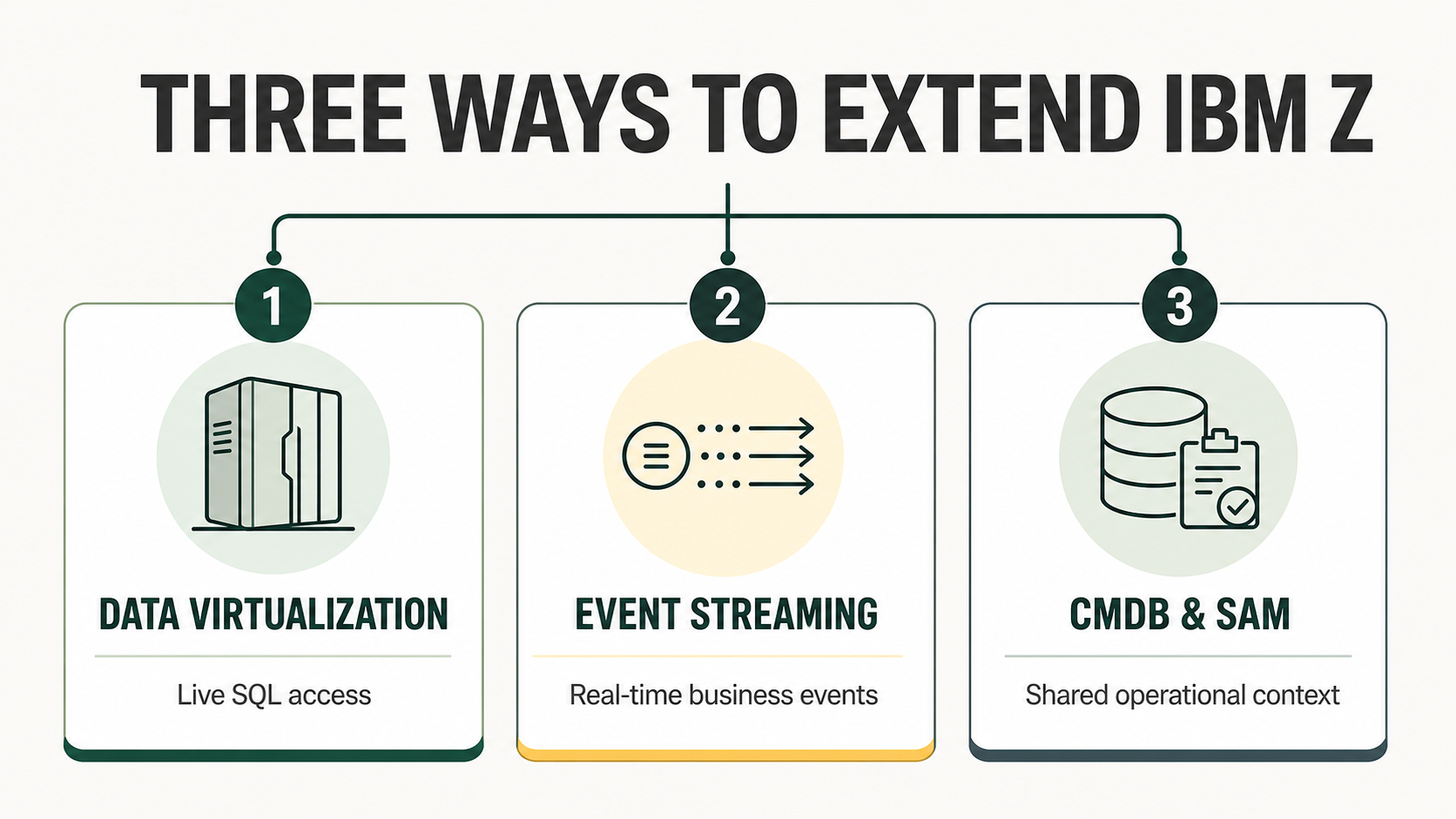
Three integration patterns did most of the work:
| Pattern | What it does | Example from SHARE |
|---|---|---|
| Data virtualization / live SQL | Query mainframe records live for BI and AI, without moving or rewriting them | CONNX serving live SQL over VSAM, Db2, and IMS |
| Event and streaming integration | Stream trusted Z data into cloud warehouses and event platforms in real time | CONNX feeding Snowflake and Kafka |
| Enterprise CMDB and SAM | Pull mainframe software into the same governance workflows as the rest of IT | Ironstream auto-populating ServiceNow |
The operating model changes too. Sessions on browser-based access such as Virtel Web Access showed how to retire green-screen emulators without touching the CICS or IMS logic underneath. IBM’s z/COBOL work brought modern 64-bit COBOL to existing applications, so teams gain performance without a rewrite. The real payoff is organizational: your Z, cloud, data, and security teams finally work from the same data.
Governance, Integration, and Cost Trade-Offs
Before you approve a migration to cut cost, prove you actually know what the mainframe costs today.
A session titled “Leaving the Mainframe: Strategy, Hype, or Cost Illusion?” made the uncomfortable case: many migration business plans rest on weak cost visibility. Without workload-level data, the savings are assumed, not measured.
The cheaper moves usually come first:
- Offload before you migrate. JOPAZ was shown moving more than 80% of CPU-heavy COBOL batch onto zIIP specialty engines, freeing general-purpose capacity for AI and new workloads with no COBOL changes.
- Manage storage by policy. Using DCOLLECT, HSM, RMM, and SMF data to tier storage and allocate cost transparently lets you optimize spend without touching applications.
Security modernizes the same way, layered on rather than ripped out. VitalSigns SIEM Agent streams z/OS security events into Splunk, QRadar, and ArcSight in real time, keeping the mainframe inside your SOC and aligned with FISMA, HIPAA, PCI, and SOX. SHARE Blueprint added two days on post-quantum cryptography, so resilience gets planned now, not retrofitted later.
The honest trade-off is that this path needs cost transparency, integration governance, and real skills. It is less dramatic than a full migration, and usually far less risky.
A Decision Framework for Enterprise Leaders
Modernization gets easier when you stop asking “migrate or not” and start asking “what do we extend first.”
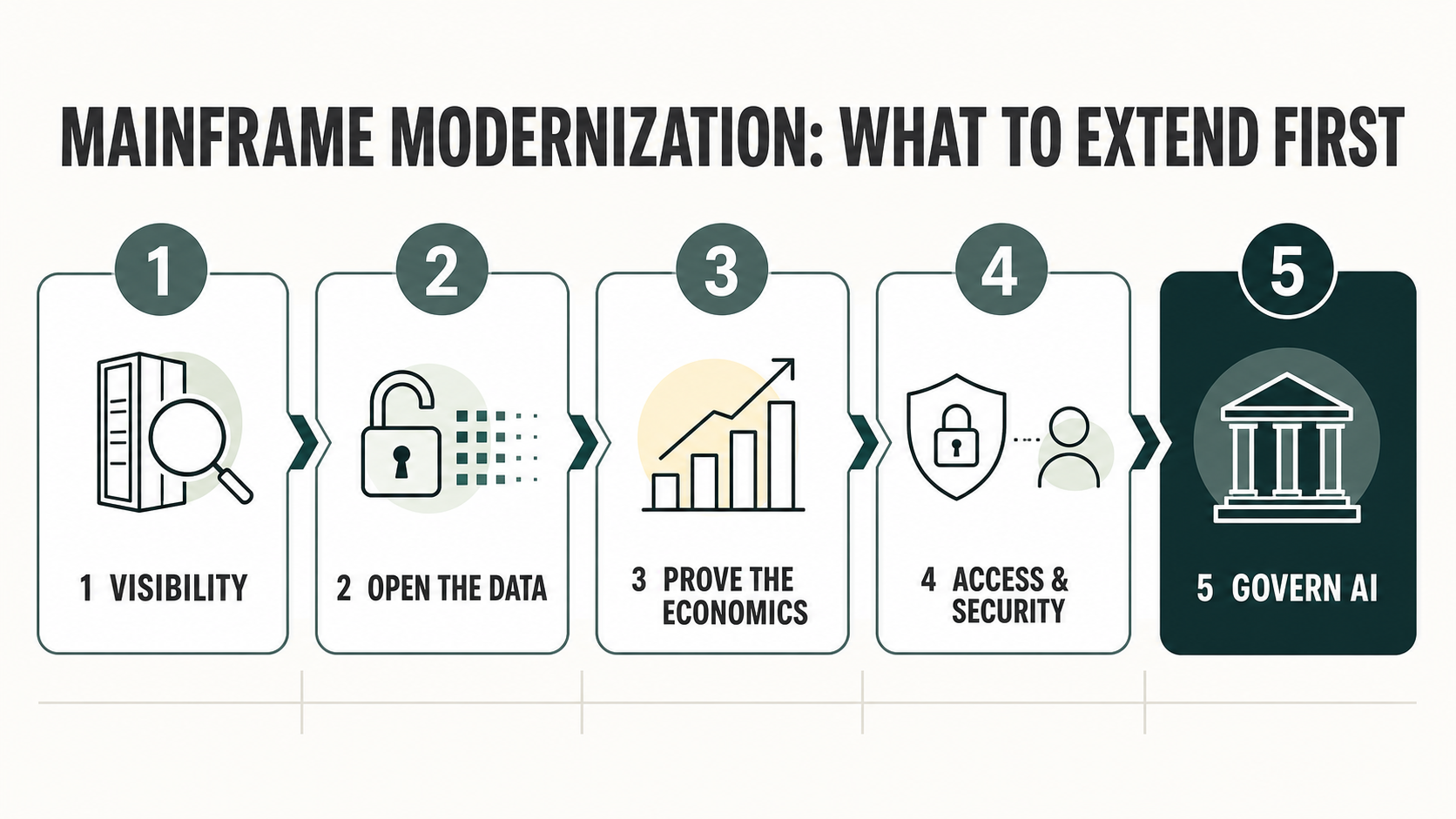
Use a simple sequence to prioritize the work:
- Start with visibility. Get mainframe software and assets into your CMDB and SAM first. You cannot govern or cost what you cannot see.
- Open the data, not the platform. Expose Z data through live SQL or streaming so BI and AI teams can use it without a migration. This is often where enterprise AI stalls because the data is not production-ready.
- Prove the economics. Measure workload-level cost, then offload CPU and tier storage before building a migration case.
- Modernize access and security in place. Retire green-screen access and route z/OS security events into your SOC.
- Govern before you scale AI. Put data governance in place before you scale GenAI on mainframe data.
Migration still makes sense for specific workloads. Treat it as one option at the end of this sequence, not the default at the start.
Key Takeaways
SHARE Pittsburgh 2026 showed how to modernize around and on IBM Z while systems of record stay put.
- Modernization is incremental. Extend Z with APIs, live data, AI, and modern security instead of rewriting it.
- Visibility and access come first. Ironstream and CONNX made mainframe software and data usable by the rest of the enterprise, with no migration.
- Prove cost before you migrate. Offload CPU, tier storage, and measure workload-level cost. Many migration cases fail on cost visibility alone.
- Security and skills are the foundation. SOC integration, post-quantum planning, and the “New to Z” track keep the platform viable long term.
Your next step is a discovery step, not a platform decision: map what to extend first, and what genuinely belongs elsewhere.
Not sure what to modernize first on your mainframe?
We map your IBM Z estate, find the low-risk wins (data access, CPU offload, integration), and show you what, if anything, truly belongs off-platform.
Extend the mainframe. Skip the rip-and-replace.

Extend the mainframe. Skip the rip-and-replace.
Frequently asked questions
What is mainframe modernization without rip-and-replace?
It means modernizing how you use, connect, and secure the mainframe through APIs, data virtualization, AI access, and SOC integration while core systems of record stay on IBM Z.
Is it cheaper to modernize the mainframe or migrate off it?
It depends on workload-level cost data, which many organizations lack. Options such as zIIP offload and policy-based storage tiering often cut cost with far less risk than migrating.
How does the mainframe fit into an enterprise AI strategy?
Tools such as CONNX expose mainframe data as SQL or live streams, so AI and BI can use it without copying it. That turns Z into a governed data source for AI rather than a blocker.
Sources
- SHARE Pittsburgh 2026: official event
- SHARE Blueprint: post-quantum satellite event
- Precisely: Ironstream mainframe software inventory for ServiceNow CMDB
- SDS: CONNX application and data access modernization
- SMT Data: SHARE Pittsburgh presentations
- IBM Community: New to Z at SHARE Pittsburgh
Our Data & IBM Services You Might Find Interesting

Legacy Modernization Services
Decide what stays on IBM Z and IBM i, what changes, and in what order — with a reversible first step.

Modern Data Architecture Services
Open up core systems to new applications and reporting safely, without rebuilding what already works.

Data Integration Consulting Services
Find out what your connections actually do, who owns them, and what breaks before you change anything.
SHARE Pittsburgh 2026 showed a lower-risk path to mainframe modernization: keep systems of record on IBM Z, then extend them with governed APIs, live data access, modern security, AI, and transparent cost controls.