
Content
The clearest takeaway from IBM’s Data Platform Summit in Austin was not a new product. It was a reminder: an enterprise AI platform is only as good as the data you feed it.
On August 20, Multishoring joined IBM Business Partners at the IBM Business Partner Data Platform Product and Partner Summit in Austin, an IBM TechXchange Workshop held at the IBM Innovation Studio. It was a closed, full-day session, and the agenda ran the length of the data portfolio: Db2, Cognos, Content Cortex, MDM, and more.
We went to hear the roadmap directly and check it against what we run into on client projects. So this is not a full recap. It is the one theme that showed up in every session, and why it matters if you make the technology calls.
Inside IBM’s Austin Data Platform Summit
The first thing worth saying: this was a working session, not a sales pitch.
IBM put its product, sales, and ecosystem people in a room with partners for the full day in Austin, and it ran both ways. IBM walked through product strategy and where the roadmap is headed. Partners like us said what we hit in the field.
The agenda covered most of the data platform:
- Db2 for the data itself
- Cognos and Planning Analytics for reporting and planning
- Content Cortex (FileNet) for content and unstructured data
- MDM and Decision Intelligence for master data and decisions
- Plus Netezza, Replication, Optim, and Workflow Automation
We sat in on the product sessions and the closing demos. That is useful for our clients for a plain reason: when you are in the room, you hear where a product is going before it turns up in a release note, and you can point out the gaps that only surface once you are delivering the work.
One thing stuck with us. IBM treated the ecosystem as part of building the roadmap, not just a channel to sell it through.
The One Lesson: Trusted Data Comes Before AI
Four very different products, and the same requirement sitting behind all of them: the data has to be clean and connected before any of it pays off.
The pattern held across the board:
- Db2 talk was about making data reachable and reliable, not only faster.
- Cognos and Planning Analytics are only as good as the numbers going into them.
- Content Cortex turns documents into data you can use, but governance decides whether AI can trust that data.
- MDM and Decision Intelligence exist because most companies still do not have one clean version of the truth.
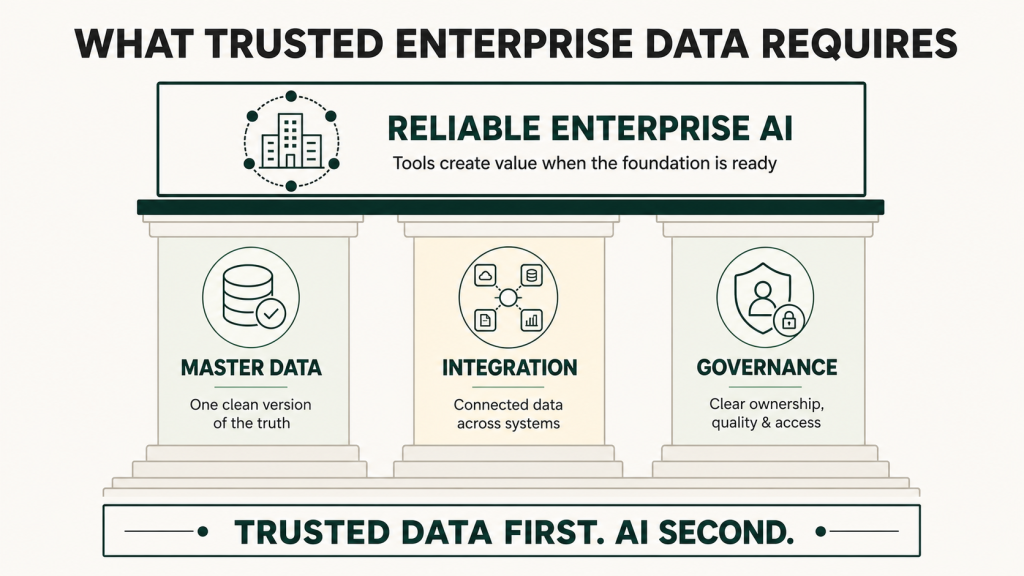
Add it up and the roadmap leans toward foundations more than features. An ai governance framework, clean master data, and integration that actually works are what turn a set of products into an enterprise ai platform you can rely on.
That matches what we see on projects. As Anna Pojawis, PMO Manager at Multishoring put it: “The roadmap confirmed what we see on every project. The tool matters less than whether the data feeding it is connected, governed, and trusted.”
None of this means AI is overhyped. It means the value shows up after the data is in order, and that sequence almost never flips.
What It Means for Enterprise Leaders
If you are a CIO, CTO, or head of core systems, do one thing before you buy more AI: audit the data underneath it.
We use a rough order with clients, and the summit backed it up. Work it in sequence:
- Start with master data. If two teams report different numbers, fix that before you put AI on top.
- Find the integration gaps. Data stuck in silos never reaches the platform that needs it, whatever your hybrid cloud strategy looks like on paper.
- Agree on governance early. Decide who owns the data, what “good” looks like, and who gets access before you scale, not after.
- Then look at the tools. Db2, Cognos, and the rest give you a lot more when the data is already clean.
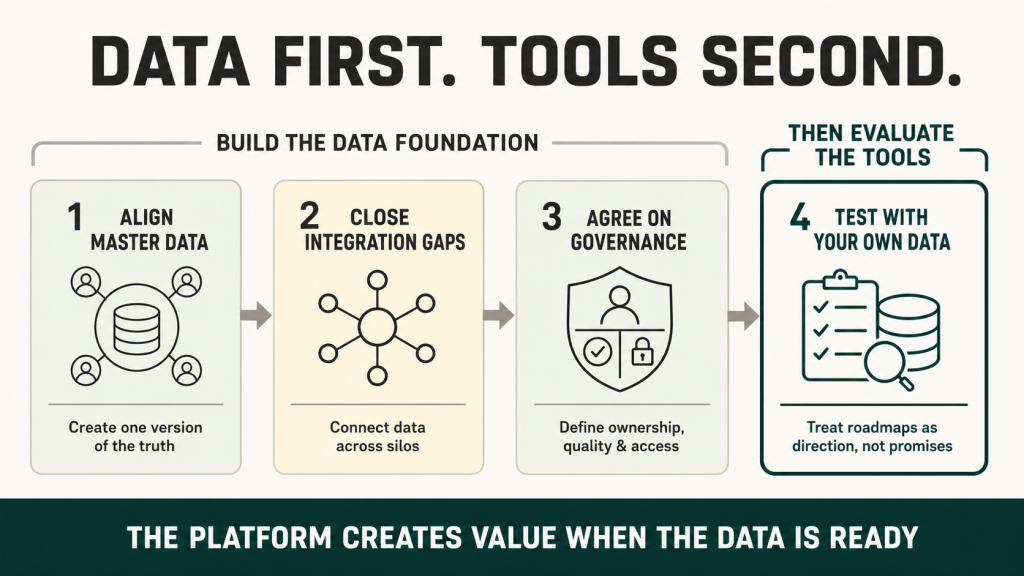
A word on what to check next. Read vendor roadmaps as direction, not promises. Confirm timelines with IBM directly, and try any new capability on your own data before you commit.
The companies that get value from an enterprise ai platform are usually not the ones with the newest tools. They are the ones whose data was ready when the tools showed up.
Key Takeaways
- The Austin summit was a closed partner session, built around roadmap and feedback rather than launches.
- The same theme ran through every session: data has to be clean and connected before AI is worth anything.
- An enterprise AI platform is only as strong as what sits under it, which is master data, integration, and governance.
- For leaders, the order is data first, tools second. Db2, Cognos, Content Cortex, and MDM all reward that.
- Multishoring was there as an IBM Business Partner, testing the roadmap against real delivery.
Is your data foundation ready for enterprise AI?
We fix the data, integration, and governance underneath your reporting – so analytics and AI run on numbers people actually trust.
Trusted data first. AI second.

Trusted data first. AI second.
IBM’s Austin Data Platform Summit 2026 – FAQ
What was the IBM Business Partner Data Platform Summit in Austin?
It was the IBM Business Partner Data Platform Product and Partner Summit in Austin, an IBM TechXchange Workshop held on August 20 at the IBM Innovation Studio. IBM and its partners worked through the roadmap for Db2, Cognos, Content Cortex, MDM, and more.
Was it open to the public?
No. It was a closed, invite-only session for IBM Business Partners. Multishoring took part in that capacity.
What is the main takeaway for enterprise leaders?
Sort out your data first: master data, integration, and governance. New AI tooling only pays off when the data feeding it can be trusted.