
Content

Scaling generative AI does not turn a fragmented data estate into a trusted source of intelligence. It exposes its weaknesses more quickly. An assistant that draws from outdated policies, poorly classified documents, or data a user should not be able to see can put unreliable information in front of far more people than a traditional report would.
That is why data governance for AI has to come before broad rollout. It is the discipline of deciding which data may feed an AI use case, who owns it, and how its use can be traced. It focuses on the data itself, rather than model behaviour, bias tests, or approval processes. Those belong to AI governance, which becomes easier to operate when the data foundation is under control.
Why data governance is the AI bottleneck
For most enterprise GenAI initiatives, the constraint is whether the organisation can safely give a capable model useful context. This is an extension of enterprise data governance, not a separate discipline invented for AI.
AI exposes hidden data problems
Business intelligence can often contain a local data problem. A report may show a number that is incomplete or differently defined, but a knowledgeable analyst can spot the inconsistency and investigate it. Generative AI works differently. It interprets and combines information at speed, then presents a fluent answer that may look more certain than the underlying sources justify.
That changes the cost of familiar data issues. Duplicate customer records can produce conflicting context. Old process documents can be retrieved alongside current ones. A sales presentation intended for one region may surface for another. If no one owns the source or its definition, no one can decide whether it belongs in an AI knowledge base.
The practical question is not, “Do we have enough data for AI?” It is whether the organisation can identify the data, explain its business meaning, and control its use. If the answer is no, scaling adds reach before it adds reliability.
Trust depends on tracing an answer
Useful AI does not require a perfect enterprise data estate. It does require a defensible path from an answer back to the information that shaped it. That path is data lineage: a record of where data came from, how it changed, and where it was used.
For a GenAI use case, lineage should not stop at a source system. Teams need to know which document version, table, business definition, transformation, or approved knowledge source was available when the system responded. NIST’s Generative AI Profile similarly recommends documenting upstream data sources and content provenance. Without that context, a disputed answer becomes a manual investigation, and an incident involving sensitive data becomes harder to contain.
What changes when data feeds GenAI and RAG
Data governance for generative AI extends established governance practices. The difference is that AI consumes data as context, not only as values in a report or fields in a transaction.
Retrieval-augmented generation (RAG) is a common example. Instead of relying only on a model’s training, a RAG application retrieves relevant enterprise content at the time of a question and supplies it as context for the response. This can make an assistant more useful and current, but it also means data controls have to work at the moment of retrieval.
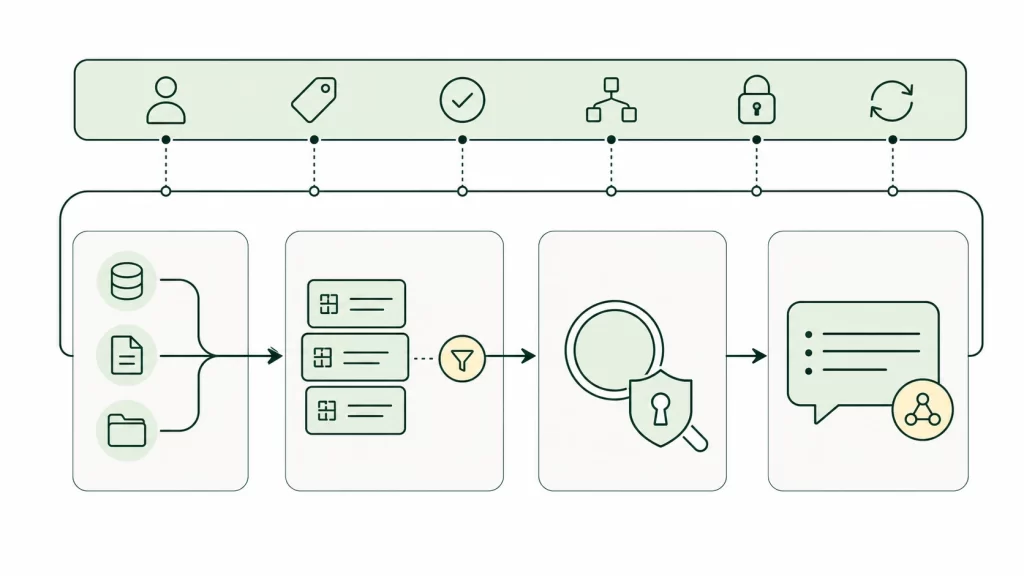
A knowledge source needs more than a dataset name
In a RAG or enterprise-search use case, the source may be a policy PDF, a support article, a contract clause, a product specification, or a collection of emails. The value lies in its meaning and context, not merely in its file location.
That raises governance questions that a conventional table inventory may not answer:
- Is this the current approved version?
- Who is accountable for its content?
- Is it relevant to the use case, or merely available?
- Does it contain confidential, personal, contractual, or regulated information?
- What business terms need to travel with it so the AI does not misinterpret it?
The aim is not to catalogue every file before starting. It is to define the approved knowledge boundary for a specific use case and make that boundary manageable as content changes.
Is your data ready to support GenAI?
A focused data governance health check maps ownership, quality, and access gaps before they weaken an AI rollout.
Get control before you scale.

Get control before you scale.
Permissions need to travel with the content
An AI application should not become a shortcut around established access rules. If a user could not open a document in the source system, the system should not reveal its contents in a generated answer.
This is where access governance moves from a periodic review to a runtime control. Identity, role, sensitivity classification, and source permissions all need to inform what may be retrieved. The implementation will differ by platform and architecture, and it should fit the organisation’s modern data architecture. The AI should retrieve only content the requesting user is entitled to use.
Freshness needs an explicit control
Traditional data quality programs often focus on completeness, validity, consistency, and duplication. Those still matter. A data profiling and cleansing baseline is often the practical place to expose those issues. GenAI adds another question: is the information current enough for this use case?
For example, an archived HR policy may be factually intact but unsafe for an employee assistant if a newer policy supersedes it. Governance needs an explicit status for content, such as draft, approved, retired, or under review, and a clear rule for what happens when a source changes or is withdrawn.
A modern data governance framework for AI
A modern data governance framework for AI should create usable control. Start with the data that supports a defined business use case, then build controls that let teams expand with confidence.
Six controls to establish before scaling
| Control area | The decision to make | Evidence that it is working |
|---|---|---|
| Purpose and ownership | Which AI use case is approved, and who owns the data decision? | Named business owner, data steward, and clear scope of use |
| Discovery and classification | What sources exist, what do they contain, and how sensitive are they? | Catalogued sources with business terms, classifications, and owners |
| Quality and context | What makes the information fit for this use case? | Defined quality rules, trusted definitions, and a remediation path |
| Lineage and provenance | Can a result be traced back to its source and version? | Source-to-use record, including document version, transformations, and content lifecycle |
| Access and policy enforcement | Who may retrieve which content, under what conditions? | Permissions applied consistently across the source and AI experience |
| Change and monitoring | What happens when data changes, fails a rule, or is no longer approved? | Refresh, review, exception, and retirement processes with accountable owners |
The table is deliberately data-centred. It sits alongside model evaluations, red-teaming, and AI risk management. Those activities become more meaningful when the team can show what information the system uses and under which controls.
Begin with one use case before expanding
Governance becomes unworkable when it is defined as a universal program before anyone can show where it changes a decision. Choose a bounded use case: an employee policy assistant, a service knowledge assistant, or a governed analytics copilot. Map the sources, owners, access rules, and freshness requirements that matter for that use case first.
This produces reusable patterns without pretending that finance data, engineering documents, and customer-service knowledge carry the same risk. A framework should standardise the decisions and evidence required, not force every domain into an identical workflow.
Make classification an operating control
Classification is often treated as a labelling exercise completed during an initial data inventory. For AI, it has to do more work. A classification should help determine whether content can be used, by whom, for which purpose, and whether it needs safeguards such as redaction or exclusion.
Useful classifications are connected to policy. A label such as “confidential” has limited value if it does not affect retrieval, sharing, retention, or review. The same is true of a data-quality signal: marking a source as incomplete should influence whether it can ground a customer-facing answer or only support internal exploration.
Use AI to assist governance work
AI for data governance can suggest business terms, identify possible sensitive content, enrich metadata, flag duplicate records, or surface stale documents for review. That can reduce the manual effort of keeping a catalogue useful.
Generative AI for data governance should assist a named steward. A model can propose that a document looks like a pricing policy, but the steward decides whether the classification is correct for the organisation, whether the document is still approved, and which risk appetite applies. Ownership and decision authority remain human responsibilities.
Governing unstructured data for AI
Unstructured content is often where GenAI delivers its first visible value and where conventional governance is least mature. Documents, images, slides, tickets, meeting notes, and knowledge-base pages rarely arrive with the clean schema, consistent ownership, or lifecycle discipline of a managed database.
Why document governance breaks down
Teams may have content repositories with permissions, but the information inside them can still be hard to govern. A policy may be revised without its older version being retired. A slide deck may be copied into several folders. A document may include different rules for different countries without metadata that makes the distinction visible.
When that content is prepared for AI search or RAG, it is commonly split into smaller passages so the system can retrieve relevant context. This improves retrieval, but it can separate text from the title, effective date, audience, or access rule that makes it meaningful. Governance needs to preserve those relationships.
Govern the retrieval layer as well as the source
A controlled source can still become uncontrolled during retrieval preparation. A document may be extracted, divided into passages, enriched with metadata, and loaded into a search index. Each step can change how the content is found and interpreted. Keep a record of the original source, its version, the preparation process, and the policy that determines who may retrieve the result.
Test retrieval with real permission scenarios, not only administrator accounts. A good test checks whether different user roles see only the documents they are entitled to use, whether retired content disappears when it should, and whether a retrieved passage can be traced to its complete source. This turns governance from a design intention into an observable control.
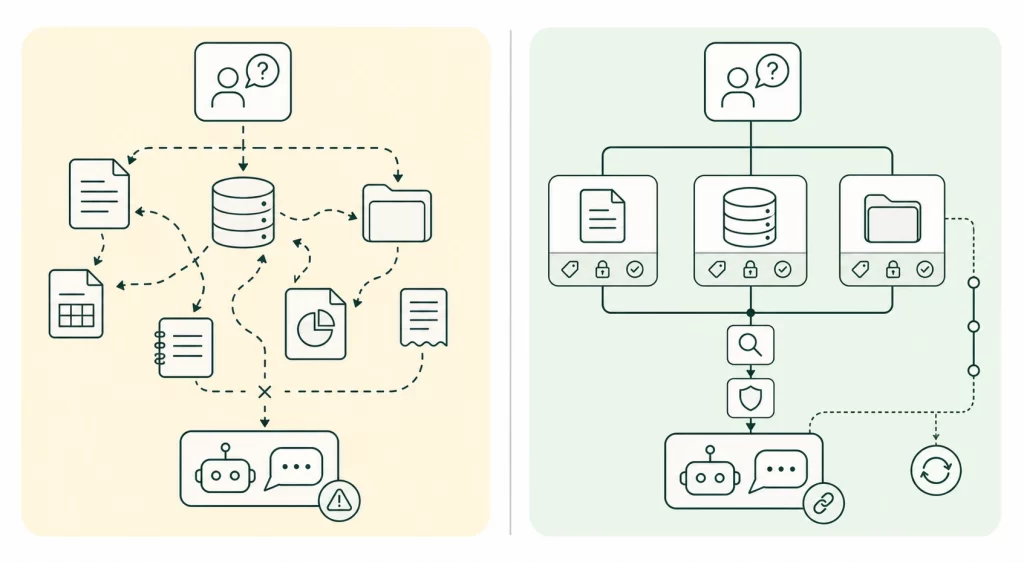
The minimum controls for AI knowledge sources
Before adding a body of unstructured content to an AI application, establish at least the following:
- a named owner for the collection and for high-value sources;
- a clear source status, version, and effective date where relevant;
- classification and access rules that can be enforced during retrieval;
- business metadata that explains audience, domain, geography, and approved use;
- rules for inclusion, update, deletion, and retirement;
- a process to refresh or remove derived search content when the source or its permissions change;
- a way to trace a retrieved passage back to the complete source and its permissions.
These controls stop the AI layer becoming an uncontrolled copy of corporate knowledge. When a source changes or is removed, the knowledge layer must change with it.
How data governance connects to AI governance
Data governance and AI governance overlap, but they solve different problems. Treating them as the same program creates gaps at both ends.
| Data governance for AI | AI governance | |
|---|---|---|
| Primary object | Data, documents, metadata, permissions, and lineage | Models, prompts, agents, outputs, risks, and controls |
| Core question | Is this data fit, allowed, understandable, and traceable for this use? | Is this AI system safe, accountable, compliant, and performing as intended? |
| Typical controls | Ownership, quality rules, classification, access policy, retention, provenance | Approval, testing, monitoring, human oversight, audit trail, incident response |
| Failure signal | Unreliable, stale, inaccessible, or overexposed source information | Unsafe, biased, non-compliant, or poorly controlled system behaviour |
The two disciplines meet when an AI system uses enterprise data. A model may pass its technical evaluation yet still produce an unacceptable result because it retrieved the wrong document. Equally, perfectly governed data will not address an unsafe prompt, a poorly designed agent action, or weak output monitoring.
For the operating model around models, agents, approvals, and controls, see our guide to an AI governance operating model. Establish what the system may know before deciding how the system may act.
Our Data & IBM Services You Might Find Interesting

Strategic Data Governance
Establish ownership, quality rules, lineage, and access controls for trusted enterprise AI.

Modern Data Architecture Services
Design a connected data foundation that supports governed retrieval across cloud and on-premises systems.

IBM Planning Analytics & watsonx Consulting
Translate AI-ready data controls into a practical IBM watsonx roadmap and delivery plan.
Before you scale GenAI, prove you can govern its data
Use this checklist before expanding a pilot to new teams, new sources, or a customer-facing use case:
- The business purpose and the decision owner are explicit.
- Every approved source has an accountable owner.
- Data and content are classified according to sensitivity and permitted use.
- Quality criteria are defined for the use case, rather than assumed from the source system.
- Key business terms and metrics have a shared meaning.
- Source permissions can be enforced in the AI experience.
- Content has a lifecycle: approved, updated, retired, or excluded.
- Derived search content is refreshed or removed when the source or its permissions change.
- Retrieval has been tested against the permissions of real user roles.
- A response can be traced to the source and version that informed it.
- Exceptions, stale content, and access failures have an owner and a response path.
- The AI governance team can see which data controls support the system’s risk decisions.
If several of those answers are unclear, start with a focused governance assessment before expanding the rollout. It maps the data flows, ownership gaps, quality issues, and access risks around the intended use case.
Build a governed foundation for AI with strategic data governance. Teams planning a lakehouse foundation can also review our watsonx.data architecture guide. If your target architecture includes IBM technologies, our IBM Planning Analytics & watsonx consulting team can help translate that foundation into a practical delivery path.