
Content

Most M&A deals fail to capture their promised value because ERP and CRM integration is treated as a purely technical afterthought rather than a strategic priority. Post-merger integration (PMI) is the complex process of combining two organizations into one cohesive entity. While executive leadership often focuses on financials and company culture, your core IT systems are where integration actually becomes real in day-to-day operations.
Delayed or poorly planned system integrations cause reporting chaos, duplicate work, and immediate operational downtime. To avoid these common pitfalls, organizations need a structured, low-disruption integration roadmap that emphasizes pre-close planning, parallel run strategies, staged migrations, and strong data governance. Unifying your core systems early establishes a much-needed single source of truth, preserves business continuity from Day 1, and ultimately accelerates the cost and revenue synergies laid out in the initial deal rationale.
If you want to understand why post-merger ERP and CRM integration matters, look at the daily operational fallout of getting it wrong. Common post-merger ERP integration failure examples share predictable patterns that directly impact the bottom line:
- Fragmented system landscapes: Legacy systems left running months or years after closing create massive compliance risks, data silos, and duplicate manual work.
- Financial blind spots: Finance and executive leadership teams are left without a reliable single source of truth to measure combined performance.
- Declining customer experience: How does CRM consolidation affect customer churn after acquisition? When sales teams work from separate, disconnected databases, key accounts suffer from overlapping contact, mixed messaging, and inconsistent pricing.
What happens if you delay ERP integration after a merger? You guarantee ongoing reconciliation headaches and bleed the exact synergies the acquisition was supposed to create.
This article serves as a practical guide for handling post-merger integration IT systems without downtime. We will show you how to unify your architecture without disrupting customers, revenue operations, or core finance processes. As a specialist partner in post-merger data and systems integration, Multishoring builds roadmaps that preserve business continuity while accelerating your synergy capture.
Why Unifying ERP and CRM Post-Merger Is Critical (and Risky)
Treating ERP and CRM integration as a back-office afterthought is a fast track to deal failure. These systems are the backbone of your merged operating model and must be front and center in your PMI planning.
Your ERP serves as the system of record for finance, supply chain, and core operations. Your CRM is the engine for sales, marketing, and customer service. So, why is ERP consolidation critical after an acquisition? Combining these platforms into a coherent landscape is the only way to establish a single data model, run consistent processes, and enable real-time decision-making across the new enterprise.
What Goes Wrong When Integration Is Delayed
The business impact of fragmented ERP and CRM after a merger is immediate and severe. When leadership under-scopes the integration, the entire organization feels the friction.
What are the risks of running multiple CRMs after a merger?
- Customer alienation and lost revenue: Sales teams working in separate CRMs inevitably double-contact key accounts. This leads to confusion around account ownership, missed upsell opportunities, and severe post-merger integration customer data issues.
- Financial reconciliation nightmares: Persistent duplicate and conflicting records between legacy ERPs lead to painful reconciliation processes, slower month-end closes, and elevated audit risks.
- Security vulnerabilities: Overlapping, partially integrated systems create inconsistent security controls, increasing your cyber and compliance risk profile.
The Strategic Upside of Getting IT Right Early
If you are wondering how to justify ERP CRM integration in post-merger business cases, look at the value creation timeline. Getting integration right early unlocks the deal’s strategic upside.
First, you achieve faster realization of cost and revenue synergies because processes and reporting are standardized across the combined entity. Second, a unified customer view allows your revenue teams to immediately run cross-sell and upsell plays. Finally, clean and consolidated ERP and CRM data forms the required foundation for deploying automation (like RPA) and advanced analytics.
Subtle Integration Risks Leadership Often Underestimates
Even with a clear strategy, post-merger integration ERP CRM risks often hide in the execution. Executive leadership tends to underestimate two critical threats:
- The “Lift-and-Shift” Trap: Simply moving data and custom configurations wholesale from one system to another is dangerous. This approach imports years of technical debt and inconsistent processes directly into your new landscape.
- User Change Fatigue: Employees are already navigating immense organizational change. Asking them to switch core systems without clear business benefits or robust support guarantees resistance and low adoption rates.
Expert Insight: How Multishoring Quantifies Integration Risk
You cannot mitigate risks you cannot see. Within the first weeks after a deal announcement, Multishoring runs a rapid, comprehensive system assessment. We inventory the existing ERP and CRM landscapes, map critical data flows, and highlight business-critical integration gaps. This allows C-level teams to accurately quantify technical debt and prioritize IT integration directly within the overall value-creation plan.
Our Integration Services

Integration after Companies Merger
Secure business continuity and accelerate synergy capture from Day 1. Our tailored IT integration roadmaps help you safely unify complex ERP, CRM, and data landscapes without disrupting daily operations.

Integration Services & Consulting
Get expert guidance on designing and executing seamless system architectures. We help you evaluate your target state, eliminate data silos, and build highly scalable platforms that connect your entire enterprise.

Azure Logic Apps Integration
Speed up your enterprise integration projects with our specialized cloud architects. Our experts utilize Azure Logic Apps to build reliable, scalable workflows that ensure seamless data connectivity across all your core systems.
Integration Strategy and Target Architectures for ERP and CRM
Your integration architecture must directly reflect the original deal rationale and your risk appetite. There is no single correct way to unify IT systems. Moving from the “why” to the “how” requires evaluating realistic integration patterns and choosing a framework that protects business continuity.
Link Integration Strategy to Deal Rationale
Before touching any software, tie your IT strategy back to the overarching M&A integration archetypes. How you bought the company dictates how you integrate it.
- Full Assimilation: The acquiring company absorbs the target completely. This usually implies standardizing on a single ERP and CRM system from Day 1 or shortly after.
- Partial Integration: The companies merge specific functions but leave others independent. This often requires best-of-breed system selection.
- Standalone or Add-on: The acquired company operates independently. This approach heavily favors keeping systems separate but connecting them via data hubs for consolidated financial reporting.
Core ERP and CRM Target Architecture Options
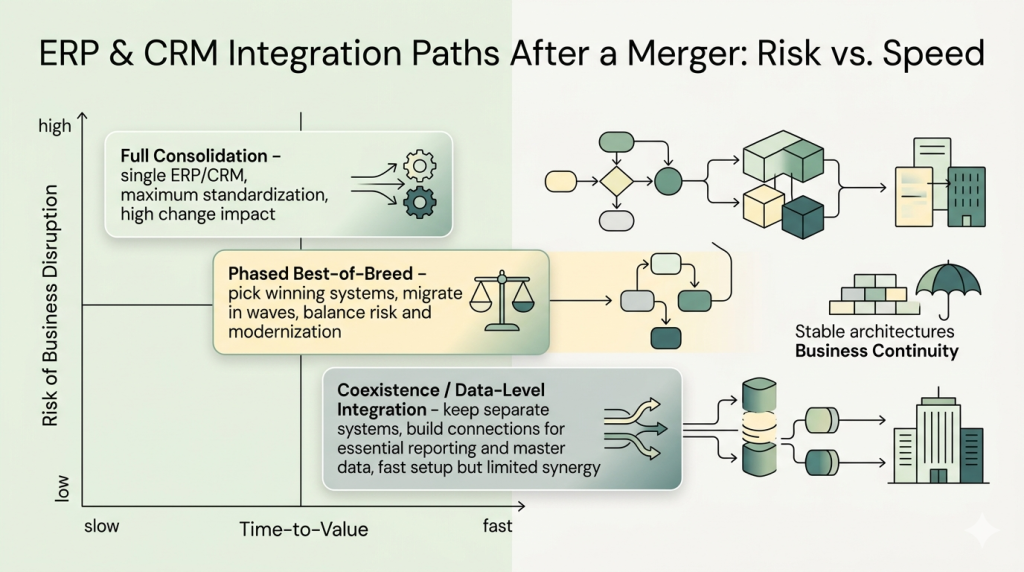
When reviewing your post-merger ERP integration strategy options, you generally have three main paths. Each carries distinct benefits and risks.
Option A – Full Consolidation to a Single Platform
This approach selects one platform as the target state – for example, standardizing on a single instance of SAP and one Salesforce environment – while migrating and decommissioning everything else.
- Pros: Delivers the cleanest long-term state. You get a single data model, the lowest ongoing maintenance costs, and simpler governance.
- Cons: Carries the highest disruption risk if rushed. Migration timelines often stretch 12 to 24 months for large ERP estates and require massive change management efforts.
Option B – Parallel ERP CRM Systems With Integration Layer After Merger
Legacy ERPs and CRMs continue running for a defined period. An integration platform, data hub, or API gateway actively synchronizes key objects like customers, orders, and invoices.
- Pros: Causes minimal short-term disruption. It allows for a gradual, phased migration and lets you pilot system consolidation by specific regions or business functions.
- Cons: Increases short-term technical complexity. If governance is weak, data duplication runs rampant, and “temporary” architectures easily become permanent IT spaghetti.
Option C – Best-of-Breed Consolidation
You select the best ERP and CRM capabilities from each company. For example, you might keep the buyer’s ERP but adopt the target company’s CRM for a specific line of business, phasing out the redundant platforms.
- Pros: Presents a clear modernization opportunity. You avoid investing further in legacy on-premise systems and can use the merger as a catalyst to move to cloud architectures.
- Cons: Requires complex decision-making, strict architecture governance, and a highly detailed roadmap to execute without breaking existing workflows.
How to Decide Between These Options
Should you consolidate ERP systems immediately after a merger or use a phased integration? What is the best CRM architecture after a merger or acquisition? The answers depend entirely on rigorous early IT and data due diligence.
Choosing between ERP consolidation and data hub in M&A comes down to a few critical criteria. You must evaluate your regulatory constraints, overall integration complexity, and the quality of existing data. You also need to factor in technical debt, internal talent availability, and how fast the board expects to realize synergy targets. A phased integration (Option B) is almost always safer for business continuity, whereas immediate consolidation (Option A) is strictly for highly assimilated, simpler operations.
The Role of Integration Platforms and Data Hubs
Modern middleware makes phased integrations highly effective. Integration Platform as a Service (iPaaS), data warehouses, and event buses act as the crucial enablers for unifying your systems.
These platforms allow you to extract and synchronize data without ripping out the underlying legacy ERP or CRM immediately. This grants executive leadership real-time reporting and visibility while the actual system consolidation happens safely in the background.
Expert Insight: Navigating Hybrid Architectures with Multishoring
Multishoring routinely helps clients evaluate these architectural options using proven reference patterns. We have deep experience designing hybrid states – such as scenarios where ERPs must remain separate for regulatory reasons, but the CRM is unified to drive sales. We architect these integrations specifically to avoid long-lived, brittle “spaghetti” code, ensuring your interim data layers are secure, scalable, and fully aligned with your long-term IT roadmap.
A Low-Disruption Roadmap: From Pre-Close to First 90 Days
Protecting business continuity during a merger requires a concrete, time-bound integration roadmap. Leading PMI playbooks stress early planning, “clean rooms,” and strict 100-day plans to prevent operational chaos. Translating these high-level strategies into specific, phased ERP and CRM actions is the only way to avoid business disruption.
Here is a structured framework for managing the transition safely from the pre-close period through the critical first 90 days.
Phase 1: Pre-Close and Signing-to-Closing Period
How do you plan Day 1 IT readiness for a merger? You start long before the deal actually closes. This phase is dedicated to mapping risks and defining exactly how the newly merged entity will operate on its first official day.
- Conduct specific IT and data due diligence: Inventory all ERP and CRM systems. Map critical business workflows like order-to-cash and procure-to-pay to identify high-risk dependencies and quick integration wins.
- Establish a “clean room”: Use an integration blueprint to model data and system scenarios securely without violating antitrust rules prior to closing.
- Define Day 1 principles: Clearly document what systems stay as-is and what must change immediately. This includes aligning basic billing codes, mapping the chart of accounts, and establishing minimum CRM visibility for key accounts.
Phase 2: Day 1 – Ensuring Continuity, Not Perfection
Day 1 readiness for ERP and CRM after acquisition is about one thing: “no surprises.” Perfection is not the goal; operational continuity is. Orders must keep flowing, invoices must go out accurately, and sales teams must know exactly where to log their work.
- Ensure immediate system access: Provision access for critical users to both legacy ERPs and CRMs as needed to perform their daily jobs.
- Deploy temporary reporting: Stand up a temporary reporting layer that combines key metrics from both legacy systems so executive leadership has visibility.
- Communicate clear rules of engagement: Give explicit instructions to sales and finance teams outlining exactly which system to use for which specific process during the interim period.
Phase 3: First 30 to 90 Days – Stabilize, Then Integrate
A phased ERP CRM migration plan after merger prevents the business from grinding to a halt. This 90-day window focuses on stabilizing the environment before executing your first structured cutovers.
Days 1 to 30: Freeze and Govern
Freeze non-essential changes to all existing ERP and CRM configurations to reduce moving targets. Confirm data ownership roles across both companies. Most importantly, stand up an Integration Management Office (IMO) with a dedicated ERP/CRM workstream to track stability metrics and cutover readiness.
Days 31 to 60: Pilot and Test
Start structured data migration pilots using sandbox environments. For example, try migrating just one business unit’s CRM accounts into the target system to test your data mapping. Run parallel ERP/CRM systems where needed, reinforcing continuity with rigorous regression testing and user acceptance testing (UAT). Begin harmonizing core processes, such as quote-to-cash, across the current systems.
Days 61 to 90: First Cutovers
Execute your first wave of full system cutovers based on specific regions or product lines. How to avoid downtime during post-merger ERP cutover? Always deploy these initial cutovers with mandatory rollback plans and hypercare support teams on standby. Implement strict post-cutover performance monitoring and refine your roadmap for subsequent waves based on the lessons learned here.
Measuring Success Without Waiting a Year
Do not wait for the final system decommissioning to measure integration success. Track pragmatic, early indicators of your post-merger ERP CRM integration roadmap 90 days in.
Watch for spikes in order error rates, drops in data-quality metrics, slow user adoption, extended time-to-close for finance, and declining customer satisfaction metrics. Link these operational KPIs directly to the synergy tracking and value-based governance practices defined in your initial deal rationale.
Expert Insight: Structuring the Integration Program with Multishoring
Multishoring typically owns the technical roadmap within our clients’ Integration Management Offices (IMOs). We set up the dedicated ERP and CRM integration workstream and coordinate directly with your internal business process owners.
For example, we recently helped a mid-market enterprise stand up a fully integrated ERP platform within 9 months of a complex acquisition. By isolating data migration into manageable, phased sprints and prioritizing temporary reporting layers, we maintained complete Day 1 continuity without a single hour of unplanned operational downtime.
Data, People, and Risk Management to Keep the Business Running
To actually prevent business disruption, you must aggressively manage data quality, user adoption, and system security. Having a phased roadmap is not enough. The operational mechanics executed behind the scenes dictate whether your system cutover is seamless or chaotic.
This is where generic M&A strategy falls short. Successfully consolidating ERP and CRM platforms requires highly specific disciplines to protect your daily operations while the underlying systems change.
Make Data a Strategic Pillar, Not a By-Product
Treat data as a core workstream in your PMI program, complete with its own dedicated strategy, governance, architecture, and tooling. If you treat data mapping as a simple administrative task, you will corrupt your target systems.
Implementing post-merger integration data governance best practices starts with defining your “golden record.” When unifying an ERP and CRM, you must establish clearly defined customer and product master records. If sales and finance teams cannot agree on what constitutes a single, accurate view of a customer, automation and reporting will fail.
Data Migration Best Practices for ERP and CRM
A reliable post-merger data migration strategy for ERP and CRM prioritizes active records and rigorous testing. Moving every single piece of legacy data is rarely the right answer.
How do you clean and map CRM data after an acquisition? Follow these key steps drawn from proven CRM and ERP migration playbooks:
- Conduct full field inventories: Map all data fields across both legacy ERPs and CRMs to identify mismatches in formatting and definitions.
- Cleanse and deduplicate: Normalize data before loading it into the target system. Do not migrate outdated contacts or redundant vendor profiles.
- Use phased migration strategies: Move your active customer records and open transactions first. Archive or backfill historical data later to reduce the size and risk of the initial cutover.
- Run repeated sandbox migrations: Test your migrations in safe sandbox environments first, followed by controlled production cutovers with mandatory rollback plans.
Change Management and User Adoption
Structured change management is a mandatory success factor in ERP/CRM integration. Users naturally experience anxiety when asked to abandon familiar workflows and data structures. If you ignore how to manage change during ERP CRM consolidation, employees will actively resist the new systems, resorting to offline spreadsheets and shadow IT.
Combat this resistance with concrete levers. Establish early communication, build power-user networks, and deliver role-specific training programs. A well-designed user experience, clear process design, and highly visible benefits – such as fewer manual data entry steps and faster reporting – are the best antidotes to user pushback.
Risk Management: Security, Compliance, and Resilience
Reducing security risks in post-merger IT integration requires treating security as a baseline requirement, not a final checklist item. Merging complex systems creates temporary vulnerabilities that malicious actors frequently target.
What are the compliance risks during post-merger ERP integration? The most common threats include accidental data exposure, broken access controls, inconsistent audit trails for financial reporting, and extended operational outages during poorly executed cutovers.
Best Practices Checklist for Integration Risk Management:
- Conduct comprehensive security and compliance assessments as part of your initial IT due diligence.
- Maintain strict environment management, ensuring clear separation of development, testing, and production environments.
- Enforce continuous backups, data encryption at rest and in transit, and active monitoring.
- Document clear incident response and rollback procedures for all critical cutovers.
Using Analytics and Automation to Manage Integration Risk
Data analytics and Robotic Process Automation (RPA) are powerful tools for monitoring integration progress. You can deploy RPA bots to automate repetitive, error-prone tasks like financial reconciliations and data validations between legacy systems. Furthermore, anomaly detection algorithms can monitor transaction flows during your parallel run phase, instantly surfacing discrepancies before they impact your customers.
Expert Insight: Data and Risk Mitigation with Multishoring
Multishoring brings pre-built data quality and migration toolkits tailored for common ERP and CRM platforms. We help C-level teams establish robust data governance and master data management structures immediately post-merger. Our deep expertise in secure integration architectures ensures your cutover strategies remain fully compliance-aware, protecting your critical business data at every step.
Summary: Key Takeaways and How Multishoring Can Help
M&A synergies are ultimately realized – or lost – within your ERP and CRM landscapes, the exact environments where your daily transactions, customer interactions, and financial reporting live. To successfully unify these systems without operational downtime, executives must execute on three core pillars of non-disruptive integration. First, you need a clear strategy and target architecture directly aligned to your deal rationale. Second, you must follow a phased roadmap spanning from pre-close through the critical first 90 days and beyond, backed by strong governance. Finally, you must enforce strict data, people, and risk management disciplines that protect core business operations while the underlying technology changes.
Knowing how to choose a post-merger integration consulting firm is a make-or-break decision for your value creation plan. For executive teams wondering who can help with complex post-merger ERP and CRM integration, Multishoring specializes specifically in post-merger data integrations, ERP and CRM consolidation, and interim architectures that preserve business continuity. Acting as your dedicated post-merger ERP CRM integration partner, we deliver the specialized, expert help for post-merger data and system integration required to safely turn disjointed IT landscapes into a single, unified foundation for your combined business.
Do not let delayed IT decisions, messy data migrations, or user resistance erode the strategic value of your latest acquisition. We invite you to assess your current post-merger ERP and CRM landscape to identify hidden technical debt and integration vulnerabilities early. Schedule an exploratory discussion with Multishoring’s integration experts today to build your low-disruption roadmap and ensure your business keeps running seamlessly from Day 1.


