
Content

Unmanaged Snowflake consumption often leads to “bill shock,” with organizations frequently seeing cost swings of 30-50% when governance is weak. This happens because Snowflake’s highly elastic model enables on-demand spending that can quickly outpace actual business value. While the platform offers world-class performance, it requires a strategic framework of roles, policies, and native controls to keep spend within agreed financial boundaries.
At Multishoring, we specialize in implementing these critical governance layers for global enterprises. As experts in both Snowflake and Databricks technologies, we help leadership teams align cost accountability across complex, hybrid data environments, ensuring cloud infrastructure remains a value driver rather than a financial risk.
The shift from traditional fixed-capacity hardware to Snowflake’s credit-based pricing represents a fundamental change in IT budget management. In the legacy world, performance was limited by pre-purchased capacity. In Snowflake, performance is nearly limitless, but so is the potential for expenditure if there are no guardrails.
Most sudden spikes stem from a lack of visibility into real-time consumption and a failure to use preventive controls. When multiple decentralized teams spin up high-powered compute resources without a central policy, costs can quietly double or triple before the end-of-month invoice arrives.
It is vital to distinguish between cost optimization and cost governance. Optimization is a reactive activity focused on technical tuning, such as right-sizing a specific warehouse or rewriting a slow query. Governance, however, is the proactive operating model that prevents inefficiencies from occurring in the first place.
A robust governance strategy integrates FinOps principles into your data platform operations. This article provides an executive playbook for implementing native Snowflake guardrails, including:
- Budgets and Resource Monitors to act as financial circuit breakers.
- Cost Anomaly Detection to identify unusual spending patterns before they impact the bottom line.
- Unit Economics to link credit spend directly to business outcomes like cost per transaction or customer.
By shifting from reactive “firefighting” to proactive governance, your organization can harness the full power of Snowflake while maintaining total spend predictability.
Is your Snowflake credit usage spiraling out of control?
We implement expert cost governance frameworks that eliminate bill shock, optimize warehouse performance, and ensure every credit spent delivers measurable business ROI.
Stop overpaying for your data.

Stop overpaying for your data.
Understanding Snowflake’s Consumption Model and Cost Drivers
To prevent “bill shock,” leadership teams must understand that Snowflake is a credit-based system where compute resources typically account for over 70% of the total spend. Unlike legacy databases with fixed annual costs, Snowflake’s price is tied directly to active usage. Without a clear mental model of how these credits are consumed, governance often degrades into reactive, random cost-cutting instead of strategic management.
The Three Pillars of Snowflake Spend
Snowflake breaks down costs into three main categories. Understanding the interplay between these drivers is the first step in building a predictable budget.
- Virtual Warehouse Compute (The Primary Driver): This covers the “engines” used to run queries and load data. Costs are calculated based on warehouse size (from X-Small to 6X-Large), and billed per second with a 60-second minimum. Because each jump in size doubles the hourly credit burn, over-provisioning by just one level can instantly double your compute costs.
- Serverless Compute: These are Snowflake-managed features like Snowpipe for data ingestion, automatic clustering, and AI services like Snowflake Cortex. While they eliminate the need for manual warehouse management, they scale transparently and can quietly accumulate spend if workloads are misconfigured.
- Storage and Data Transfer: Storage is billed at a flat monthly rate per compressed Terabyte. Data transfer costs only apply when moving data across different regions or cloud providers (egress). While usually a smaller portion of the bill, these can spike during major cross-cloud migrations or if data retention policies are too loose.
Why Snowflake Bills Explode
Most sudden spikes in consumption are not caused by business growth, but by technical and policy gaps.
- Oversized, Always-On Warehouses: Leaving a Large warehouse running for tasks that only require an X-Small wastes thousands of dollars a month.
- Default Auto-Suspend Settings: Many teams leave the default 10-minute suspension period unchanged. For interactive BI tools, reducing this to 60 seconds often saves 30-50% on warehouse spend.
- Runaway Queries: A single inefficient join or a “rogue” query without a statement timeout can burn credits for hours before it is detected.
- Decentralized Resource Sprawl: In organizations with multiple independent teams, the lack of a central provisioning policy allows anyone to spin up high-powered resources without oversight.
Using Native Tools for Immediate Visibility
Snowflake provides built-in tools to help you identify these cost drivers before the invoice arrives. The Cost Management Interface in Snowsight offers visual tiles that highlight your top-spending warehouses and serverless features. (For engineering teams diving deep into technical query profiling and auto-suspend thresholds, SELECT’s Snowflake cost optimization guide provides proven warehouse tuning benchmarks).
For deeper analysis, your team should use the ACCOUNT_USAGE and ORGANIZATION_USAGE schemas. These allow for custom SQL-driven dashboards that track unit economics, such as the cost per dashboard refresh or cost per data pipeline run.
Our Data Consulting Services You Might Find Interesting

Data Warehouse Consulting Services
We design, build, and modernize data warehouses that bring order to your fragmented data.

Modern Data Architecture Services
We design and implement data architectures that replace aging legacy systems with a scalable cloud foundation.

Data Governance Consulting & Integration
We help you build a practical system of trust around your information. We work with you to make sure your data is accurate.
From Cost Reporting to Cost Governance in Snowflake
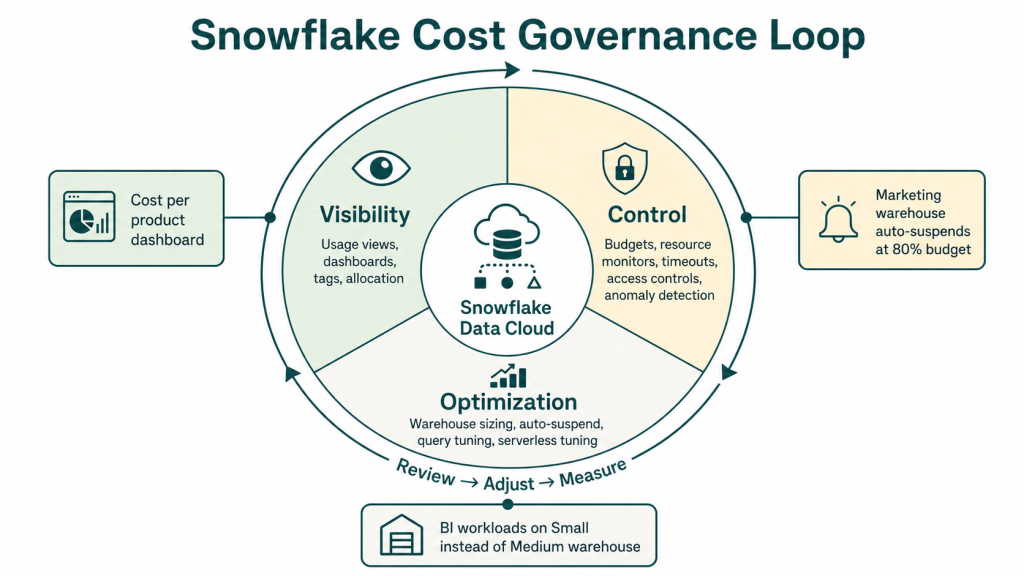
Effective Snowflake governance moves beyond monthly reporting by creating a continuous loop of visibility, control, and optimization that links technical spend to business value. Organizations that treat Snowflake as a fixed expense often miss the opportunity to scale efficiently. A mature operating model ensures that every credit spent is justified by a business outcome, preventing “bill shock” through proactive guardrails rather than reactive firefighting.
The Three Pillars of a FinOps Strategy
Snowflake recommends a governance model built on three distinct but connected phases to manage a consumption-based platform.
- Visibility (Understand and Contextualize): You cannot manage what you cannot see. This phase focuses on attributing costs to specific teams, products, or cost centers using consistent tagging and Snowsight dashboards.
- Control (Enforce and Automate): This phase implements automated guardrails to prevent uncontrolled growth. It includes setting Snowflake Budgets for serverless features and Resource Monitors for virtual warehouses to act as financial circuit breakers.
- Optimization (Refine and Improve): Once spend is visible and controlled, teams focus on increasing efficiency. This includes right-sizing warehouses, tuning query performance, and adjusting data retention policies based on actual needs.
Shifting the Conversation to Unit Economics
To truly understand platform value, leadership should shift the conversation from “total credits spent” to unit economics. Instead of focusing on the aggregate monthly bill, track metrics that align with business growth:
- Cost per customer or per dashboard refresh.
- Cost per transaction or model training run.
- Cost per terabyte scanned to measure query efficiency over time.
This approach allows the CFO to see Snowflake as a strategic value driver rather than just a technical line item.
Establishing Accountability and RACI
Governance often fails due to a lack of clear ownership rather than a lack of tools. A robust model requires a defined RACI (Responsible, Accountable, Consulted, Informed) model to answer critical operating questions:
- Who is responsible for provisioning new warehouses or serverless features?
- Who approves budget exceptions when a high-priority project needs more compute power?
- Who is accountable for decommissioning orphaned resources or “stale” clones that still accrue storage costs?
Showback vs. Chargeback Models
Organizations typically move through levels of maturity in how they handle cost accountability.
| Model | Primary Focus | Cultural Impact |
|---|---|---|
| Showback | Transparency and education. Teams see their costs but are not directly billed. | Lower internal resistance; drives awareness and behavioral change without immediate financial penalty. |
| Chargeback | Accountability and direct billing. Costs are allocated to specific department budgets. | High incentive to optimize; turns every department into a financial stakeholder in the data platform. |
At Multishoring, we help enterprises design these RACI models and can align your Snowflake and Databricks tagging strategies to provide a unified view of your total data platform spend.
The diagram below summarizes how visibility, control, and optimization come together in a continuous loop to prevent financial regressions.
Using Native Snowflake Controls to Put Hard Limits on Spend
Snowflake provides built-in “circuit breakers” that act as preventive controls to stop overspending before it impacts your budget. While visibility helps you understand where money is going, it does not stop a runaway query or an oversized warehouse from burning credits. You must configure native guardrails like Budgets and Resource Monitors to enforce financial boundaries automatically.
Budgets vs. Resource Monitors: Choosing the Right Guardrail
Understanding the difference between these two features is critical for a complete governance strategy.
- Snowflake Budgets: These are high-level controls that monitor credit usage across multiple objects and serverless features, such as Snowpipe or Tasks. You can set monthly spending limits for the entire account or specific departments and receive alerts via email or webhooks (Slack/Teams) when spending is projected to exceed the limit.
- Resource Monitors: These focus specifically on virtual warehouses. Unlike Budgets, they can be configured to automatically suspend a warehouse the moment it hits a credit quota, providing a hard stop to compute spending.
For the best protection, we recommend using Resource Monitors as warehouse-level safety nets and Budgets to track aggregate spend across your entire data ecosystem.
Essential Warehouse Policies: Sizing, Auto-Suspend, and Timeouts
Most organizations can reduce their compute bill by 30% or more just by standardizing three warehouse settings.
- Strict Auto-Suspend: Change the default 10-minute suspension to 60 seconds for BI and interactive workloads. This prevents paying for idle compute time while a warehouse waits for the next user query.
- Right-Sizing Tiers: Always start with the smallest warehouse size (X-Small) and only scale up if performance data shows a clear need. Moving up just one size level doubles your hourly credit burn, so every “step up” must be justified.
- Statement Timeouts: Use the
STATEMENT_TIMEOUT_IN_SECONDSparameter to cap query runtimes. This acts as a safety valve to terminate inefficient joins or “rogue” queries before they consume thousands of credits.
AI-Driven Early Warning: Snowflake Cost Anomalies
Snowflake’s Cost Anomalies feature uses machine learning to detect unusual spending patterns across your accounts. Unlike static budgets, this system learns your historical usage and flags irregular spikes—such as a misconfigured data pipeline—before they become major financial issues.
This acts as an automated “early warning system,” allowing your team to investigate and remediate spikes in hours rather than waiting for a month-end invoice review.
A Checklist for Serverless Governance
Serverless features scale transparently, which can lead to “silent” credit consumption if they are not governed. Use this checklist to keep serverless costs in check:
- Automatic Clustering: Enable only on large (1TB+), high-churn tables where query performance gains actually outweigh the clustering cost.
- Search Optimization: Regularly audit these paths to ensure they are only applied to tables requiring frequent, high-speed point lookups.
- Materialized Views: Only use these for tables with infrequent updates; otherwise, the cost of background maintenance will negate any query savings.
- Snowpipe & Tasks: Group these into specific Budgets so you get alerts if ingestion volumes or scheduled jobs spike unexpectedly.
Making Snowflake Cost Governance Stick Across Teams
Governance only works when it is embedded into daily operations through clear accountability, standardized “Golden Dashboards,” and a disciplined steering cadence. Even the best technical controls will fail if engineering and finance teams are not looking at the same data. Operationalizing governance means moving from a reactive “clean-up” mode to a culture where cost is treated as a first-class engineering constraint.
Establishing a Steering Cadence and Golden Dashboards
To maintain alignment, organizations should implement a monthly or bi-weekly FinOps steering session. These meetings bring together stakeholders from Finance, Engineering, and Product to review budget variance, unit costs, and any detected anomalies.
The foundation of these meetings is a set of “Golden Dashboards”. These are not just technical usage charts; they display unit economics to align technical spend with business value:
- Cost per query or per data pipeline run.
- Cost per product event or business unit.
- Warehouse idle ratios and backfill burn rates.
Embedding Cost Awareness into Engineering Workflows
Effective governance shifts cost considerations “left” into the software development lifecycle (SDLC). Engineering teams should treat cost Service Level Objectives (SLOs) with the same priority as system latency or availability.
In our experience, you can operationalize this through three practical steps:
- Pull Request (PR) Checklists: Require engineers to provide an estimated credit impact before deploying new warehouses or significant serverless features.
- Cost Error Budgets: Define a maximum acceptable spend for specific projects; if the budget is breached, teams must prioritize remediation over new feature development.
- On-Call Runbooks: Create clear instructions for handling cost spikes or anomaly alerts, ensuring rapid response before the month-end invoice arrives.
Enforcing Tagging and Lineage as Governance Enablers
You cannot attribute value without accurate metadata. Enforcing a mandatory tagging strategy is a prerequisite for any scalable governance model. Every warehouse, database, and query should be tagged by Team, Product, and Environment.
Data lineage further strengthens this by tracing costs from source ingestion through transformations to the final consuming product. This allows for a fair allocation of shared platform costs, which reduces internal friction during budget reviews.
The Snowflake Governance Maturity Model
Most enterprises progress through three distinct levels of maturity as they refine their operating model:
- Level 1: Reactive – Governance is informal. Teams deal with bill shock after it happens using basic dashboards and manual spreadsheets.
- Level 2: Controlled – Native guardrails like Budgets and Resource Monitors are in place. A steering cadence is established, and teams track basic unit metrics.
- Level 3: Optimized – FinOps is integrated into the SDLC. Cost SLOs are automated, and anomaly remediation is part of the standard incident response process.
At Multishoring, we help you bridge the gap between these levels. Because we are experts in both Snowflake and Databricks, we can align your tagging and unit-cost metrics across your entire data estate, providing leadership with a unified view of your platform spend.
Summary: Turning Snowflake From Cost Risk Into Value Platform
Effective Snowflake cost governance is a continuous journey, not a one-time project, that transforms the platform from a financial risk into a strategic asset.. Preventing “bill shock” requires moving beyond reactive, ad-hoc query tuning to a proactive operating model built on visibility, automated controls, and shared accountability. Organizations that implement these frameworks typically see more predictable cloud spend and a significantly higher return on their data investments.
Key Takeaways for Financial and Technical Leadership
To secure your Snowflake environment, keep these three core principles at the center of your strategy:
- Master Your Drivers: Understand that compute resources—virtual warehouses and serverless features—typically account for over 70% of your bill. Small configuration errors, like over-provisioning a warehouse by just one size, can instantly double your hourly costs.
- Implement the Governance Loop: Establish a permanent cycle of Visibility (attributing costs via tags), Control (enforcing limits with monitors), and Optimization (systematically right-sizing resources).
- Operationalize Accountability: Shift cost awareness “left” into the engineering workflow. Governance only sticks when engineers treat cost as a first-class constraint, similar to performance or system availability.
Critical Questions for Your Data Team
Use this checklist to assess your current governance maturity and identify immediate gaps:
- Which of our virtual warehouses are currently governed by resource monitors with “suspend” actions enabled?
- Do we have an automated process to notify stakeholders the moment Snowflake costs spike by more than 20% overnight?
- Are we tracking unit economics—such as cost per query or cost per customer—to measure the actual business value of our spend?
- Is every Snowflake object (warehouse, database, table) assigned a mandatory tag for department or product attribution?
How Multishoring Can Help
Managing costs in a complex data estate is challenging, especially when Snowflake and Databricks coexist in a hybrid environment. At Multishoring, we specialize in designing and implementing these governance layers to ensure your platform remains efficient as it scales.
We help leadership teams bridge the gap between technical operations and financial predictability through architecture audits, RACI model design, and native guardrail implementation.
Ready to secure your Snowflake environment?
Contact Multishoring today for a comprehensive cost governance assessment.
Snowflake Cost Governance FAQ
1. Who should own Snowflake cost governance policies?
Governance is a joint effort between Data Engineering, FinOps, and Product leadership. Engineering defines the technical standards, while FinOps validates the budget impact. Product owners must accept responsibility for spending tied to their specific business outcomes.
2. Is showback recommended before chargeback?
Yes, establishing transparent showback first reduces internal friction and drives behavioral change. It allows teams to see their cost drivers and remediate inefficiencies before they are directly billed. This phased approach helps build a cost-conscious culture without immediate financial penalties.
3. What is the difference between Budgets and Resource Monitors?
Resource monitors act as warehouse-level circuit breakers, while Budgets provide an aggregate view of warehouses and serverless features. Resource monitors can automatically suspend a warehouse when a credit limit is reached. Budgets send alerts via email or webhooks when projected monthly spending for a group of objects is on track to exceed the limit.
4. Are Snowflake tags reliable for cost allocation?
Tags are highly reliable if they are governed centrally and enforced in your CI/CD pipelines. We recommend blocking the deployment of any untagged warehouse or database to ensure 100% cost attribution. When validated correctly, tags provide a consistent way to roll up costs to specific departments or products.
5. Can Snowflake credits be allocated per individual query?
Yes, query tags allow for granular cost attribution even on shared warehouses. By setting query tags via session parameters, you can attribute the cost of specific workloads to different projects or users. This is essential for organizations where multiple teams consume the same compute resources.


