
Content

Most enterprise AI pilots never reach production – and the reason is rarely the model. The demo works. The proof of concept impresses the steering committee. Then the system stalls somewhere between “it works in the lab” and “it runs in front of customers,” and it quietly never ships.
If that sounds familiar, you are not behind. It is the default outcome. Organizations run pilot after pilot, budgets climb, and the portfolio of live AI stays thin. The question that matters is not “can we build it” – you clearly can. It is “why can’t we ship it, and what would it take to scale safely?”
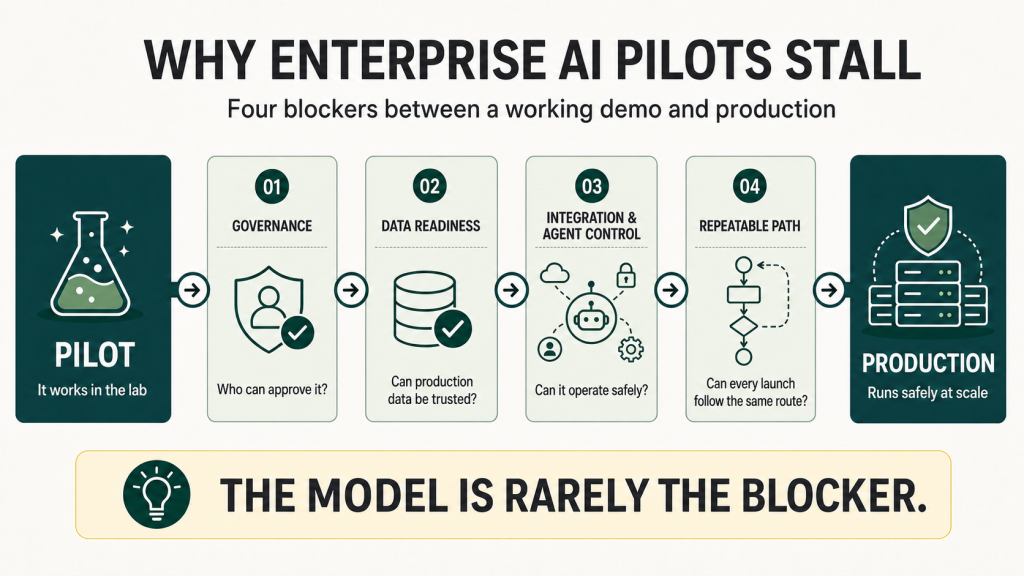
The honest answer is that shipping AI is not a modelling problem. It is a production problem. A pilot has to clear four things before it can run for real: governance, data readiness, integration and agent control, and a repeatable path from pilot to production. Miss any one and the system stalls – not because the AI is bad, but because no one can confidently put it into the business.
This guide is the map. It is written for the leaders accountable for enterprise AI adoption – CIOs, Chief AI Officers, and the executives who have to answer for both the results and the risk. It walks through why pilots stall, the four blockers in turn, and how to move from a shelf full of proofs of concept to AI that actually runs. Each section links to a deeper guide where you need the detail.
Why most AI pilots stall: the four failure modes
Pilots stall for organizational reasons, not technical ones. The model usually works. What is missing is everything around the model that makes it safe to run in the business. In our experience these gaps cluster into four failure modes – and most stalled pilots are tripping over more than one.
Before the four, it helps to name the trap they share. A pilot is judged on whether the AI works. Production is judged on whether the organization can run and stand behind the AI. Those are different bars, and a proof of concept optimized for the first rarely clears the second. That is why “it worked in the demo” and “it never shipped” are not a contradiction – they are the normal result of building for the wrong bar. Here are the four blockers.
1. No governance to approve it
The pilot works, and then someone asks the questions that decide production: who is accountable, what data does it touch, how was it tested, what happens when it drifts? With no governance to answer them, the safe choice is to wait. The system sits in limbo – not rejected, just never approved. In regulated sectors this is the single most common stall.
2. Data that is not AI-ready
Pilots run on a clean, curated slice of data. Production runs on the messy reality – scattered across systems, inconsistent, poorly governed, much of it unstructured. A model that shone on the sample degrades on the real thing, or the team discovers the data it needs is not accessible, trustworthy, or complete enough to rely on. The pilot does not fail loudly; it just cannot be fed.
3. Integration and agent control gaps
A demo answers questions in a sandbox. A production system has to plug into real workflows, with real permissions, real security, and real oversight. This gap is widest with AI agents, which do not just respond but act inside your systems. Letting an agent take actions in production demands access controls, human oversight, monitoring, and an audit trail that a demo never needed. Without them, “it works” and “we can safely let it loose” are miles apart.
4. No repeatable path to production
Even when a single pilot clears the first three, many organizations have no defined route from proof of concept to live system. Every launch becomes a bespoke negotiation – fresh approvals, fresh debate, fresh escalation. That does not scale. The first system might limp into production on heroics; the tenth never will, because there is no process to carry it.
The pattern underneath all four: each is a reason someone cannot confidently say “yes, ship it.” Pilots do not stall because the AI is not good enough. They stall because the organization is not yet set up to run AI it can trust. The rest of this guide takes the four blockers in turn – starting with the one that gates all the others.
Tired of AI pilots that never make it to production?
We help enterprises clear the four blockers between proof of concept and production – and build a repeatable path that turns stalled pilots into AI your business actually runs.
Turn proofs of concept into production.

Turn proofs of concept into production.
Governance as the unlock, not the brake
Governance is what lets someone confidently say “ship it” – which makes it the blocker that gates all the others. Teams tend to see governance as the thing that slows AI down. In production, the opposite is true. The absence of governance is what freezes pilots, because no one will approve a system they cannot account for.
Recall the four questions that stall a pilot: who is accountable, what data does it touch, how was it tested, what happens when it drifts? Governance is simply the operating model that keeps those answers ready – a live inventory of your models and agents, clear approval gates, testing against defined thresholds, monitoring in production, and an audit trail. With that in place, the questions stop being blockers and become a checklist.
The key mental shift is from wall to gate. A wall stops everything; a gate has a known way through. When teams know exactly what production readiness looks like, they build toward it from the start, and approvals turn from anxious one-offs into a repeatable standard. That is why governance speeds AI up: the tenth high-risk system ships faster than the first, because the path is known.
For regulated enterprises, governance does double duty. The same controls that unlock production also map directly to the EU AI Act and the NIST AI Risk Management Framework, so you satisfy compliance and delivery with one set of work rather than two. Build it once, use it everywhere.
The practical move is not to govern everything at once. Stand up the operating model on your highest-value, highest-risk use case first, prove the gate works, then extend the same controls across the portfolio.
This is the largest of the four blockers, and it has its own detailed playbook – the roles, the inventory, the control mapping, and the pilot-to-production gate. For the full operating model, see our guide to AI governance for regulated enterprises.
Getting enterprise data AI-ready
A model is only as good as the data it runs on in production – and production data is nothing like the pilot sample. This is the second failure mode, and it is the one teams underestimate most. The pilot ran on a clean, curated extract. The live system has to run on the real thing.
The gap between the two is where pilots quietly die. Real enterprise data is scattered across systems, inconsistent, often poorly governed, and heavily unstructured – documents, emails, tickets, PDFs. A model that performed on the sample degrades on the mess, or the team finds the data it needs is not accessible, complete, or trustworthy enough to depend on.
“AI-ready” is a useful bar to aim for, and it is worth being precise about what it means. AI-ready data is not a data lake or a bigger warehouse. It is data that is:
- Governed – with clear ownership, lineage, and access control, so you know where it came from and who can use it.
- High quality – accurate, consistent, and complete enough to trust in a decision.
- Well structured and accessible – organized so models can actually consume it, including a real plan for unstructured content.
- Compliant – handled in line with privacy and regulatory obligations, which matters doubly once AI is involved.
There is an important distinction underneath this. Getting data AI-ready is closely tied to governance, but it is a separate discipline. Data governance controls the information feeding your models; AI governance controls the models themselves. Both have to be in place, and they reinforce each other – but a common mistake is assuming a strong AI governance program covers the data question. It does not.
The encouraging part: most regulated enterprises already have a head start here. Years of data warehousing, BI, and modernization work is exactly the foundation AI readiness builds on. The task is usually to extend that foundation to AI’s needs – especially unstructured data and real-time access – rather than start over.
The practical first step is honest assessment. Before scaling any pilot, ask whether the data behind it is genuinely production-grade, or whether it only looked ready because the sample was hand-picked. That single question surfaces most data-driven stalls before they happen.
Data readiness has its own detailed guide, covering the readiness gap, structuring data for GenAI and RAG, and a full checklist.
From demo to dependable: agents and integration in production
A demo answers questions in a sandbox. A production system has to act inside your business – with real permissions, real security, and real oversight. That gap is the third failure mode, and it is widening fast as enterprises move from AI that responds to AI that does things.
A chatbot that drafts an answer is low-stakes; if it is wrong, a human catches it. The moment AI plugs into live workflows – updating records, triggering processes, moving money – the bar jumps. Now “it works” is not enough. The question becomes “can we safely let it operate in our systems,” and that is a different problem entirely.
Nowhere is this sharper than with AI agents. An agent does not just reply – it takes actions across your systems to complete a task. That is exactly what makes agents valuable and exactly what makes them hard to put into production. Letting software act on your behalf demands controls a demo never needed:
- Access and permissions – the agent should reach only the systems and data its task requires, and no more.
- Human oversight – clear points where a person reviews or approves before consequential actions run.
- Monitoring – live visibility into what the agent is doing, so problems are caught in motion, not after.
- An audit trail – a record of what it did and why, for both debugging and accountability.
There is a pattern worth internalizing here: with agents and integrations, the model is the easy part. The demo proves the AI is capable. Production is won or lost on integration, security, and control – the plumbing and the guardrails, not the intelligence. Teams that spend all their effort on the model and none on this gap are the ones whose agents never leave the pilot.
The same logic applies to any AI that touches live systems, agent or not. Integration is where a proof of concept meets the messy reality of enterprise architecture – legacy systems, security policies, and workflows that were never designed with AI in mind. Underestimating that work is a reliable way to strand a promising pilot.
The practical takeaway: when you scope a pilot you intend to ship, treat integration and control as first-class from day one, not as a phase you bolt on after the model works. Building the guardrails in is what turns an impressive demo into a system the business can depend on.
Enterprise AI agents have their own detailed guide, covering the demo-to-production gap, high-value use cases, and the guardrails in depth.
A staged path from pilot to production
Clearing the first three blockers on one pilot is a win. Clearing them repeatedly, on every pilot, is what actually scales. This is the fourth failure mode: even organizations that ship one system often have no defined route to production, so every launch becomes a bespoke fight. The fix is a repeatable path – the same known steps for every system, sized to its risk.
The goal is to replace negotiation with process. When the route to production is defined, teams build toward it from the start, reviewers assess against a standard instead of their instincts, and the tenth launch is easier than the first. Here is what that path looks like in practice.
- Classify risk early. Assign the system’s risk tier at the pilot stage, so the team knows the production bar before they build, not after. Tiering also right-sizes the effort – a low-risk internal tool should not carry the same weight as a customer-facing model.
- Build controls in, not on. Governance, data readiness, integration, and oversight belong in development from day one. Retrofitting them after the model works is the single biggest cause of delay.
- Ready the data for production. Confirm the data behind the pilot is genuinely production-grade – governed, complete, and accessible – not just a hand-picked sample that flattered the demo.
- Review against the tier. Check the system against its tier’s requirements: tested, oversight defined, monitoring ready, integration secure. Light for low risk, thorough for high.
- Approve and record. A named owner signs off, and the decision is logged. This is the gate between pilot and production – a clear yes, on the record.
- Monitor and revisit. Once live, monitoring runs continuously, and the system returns for review on a cycle or after any material change. Production is not the finish line; it is the start of operation.
Two principles make this work across a portfolio rather than a single project.
Start small, then templatize. You do not need the whole machine running before you ship anything. Stand up the path on your highest-value, highest-risk use case first. Prove it works, then reuse the same steps as a template for everything that follows. The first system is the hardest; each one after gets faster.
Scale the process, not just the models. The organizations that win with AI are not the ones with the cleverest pilots. They are the ones that turned production into a repeatable capability – so going from five live systems to fifty is a managed operation, not fifty separate leaps of faith.
That is the shift this whole guide points to: from AI as a series of one-off experiments to AI as something your organization runs, reliably, at scale.
Summary: from experiments to production
Enterprise AI pilots do not stall because the technology fails – they stall because the organization is not yet set up to run AI it can trust. The model works in the demo; what is missing is everything around it that makes shipping safe. Once you see the problem that way, “it worked but never launched” stops being a mystery and starts being something you can fix.
The fix is to clear the four blockers that stand between a proof of concept and a production system:
- Governance – the operating model that lets someone confidently approve a system, and the gate that unlocks all the others.
- Data readiness – production-grade data that is governed, high quality, and accessible, not a hand-picked pilot sample.
- Integration and agent control – the permissions, oversight, monitoring, and audit trail that let AI act safely inside your systems.
- A repeatable path to production – the same known, risk-tiered steps for every system, so launches scale instead of becoming one-off fights.
The organizations pulling ahead are not the ones with the cleverest pilots – they are the ones that turned production into a repeatable capability. You do not have to build the whole machine before shipping anything. Start with your highest-value, highest-risk use case, stand up the four foundations around it, prove the path works, then reuse it across the portfolio. That is how AI moves from a shelf of experiments to systems your business actually runs – safely, and at scale.