
Content
The EU AI Act is law, it is enforceable, and its deadlines are already in motion – and if you think it does not apply to a US company, check again. The Act reaches any organization whose AI systems are used in the EU or whose output is used there, regardless of where the company sits. For most US enterprises with European customers, operations, or users, that means it applies.
This is not another explainer on what the Act “might mean someday.” It is a working playbook: what the regulation actually requires, when each obligation lands, and how to turn those requirements into concrete controls you can operate. The stakes are real – penalties for the most serious violations run into tens of millions of euros or a percentage of global turnover, whichever is higher.
Here is the practical framing to hold onto. The EU AI Act tells you what you must do; the NIST AI Risk Management Framework tells you how to do it. One is the legal requirement, tiered by risk. The other is the most widely used blueprint for building the controls that satisfy it. Run them together and you get a single set of controls that answers the law, rather than two disconnected compliance efforts.
This guide is for the people who own that work – risk, compliance, legal, and the Chief AI Officer. It covers what the Act covers and its risk tiers, the compliance timeline, the requirements by tier, how to map those requirements to NIST AI RMF, a practical compliance checklist, and how governance turns all of it into something you can actually run. Where dates matter, confirm them against the official text – the Act is phased and guidance keeps arriving – but the direction is fixed, and waiting is not a strategy.
What the EU AI Act covers: the risk tiers
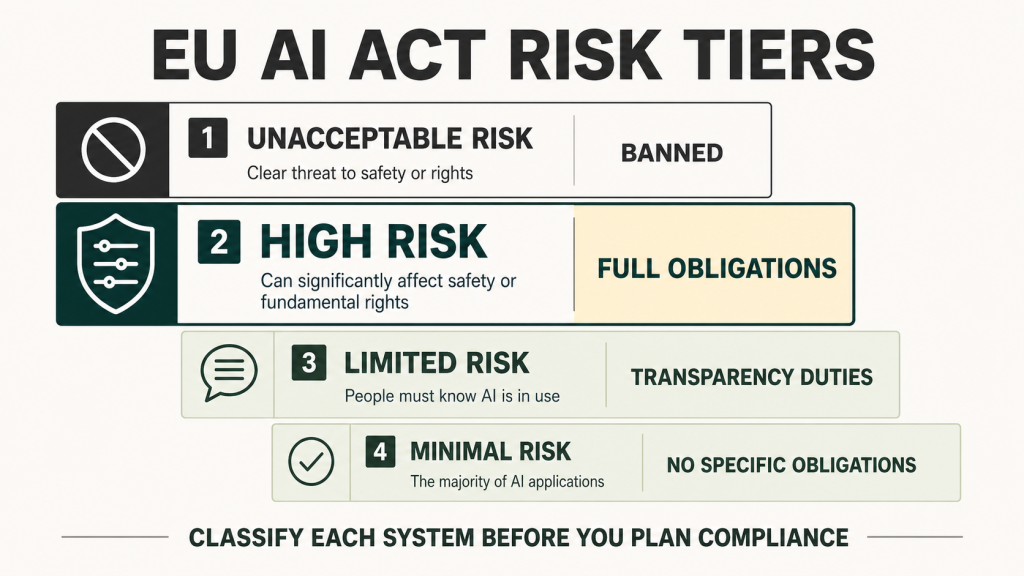
The EU AI Act sorts every AI system into one of four risk levels, and your obligations follow the level – not the technology. Get the classification right and everything else falls into place. Get it wrong and you either over-invest in a low-risk tool or, far worse, under-protect a high-risk one.
This risk-based structure is the single most important thing to understand about the Act. It does not regulate “AI” as one undifferentiated thing. It asks how much harm a given system could do, and scales the rules accordingly.
The four tiers
| Risk tier | What it means | Your obligation |
|---|---|---|
| Unacceptable risk | Uses considered a clear threat to safety or rights – for example, social scoring or certain manipulative systems. | Banned. The decision here is to stop, not to comply. |
| High risk | Systems that can significantly affect safety or fundamental rights – credit scoring, insurance pricing and eligibility, employment and hiring, essential services, and more. | Permitted, but subject to the full set of obligations (see Section 3). This is where most enterprise effort goes. |
| Limited risk | Systems where the main concern is that people know they are dealing with AI – chatbots, certain generated content. | Transparency obligations: disclose that AI is in use. |
| Minimal risk | Everything else – the large majority of AI applications. | No specific obligations under the Act. |
Why classification is the first job
Notice what this means in practice: before you can comply, you have to know which tier each of your AI systems falls into. That sounds obvious, but it is where many organizations stumble, for two reasons.
First, most enterprises do not have a complete picture of the AI they are already running – so the classification exercise doubles as a discovery exercise. Second, the high-risk category is broader than people expect. Common, revenue-generating use cases in banking, insurance, healthcare, and HR sit squarely inside it, which is exactly why regulated industries carry the heaviest load.
A practical starting move: build an inventory of your AI systems and assign each a provisional risk tier. That inventory is the foundation for everything that follows – the timeline, the requirements, and the controls. If that sounds familiar, it is: it is the same model inventory that sits at the heart of AI governance, which is not a coincidence we will return to.
A note on general-purpose AI
The Act also sets specific obligations for general-purpose AI models – the large foundation models that many enterprise applications are built on. If you build on top of a third-party model rather than training your own, you are still responsible for how your system uses it, and you inherit part of the compliance picture from the provider. Know which foundation models sit under your applications and what their providers do and do not cover.
Is your AI ready for the EU AI Act deadlines?
We help enterprises classify their AI systems, map obligations to concrete controls with NIST AI RMF, and turn one-time compliance into an operating model that holds – well before the deadlines land.
Find the gaps before a regulator does.

Find the gaps before a regulator does.
Key deadlines and the compliance timeline
The EU AI Act does not switch on all at once – it phases in, and the phasing is deliberate: the most dangerous uses are banned first, and the heaviest obligations come later. That staggering is good news and a trap at the same time. Good, because you have time to prepare for the high-risk requirements. A trap, because “later” makes it easy to do nothing until the deadline is on top of you.
The important thing is to understand the order, then map your own systems onto it.
The phasing, in plain terms
The Act rolls out in stages, roughly in this sequence:
- Prohibited practices first. The bans on unacceptable-risk uses applied earliest. If you run anything in that category, this deadline has effectively already passed – the task is to stop, now.
- General-purpose AI obligations next. Rules for foundation-model providers phased in after the bans, affecting anyone who builds on or supplies large general-purpose models.
- High-risk obligations last, and largest. The full set of requirements for high-risk systems is the final and most demanding phase. This is where most enterprise compliance work lands, and it is the deadline worth planning backward from.
Because the exact dates shift as the EU issues guidance and, in some cases, adjusts timelines, confirm the current schedule against the official text before you commit to internal deadlines. The sequence above is stable; the specific dates are what you verify.
Why the timeline is a planning tool, not a countdown
The mistake is to treat the timeline as a countdown to a single day of reckoning. It is better used as a planning backbone. A few principles:
- Work backward from the high-risk deadline. The heaviest obligations take the longest to build – risk management, documentation, testing, oversight. Start from the date they land and plan the build in reverse.
- Do the discovery now. You cannot plan against a timeline until you know which of your systems fall into which tier. The inventory from the last section is the prerequisite for everything here.
- Sequence by risk, not by convenience. Fix prohibited uses immediately, then prioritize your high-risk systems, then handle transparency obligations. Let the tiers set the order.
The cost of waiting
There is a real penalty for treating this as a future problem. High-risk compliance is not a document you produce the week before a deadline – it requires controls that have to be designed, built, tested, and shown to work over time. An organization that starts late cannot compress that work, and “we didn’t have time” is not a defense a regulator accepts. The enterprises that will be ready are the ones treating the timeline as a reason to start now, not a reason to wait.
Requirements by risk tier
For most enterprises, “EU AI Act compliance” really means “high-risk compliance” – because that tier carries almost all the obligations, and it is where your important use cases live. So this section focuses there, with the lighter tiers covered briefly at the end.
The high-risk requirements look like a long list, but they group into a handful of themes. Read them and a pattern jumps out: this is not exotic AI regulation. It is disciplined engineering and governance, written into law.
What high-risk systems require
The Act’s obligations for high-risk AI systems fall into these areas:
- Risk management system. A continuous process to identify, assess, and mitigate the risks a system poses across its lifecycle – not a one-time review.
- Data governance. Training, validation, and testing data must be relevant, representative, and appropriately managed. Poor data is a compliance problem here, not just a quality one.
- Technical documentation. Documentation detailed enough to show the system meets the requirements – kept current, ready to produce on request.
- Record-keeping. Automatic logging of events over the system’s lifetime, so its operation can be traced and reconstructed.
- Transparency and information to users. Deployers must understand what the system does and how to use it correctly, with clear instructions.
- Human oversight. Real, effective oversight by people – the ability to intervene, override, or stop the system.
- Accuracy, robustness, and cybersecurity. The system has to perform reliably, resist errors and manipulation, and be secured against attack.
The theme underneath the list
Look at that list as a whole and the message is clear: the Act is asking you to know your system, control it, document it, and keep a human meaningfully in charge. If you have mature model risk management or a real AI governance program, most of this is already familiar – the Act is codifying good practice, not inventing new science.
This is also why the requirements map so cleanly onto a control framework, which is the subject of the next section. Each obligation above corresponds to a control you build once and operate continuously.
A note on providers versus deployers
The Act splits responsibility between providers (who develop or supply an AI system) and deployers (who use it). The obligations differ, and many enterprises are both – building some systems and using others. Two practical implications:
- Know your role for each system. Your obligations for a model you built are not the same as for a third-party tool you deploy.
- If you deploy a vendor’s high-risk system, part of your compliance depends on what they provide. Get their documentation and confirm what they cover before you rely on it.
The lighter tiers, briefly
For completeness: limited-risk systems mainly carry transparency duties – tell people they are interacting with AI, and label AI-generated content where required. Minimal-risk systems have no specific obligations, though following the same good practices voluntarily is sensible and future-proofs you as the system or the rules evolve.
With the requirements defined, the practical question is how to build controls that satisfy them without reinventing the wheel. That is where NIST AI RMF comes in.
Mapping the Act to NIST AI RMF
Do not build a separate control set for the EU AI Act. Build one set of controls, organized by NIST AI RMF, that satisfies the Act – and your other AI obligations at the same time. This is the single biggest efficiency available in AI compliance, and most organizations miss it by treating each regulation as its own project.
The reason the mapping works is that the two documents do different jobs. The EU AI Act is the requirement – legally binding, tiered by risk. The NIST AI Risk Management Framework is the method – a voluntary, widely adopted structure for actually building AI controls. The Act tells you the destination; NIST gives you the route.
The four NIST functions
NIST AI RMF organizes the work into four functions:
- Govern – the culture, roles, accountability, and policies that sit across everything else.
- Map – understanding the context and risks of each AI system.
- Measure – testing, evaluating, and tracking those risks with real metrics.
- Manage – prioritizing, treating, and monitoring the risks over time.
How the Act’s requirements map onto them
Line the two up and the fit is close to one-to-one:
| EU AI Act requirement | NIST AI RMF function | The control you build once |
|---|---|---|
| Risk management system | Map + Manage | A lifecycle risk process for each system |
| Data governance | Map + Govern | Data quality, lineage, and access controls |
| Accuracy, robustness, security | Measure | Testing and evaluation against thresholds |
| Human oversight | Govern | Defined oversight and intervention points |
| Record-keeping & documentation | Govern + Manage | Logging, technical docs, and an audit trail |
| Ongoing monitoring | Manage | Production monitoring and incident response |
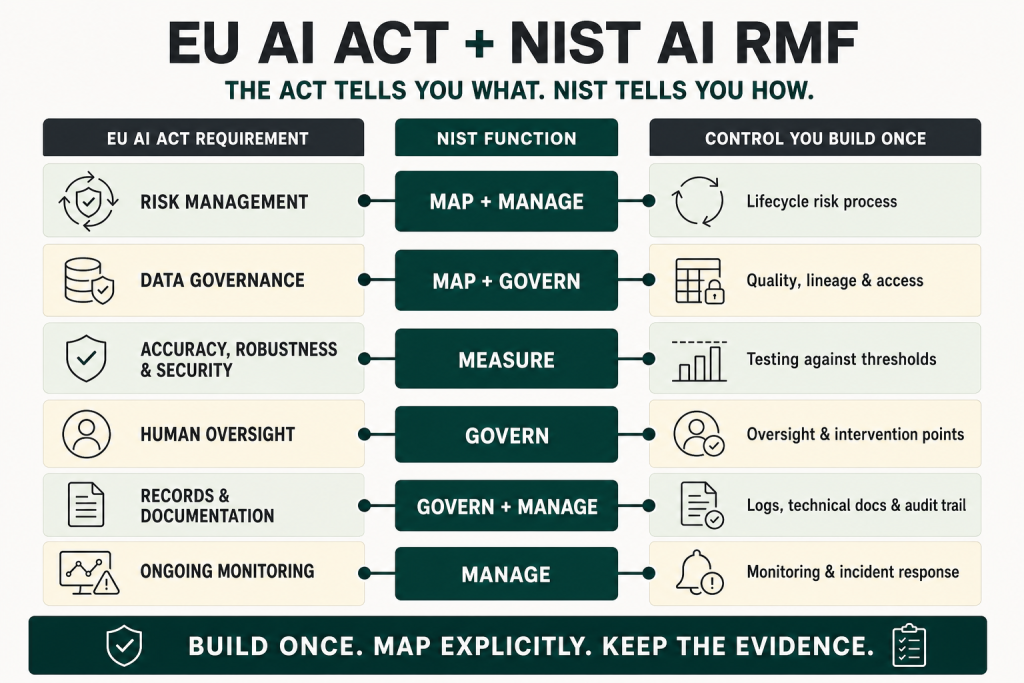
The point of the table is the last column. Each control you build serves the NIST function, the Act’s requirement, and usually your internal risk standard – all at once. Build a testing-and-evaluation process once, and it answers the NIST “measure” function, the Act’s accuracy and robustness obligation, and your model validation policy together. That is one piece of work doing three jobs.
Why this is the efficient path
Two practical payoffs make the mapping worth the effort:
- You avoid duplicated work. Organizations that build controls per regulation end up with overlapping, inconsistent processes and a compliance function that reinvents itself every time a new rule appears. One framework-based control set scales; a pile of one-off responses does not.
- You are ready for what comes next. More AI regulation is coming, in the EU and elsewhere. A control set organized around a solid framework absorbs new requirements as additions, rather than forcing a fresh project each time. NIST is a sensible backbone precisely because it is regulation-agnostic.
A caution worth stating: NIST AI RMF is a method, not a certificate. Using it does not by itself prove EU AI Act compliance – you still map your controls explicitly to the Act’s specific obligations and keep the evidence. Think of NIST as how you organize the work, and the Act as the checklist you prove against.
EU AI Act compliance checklist
Use this as a working checklist to see where you stand on EU AI Act compliance – scored per high-risk system, not for your organization in the abstract. It follows the requirements from Section 3 and the phasing from Section 2. If you cannot answer “yes” to an item, that is not a failure – it is the next piece of work.
Treat it as a recurring audit, not a one-time exercise. Systems change, new ones appear, and the Act’s obligations phase in over time, so the questions get asked again.
Foundation: know your estate
| Check | Why it matters |
|---|---|
| We have a complete inventory of the AI systems we build and use | You cannot comply with what you cannot see; this is the prerequisite for everything below. |
| Each system has an assigned EU AI Act risk tier | The tier decides the obligations – misclassification means the wrong amount of control. |
| We know our role – provider or deployer – for each system | Obligations differ, and many enterprises are both. |
| Any prohibited-use systems have been identified and stopped | This is the earliest, non-negotiable deadline. |
For each high-risk system
| Check | Maps to (Act requirement) |
|---|---|
| A lifecycle risk management process is in place | Risk management system |
| Training, validation, and test data are governed for quality and representativeness | Data governance |
| Technical documentation is complete and kept current | Technical documentation |
| The system logs events automatically over its lifetime | Record-keeping |
| Deployers have clear instructions and understand the system’s limits | Transparency to users |
| Effective human oversight and intervention is defined and working | Human oversight |
| Accuracy, robustness, and cybersecurity are tested against thresholds | Accuracy, robustness, security |
| For third-party systems, we have the provider’s documentation and know what they cover | Provider / deployer split |
Operating and evidence
| Check | Why it matters |
|---|---|
| Controls are mapped explicitly to the Act’s obligations, with evidence kept | NIST is the method; the Act is what you prove against. |
| Production monitoring is live, with incident response defined | Compliance is continuous, not a launch-day snapshot. |
| A named owner is accountable for each system’s compliance | Unassigned accountability is where compliance quietly fails. |
| We track the Act’s phased deadlines and plan backward from them | The heaviest obligations take the longest to build. |
How to read your score:
- Gaps in the foundation block are the priority. Without an inventory and tier classification, you cannot even scope the rest – fix these first.
- A red flag on a high-risk, customer-facing system outranks everything. Those are the systems a regulator looks at first and the ones with the most exposure.
- You do not need every box ticked tomorrow. You need a credible plan that reaches each obligation before its deadline – and the evidence that you are executing it.
This checklist tells you where the gaps are. Closing them, and keeping them closed, is not a one-off project – it is an operating capability. That is what the final section is about.
How governance operationalizes compliance
A checklist tells you what to do once. Governance is what keeps you compliant after the auditors leave. EU AI Act compliance is not a project with an end date – it is an ongoing state, and only an operating model keeps you in it.
Point-in-time compliance decays fast. Models drift, new systems ship, obligations phase in, and regulators issue new guidance. Without a standing operating model, each change reopens the whole question – and you scramble to reassemble evidence you should have had all along.
The operating model that prevents that is AI governance, and its parts map straight onto what the Act requires:
- A live inventory and risk tiering – so classification stays current, the same inventory the checklist starts with.
- Clear accountability – a named owner per system, plus executive ownership of AI risk.
- Approval gates – no high-risk system reaches production without meeting its obligations.
- Continuous monitoring and an audit trail – evidence generated as you operate, not reconstructed under pressure.
Put plainly: the controls the EU AI Act requires and the controls a mature AI governance program runs are the same controls. Build governance once and compliance becomes a byproduct of how you operate. We cover that operating model in full in our guide to AI governance for regulated enterprises.
There is a payoff beyond avoiding penalties. An organization that has operationalized compliance ships AI faster, because the controls are already there – compliance stops being a brake and becomes the confidence to deploy. The EU AI Act is demanding, but it asks for little a well-run AI program should not already do. Treat it as the forcing function to build that program properly.
Summary: compliance you can operate
The EU AI Act is enforceable, phased, and reaches US enterprises with any EU footprint – so the question is not whether it applies, but whether you are ready. The structure is simpler than the length of the law suggests: every AI system falls into a risk tier, and your obligations follow the tier. Almost all the weight sits on high-risk systems, which is exactly where regulated industries’ important use cases live.
The efficient path is to stop treating this as a standalone legal exercise. Classify your systems, plan backward from the phased deadlines, and build one set of controls – organized by NIST AI RMF – that satisfies the Act’s requirements and your other AI obligations at once. The Act tells you what; NIST tells you how; each control you build does several jobs at the same time. A working checklist tells you where the gaps are, and closing them is a matter of execution against the timeline.
Then make it last. Point-in-time compliance decays the moment the deadline passes, so the real goal is an operating model – AI governance – that keeps you compliant as systems and rules change. Build that once and compliance becomes a byproduct of how you run AI, not a recurring scramble. Done well, it delivers more than avoided penalties: it gives you an AI capability you can defend to a regulator and scale with confidence.
Frequently asked questions about EU AI Act compliance
Does the EU AI Act apply to US companies?
Often, yes. The Act applies based on where an AI system is used or where its output is used, not where the company is headquartered. A US enterprise whose AI systems serve EU customers, operate in the EU, or produce output used there generally falls in scope. If you have any EU footprint, assume it applies until you have confirmed otherwise.
What are the EU AI Act’s risk tiers?
Four. Unacceptable-risk uses are banned. High-risk systems – common in credit, insurance, employment, healthcare, and essential services – are permitted but carry the full set of obligations. Limited-risk systems mainly have transparency duties, such as disclosing that AI is in use. Minimal-risk systems have no specific obligations.
What does the EU AI Act require for high-risk systems?
A risk management system, data governance, technical documentation, event logging, transparency and instructions for users, effective human oversight, and accuracy, robustness, and cybersecurity. In practice these are disciplined engineering and governance controls, operated continuously rather than produced once.
How does the EU AI Act relate to the NIST AI Risk Management Framework?
The Act is the legal requirement; NIST AI RMF is a voluntary method for building the controls that meet it. Its four functions – govern, map, measure, manage – map closely onto the Act’s obligations, so one framework-based control set can satisfy both. NIST is the method, not a certificate – you still map controls explicitly to the Act and keep the evidence.
What are the penalties for non-compliance?
They are significant – the most serious violations carry fines reaching tens of millions of euros or a percentage of global annual turnover, whichever is higher, with lower tiers for lesser breaches. Confirm the current figures against the official text, as they are set in the regulation.
When do the EU AI Act’s obligations take effect?
The Act phases in: prohibited practices first, general-purpose AI obligations next, and the full high-risk requirements last. Because specific dates shift as guidance is issued, verify the current schedule against the official text, and plan backward from the high-risk deadline since those obligations take the longest to build.