
Content

Most enterprise AI programs do not stall because the model is weak. They stall because the data underneath is fragmented, ungoverned, or not available where the AI needs it. If you are deciding where to invest next, start with the data foundation, not the model.
When IBM brought its Storage Strategy Days to Austin on September 15-16, 2026 – the first edition in the Americas – the theme under the sessions was hard to miss. Storage was not framed as boxes and capacity. It was framed as the layer that decides whether data is available, protected, and trusted enough for AI to act on. That matches what Gartner has said: at least 30% of generative AI projects are abandoned after proof of concept, largely over poor data quality.
This article is written for CIOs, CDOs, CAIOs, and heads of data who are being asked to show a return on AI. It covers why AI-ready data has moved to the top of the infrastructure agenda, what a data foundation for AI requires, and where to spend before you buy another model or GPU cluster. IBM’s event is used as evidence of where the market is heading, not as a product pitch.
Why AI-ready data moved to the top of the infrastructure agenda
The pressure changed. Leaders are now judged on AI that runs in production, and that spotlight lands on the data layer, not the model.
For a few years, storage was a capacity conversation: how many terabytes, how fast, how cheap. That framing is fading. At its Austin Strategy Days, IBM put its entire storage portfolio – flash, software-defined storage, mainframe systems, resilience, and its application data platform – into one discussion about feeding AI. When an infrastructure vendor rebuilds its whole story around data for AI, it tells you where budgets are moving.
AI does not fail politely in a slide deck. It fails when an agent cannot reach the right data, or reaches data no one trusts. So the questions that used to sit with the storage team – where data lives, how it is governed, whether it can be recovered – are now board-level AI questions.
Is your data foundation ready for enterprise AI?
We fix the availability, quality, governance, and recoverability underneath your data – so analytics and AI run on numbers people actually trust.
Trusted data first. AI second.

Trusted data first. AI second.
The real problem: AI fails on the data foundation, not the model
When an AI initiative stalls, the model is rarely the reason. The data underneath it is.
Gartner predicted that at least 30% of generative AI projects would be abandoned after proof of concept, citing poor data quality among the main causes. Informatica’s CDO research points the same way: 43% of leaders name data quality and readiness as their top obstacle to AI success. IBM frames it plainly: most organizations are limited not by model capability but by fragmented data, inconsistent definitions, and governance gaps that stop AI at scale.
The pattern is familiar. A pilot runs on a clean, curated sample. Production data is scattered across warehouses, lakes, SaaS tools, and old systems, with gaps and mismatched formats. The model that impressed everyone now answers from broken inputs, and people stop trusting it. That is why so many pilots stall before scale, and why the first question is whether your data is AI-ready at all.
What a data foundation for AI requires
An AI-ready data foundation is defined by four properties, not by any single product.
| Property | What it means in practice | Why it matters for AI |
|---|---|---|
| Availability | Data reachable where AI runs, across on-prem, private, and public environments – the point of hybrid cloud storage. | Agents cannot use data they cannot reach. |
| Quality and consistency | One trusted, deduplicated version of each record and metric. | A confident wrong answer is worse than none, because someone acts on it. |
| Governance and access | Clear ownership, plus control over what each user and agent can see. | AI inherits whatever access rules the data carries, or the gaps in them. |
| Resilience and recoverability | Proof that critical data and services can be restored, not just backed up. | AI raises the cost of downtime and corruption, so recovery has to be provable. |
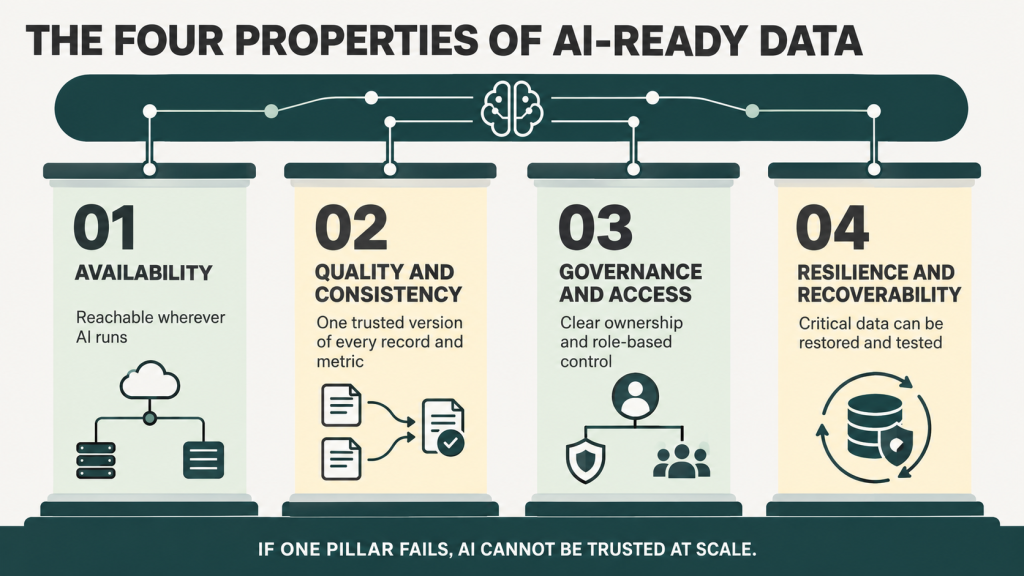
That is what IBM’s event pointed at. Storage Scale, Ceph, and Fusion were positioned around governed, high-performance data access for AI, while Storage Defender and its Predatar partnership pushed resilience toward continuous proof of recovery. You do not need those products to take the lesson: the market now treats availability, governance, and recoverability as one foundation, not separate projects.
Governance, data quality and the economics of AI at scale
Agents change the math. They query far more than people do, so cost, risk, and quality problems scale with them.
Treat data quality management as an ongoing service, not a one-time cleanup. Cleaning data once in a fragmented estate is like mopping with the tap running – new bad data keeps arriving. Automated checks and clear ownership keep records trustworthy as volume grows.
Governance carries the same weight. Every agent should see only the data its role allows, and a governance layer built for AI is what makes that enforceable, not aspirational.
Then there is cost. Public cloud AI gets expensive fast once you add storage, compute, and egress fees. That is part of why Gartner expects more than 20% of enterprises to run AI workloads in their own data centers by 2028, up from under 2% in early 2025. Where data lives is now a cost and sovereignty decision, which is what a deliberate hybrid strategy controls.
A decision framework for enterprise leaders
You do not need a perfect data estate before you start. You need a defensible sequence.
- Start from the decisions, not the data lake. Pick the few use cases and the data they depend on.
- Fix availability and quality first. Make that data reachable and trusted before you point AI at it.
- Set governance and access up front. Decide ownership and what each agent may see before you scale.
- Prove recoverability. Confirm the critical data behind those use cases can be restored and tested.
- Then scale, watching cost. Expand use case by use case, tracking storage and query spend.
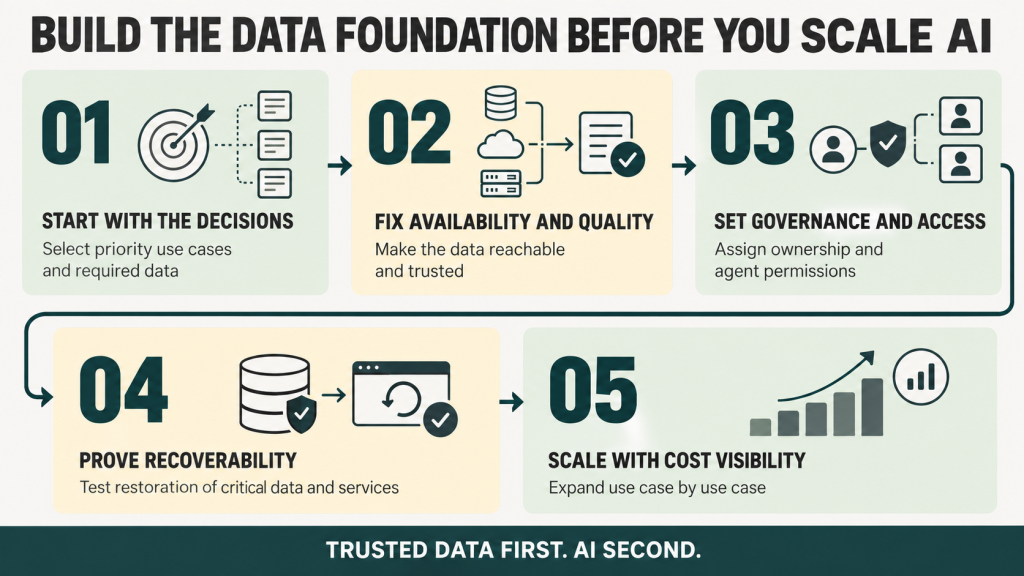
Your data foundation is AI-ready when you can tick all five:
- The data behind each priority use case is reachable across your hybrid environment
- Each core record and metric has one trusted, owned definition
- Access control governs what every user and agent can see
- Critical data has proven, tested recovery
- You can see and predict the cost of AI as usage grows
IBM Storage Strategy Days 2026 – Key takeaways
- The model is rarely the bottleneck. AI stalls on scattered, ungoverned, or unreachable data, not the algorithm.
- AI-ready data has four properties: availability, quality and consistency, governance and access, and proven recoverability.
- Storage is now an AI decision. IBM’s Austin Strategy Days reframed its portfolio around data for AI, whatever your vendor.
- Sequence beats scale. Fix and govern the data behind a few use cases, prove recovery, then expand while watching cost.
Related services: Modern Data Architecture · AI Data Integration Solutions · Data Governance Services and Consulting
IBM Storage Strategy Days 2026 Conclusions – FAQ
What is AI-ready data?
AI-ready data is enterprise data that is available where AI runs, accurate and consistent, governed with clear ownership and access control, and provably recoverable. It goes beyond traditional data quality: the point is that people and AI agents can trust and reach it at scale.
Why do most AI projects fail – the model or the data?
Usually the data. Gartner ties a large share of abandoned generative AI projects to poor data quality, and surveys rank data quality and readiness as the top obstacle. Models rarely fail in production; the fragmented, ungoverned data feeding them does.
How does hybrid cloud storage affect AI cost?
Public cloud storage, high-performance compute, and egress fees make AI expensive at scale. A hybrid approach lets you place workloads where they are most cost-effective and compliant, which is why more enterprises are moving AI workloads back into their own data centers.
Sources
- Gartner Predicts 30% of Generative AI Projects Will Be Abandoned After Proof of Concept by End of 2025
- Why Half of GenAI Projects Fail – Gartner
- The Surprising Reason Most AI Projects Fail (CDO Insights 2025) – Informatica
- Why Most Enterprise AI Projects Stall Before They Scale – IBM
- What Is AI-Ready Data? – IBM
- What Is Hybrid Cloud? – IBM
- Registration Now Open: IBM Storage Strategy Days (Austin) – IBM Community
- IBM Introduces Autonomous Storage with New FlashSystem Portfolio – IBM Newsroom