
Content

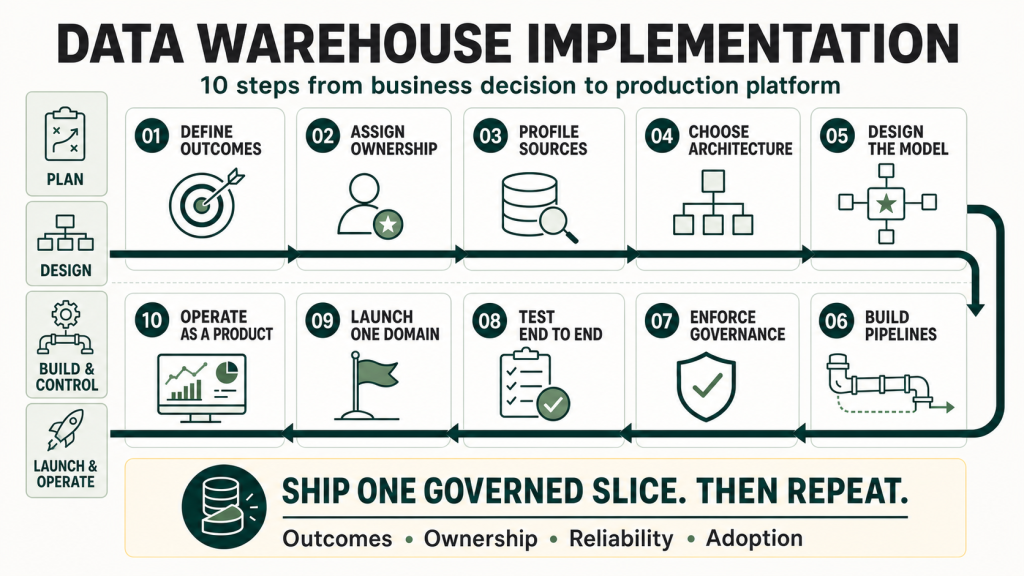
A successful data warehouse implementation starts with one business decision, ships one governed slice of data into production, and then expands through repeatable releases. The practical sequence is: define outcomes, assign ownership, profile sources, choose the architecture, model the data, build pipelines, enforce governance, test end to end, launch in phases, and operate the platform against service and cost targets.
The warehouse is not finished when the first dashboard loads. It is finished when Finance, Sales, and Operations use the same definitions; failed pipelines are recoverable; access is controlled; lineage is visible; and the team can add a new source without rebuilding the platform.
What Is Data Warehouse Implementation?
Data warehouse implementation is the delivery process that turns analytical requirements into a production data platform. It covers business scope, architecture, data modeling, ingestion and transformation, security, testing, deployment, adoption, monitoring, and continuous optimization.
Implementation is broader than design. Data warehouse design defines the target architecture, schema, grain, dimensions, and technical patterns. Implementation makes those decisions operational: code, environments, pipelines, tests, permissions, runbooks, service levels, and ownership. If your architecture decision is still open, start with our guide to data warehouse design and architecture before committing to a platform.
A warehouse also differs from a data lake. A warehouse serves structured, governed data for reporting and analytical queries. A lake retains raw or lightly processed structured, semi-structured, and unstructured data. A lakehouse combines lake storage with warehouse-style management and performance patterns; medallion architecture organizes that flow into bronze, silver, and gold layers.
Plan your data warehouse with us
We help with planning, designing, and optimizing data warehouses for performance and value. Our solutions ensure your data works effectively for your business goals.
Our experts ensure data quality and efficiency for your business.

Our experts ensure data quality and efficiency for your business.
What Should Be Decided Before Implementation Starts?
Do not approve the build until the project has a named business owner, a bounded first release, measurable acceptance criteria, and an agreed source inventory. A platform choice without these decisions creates a technology program with no defensible definition of done.
The minimum implementation charter should answer:
- Which business decisions or reports will the first release improve?
- Which subject area ships first: finance, sales, supply chain, customer, or another bounded domain?
- Who owns each business definition and approves changes?
- Which source systems feed the release, and who owns those systems?
- What freshness, availability, recovery, and query-performance targets apply?
- Which data classifications, residency rules, and access restrictions apply?
- What is explicitly outside the first release?
The first production slice should be valuable enough to earn adoption and narrow enough to expose architecture, quality, and operating problems early. A finance mart with a governed chart of accounts, for example, tests more of the real system than a platform demo populated with clean sample data.
Services You Might Find Interesting


The 10 Data Warehouse Implementation Steps
The ten steps below form one delivery loop. Large programs run several loops in parallel by domain, but they should preserve the same gates, artifacts, and ownership model.
1. Define Business Outcomes and Acceptance Criteria
Start with decisions and metrics, not a list of source tables. Each use case needs an executive owner, intended users, current pain, target behavior, and acceptance criteria that a business stakeholder can test.
Replace “centralize enterprise data” with concrete outcomes such as:
- Finance closes the month from governed actuals and mappings rather than manually reconciled workbooks.
- Sales and Finance use one approved definition of booked revenue.
- Operations receives inventory data before the daily planning window.
- Analysts trace a KPI from dashboard to transformation and source field.
Define success at three levels: business adoption, data fitness, and platform service. Business adoption measures whether the target users switched. Data fitness covers completeness, validity, reconciliation, and freshness. Platform service covers pipeline reliability, recovery, query performance, and spend.
Exit gate: the sponsor approves the first domain, metric definitions, service targets, and a testable definition of done.
2. Establish Ownership and the Delivery Team
One accountable owner must resolve business-definition conflicts. A steering committee without decision rights only schedules the conflict for another meeting.
The core team usually includes:
- an executive sponsor who owns the outcome and funding;
- domain owners and data stewards who approve definitions and quality rules;
- a product owner who controls scope and release priorities;
- a data architect who owns the target architecture and modeling standards;
- data engineers who build ingestion and transformation pipelines;
- analytics engineers or BI developers who build the semantic and consumption layers;
- security, privacy, and platform engineers who own controls and environments;
- operations owners who accept monitoring, support, recovery, and cost management.
Use a RACI only after assigning one accountable person to each major decision. Shared accountability is unowned accountability.
Exit gate: every dataset, metric, pipeline, control, and production service has an owner.
3. Inventory and Profile Source Data
Profile real source data before finalizing estimates or schemas. System documentation describes intended behavior; profiling reveals duplicates, nulls, invalid dates, drifting codes, broken keys, and undocumented spreadsheet logic.
For every source, record:
- business and technical owner;
- extraction method and supported change tracking;
- expected volume, growth, and update frequency;
- schema and code-set volatility;
- key quality rules and reconciliation totals;
- sensitivity classification and residency constraints;
- outage windows, rate limits, and upstream dependencies;
- historical depth and backfill method.
Preserve a replayable raw copy when the architecture permits it. Microsoft’s published DataOps reference architecture lands data before validation so a bad transformation can be corrected and replayed instead of permanently discarding the original input. That is a sound operational pattern, not a vendor-specific feature (Microsoft Azure Architecture Center).
Exit gate: the team has a signed source inventory, profiling report, quality baseline, and backfill estimate.
4. Choose the Target Architecture and Platform
Choose architecture against workloads, controls, team capability, and total operating cost. Do not score platforms by feature count; score them against the first three years of expected use.
| Decision | Choose this when | Design consequence |
|---|---|---|
| Cloud warehouse | Reporting and SQL analytics dominate; governed structured data is the main product | Simpler BI consumption and workload management |
| Lake plus warehouse | Raw files, replay, data science, and governed BI all matter | Separate raw, transformation, and serving responsibilities |
| Lakehouse | One platform must support BI, engineering, and ML over common storage | Strong catalog, table-format, and workload-isolation discipline is mandatory |
| ETL | Sensitive or invalid data must be transformed before warehouse loading | More processing outside the warehouse |
| ELT | The platform can scale transformations and raw landing is controlled | Faster ingestion, but transformation governance moves into the platform |
| Batch | The business decision tolerates scheduled freshness | Lower operational complexity |
| Streaming or micro-batch | The decision loses value when data arrives late | Continuous monitoring, replay, ordering, and idempotency become core requirements |
Separate development, test, and production. Automate infrastructure and deployment rather than configuring production by hand. Microsoft’s DataOps pattern explicitly treats environment automation and pipeline automation as controls that reduce delivery errors (Microsoft Azure Architecture Center).
Exit gate: an architecture decision record documents requirements, tradeoffs, rejected options, recovery design, environment strategy, and a cost model.
5. Design the Data Model and Semantic Contract
Set the grain before building fact tables. Grain defines what one row represents; changing it later forces data reloads, measure rewrites, and reconciliation work.
Model business processes around facts and conformed dimensions rather than copying source-system schemas. Define slowly changing dimension behavior explicitly, including which attribute changes overwrite history and which create a new version. Assign business owners to shared definitions such as customer, product, legal entity, account, revenue, margin, and order status.
The semantic contract should specify:
- fact-table grain and keys;
- dimensions and history rules;
- metric formulas and allowed filters;
- source-to-target mappings;
- currency, fiscal-calendar, time-zone, and unit conversions;
- late-arriving data behavior;
- reconciliation rules and tolerances;
- data classification and field-level access.
Do not put every use case into one universal model. Use conformed dimensions to connect bounded marts without forcing unrelated domains into a single release.
Exit gate: domain owners approve the model, metric definitions, mapping rules, and representative query paths.
6. Build Replayable Ingestion and Transformation Pipelines
Production pipelines must be idempotent, observable, and restartable. A job that works only when every upstream source behaves perfectly is a demo.
Build in layers:
- Land source data with load metadata and immutable audit fields.
- Validate schema, completeness, and control totals.
- Quarantine malformed records without hiding the failure.
- Standardize types, codes, units, and business keys.
- Apply business transformations as version-controlled code.
- Load dimensional or serving models.
- Publish freshness and quality status with the data product.
Use incremental extraction or change data capture where the source supports it, and design full backfills before the first production incident demands one. Keep credentials in a managed secret store, not pipeline configuration files. The underlying extract-transform-load mechanics are covered in our five-step ETL process guide.
Exit gate: pipelines pass replay, duplicate, late-data, schema-change, and partial-failure tests.
7. Enforce Data Quality, Governance, and Security
Governance belongs in the delivery path, not in a policy document attached before launch. Every production dataset needs an owner, classification, quality checks, lineage, retention rule, and approved access path.
Implement least-privilege access through roles and groups. Separate platform administration, pipeline identities, data stewardship, development, and consumption. Encrypt data in transit and at rest, centralize key and secret management, log access, and test the removal of access when roles change.
Data quality controls should run at several points: source arrival, post-standardization, model load, and business reconciliation. Publish failed checks and ownership beside the dataset so users know whether it is fit for use. For a deeper control checklist, see data warehouse security and compliance.
Exit gate: security approves the control design; stewards approve quality rules; lineage connects source, transformation, model, and report.
8. Test the Entire Analytical Product
Test numbers, behavior, recovery, security, and performance. Unit tests alone prove that individual transformations run; they do not prove that the CFO’s total reconciles or that the platform survives a failed load.
The test plan should include:
- transformation unit tests and schema-contract tests;
- source-to-target reconciliation and control totals;
- referential integrity, duplicate, null, range, and freshness checks;
- representative BI queries under expected concurrency;
- role, row-level, and column-level access tests;
- restart, replay, backfill, and disaster-recovery exercises;
- user acceptance tests against named decisions and reports;
- parallel-run comparison against the current reporting process.
Test with production-like data volume and skew. AWS warns that analytical platforms rely on architecture-specific table, loading, and query practices; a design copied from a conventional SQL system will not automatically use massively parallel and columnar execution well (Amazon Redshift documentation).
Exit gate: business owners sign off reconciliations, operations accepts recovery tests, and performance meets the declared service targets.
9. Launch One Domain, Then Expand
Release a bounded business domain and run it in parallel with the legacy process long enough to explain differences. A big-bang enterprise cutover concentrates data, process, security, and adoption risk into one date.
The launch plan needs:
- data freeze and cutover rules;
- user training tied to real workflows;
- reconciliation ownership and escalation paths;
- hypercare coverage and incident severity definitions;
- legacy report retirement criteria;
- adoption reporting by team and use case;
- a prioritized backlog for the next domain.
Do not preserve two sources of truth indefinitely. Set an evidence-based retirement gate, then remove the old report or pipeline once the new product meets it.
Exit gate: target users have adopted the new product, reconciliations are closed, and the legacy path has a dated retirement decision.
10. Operate the Warehouse as a Product
The operating model determines whether the warehouse stays trusted after launch. Monitor the data, pipelines, platform, users, and spend as one service.
Track at least:
- source arrival and end-to-end freshness;
- pipeline success, duration, retries, and backlog;
- data quality pass rates and open exceptions;
- query latency, concurrency, queue time, and failed queries;
- storage growth and compute consumption by workload;
- access anomalies and privileged-role changes;
- recovery-point and recovery-time performance;
- dataset and report adoption;
- cost per domain, workload, or data product where allocation is practical.
Separate ingestion, transformation, BI, and ad hoc workloads when one can starve another. Apply budgets, alerts, schedules, auto-suspend policies, and workload tagging from the first production release. Our guides to data warehouse cost optimization and database performance tuning cover those operating disciplines in detail.
Exit gate: service owners review reliability, quality, adoption, security, and cost on a fixed cadence, with an improvement backlog tied to the results.
What Deliverables Should the Implementation Produce?
The deliverables should let another qualified team operate and extend the warehouse without reverse-engineering it. Architecture diagrams alone do not meet that standard.
| Area | Required deliverables |
|---|---|
| Business | charter, use-case backlog, metric catalog, acceptance criteria, ownership map |
| Data | source inventory, profiling report, mappings, data model, quality rules, lineage |
| Platform | architecture decision records, environment design, infrastructure code, cost model |
| Engineering | version-controlled pipelines, tests, deployment workflow, backfill and replay procedures |
| Security | classifications, access matrix, threat review, audit logging, retention and key-management design |
| Operations | dashboards, alerts, runbooks, incident paths, service targets, recovery plan, capacity and cost controls |
| Adoption | training, parallel-run evidence, report retirement plan, usage measures, domain roadmap |
Treat documentation as a release artifact. If a pipeline changes without updating ownership, lineage, tests, and the runbook, the release is incomplete.
Why Data Warehouse Implementations Fail
Most failures are governance and delivery failures expressed through technology. The warning signs appear early:
- The project starts with a platform purchase. The team optimizes for installing features instead of changing a business decision.
- Scope is “all enterprise data.” No release can prove value, so architecture work expands without a production feedback loop.
- Definitions remain political. The warehouse centralizes conflicting logic instead of resolving it.
- Profiling happens after modeling. Real data breaks estimates, keys, history rules, and load logic.
- Security and operations arrive at the end. Manual permissions, missing logs, and untested recovery delay launch or create production risk.
- Pipelines hide bad records. Dashboards stay green while totals drift.
- The legacy process never retires. Users compare two official answers and trust neither.
- Spend has no owner. Elastic compute removes the capacity ceiling but also removes the natural spending brake.
Use stage gates to stop weak assumptions before they compound. A one-week profiling delay costs less than rebuilding a model after historical loads expose broken keys.
FAQ: Data Warehouse Implementation
How long does a data warehouse implementation take?
There is no defensible universal timeline. Duration depends on source count, history volume, data quality, security controls, integration complexity, and the size of the first release. Plan for a bounded domain release first and estimate the broader program only after profiling real data and completing the architecture decision.
How much does data warehouse implementation cost?
Cost includes delivery labor, platform consumption, integration tooling, environments, security, testing, migration, training, and ongoing operations. Build a workload-based cost model from data volume, refresh frequency, concurrency, retention, recovery, and query patterns; a license quote alone is not a project estimate.
Should we use ETL or ELT for a cloud data warehouse?
Use ELT when governed raw landing is acceptable and the warehouse or lakehouse can run transformations efficiently. Use ETL when data must be filtered, masked, or standardized before it enters the target platform. Enterprise implementations often combine both by source and sensitivity level.
What is the best first use case for a data warehouse?
Choose a use case with an executive owner, measurable pain, available source data, and cross-functional value. A governed finance or sales subject area often works because conflicting metrics are visible and acceptance can be tested through reconciliation.
How do we know the data warehouse is ready for production?
It is ready when business owners approve reconciled metrics, representative workloads meet service targets, access controls pass testing, pipelines recover from failure, lineage is available, operations accepts the runbooks, and the cutover has a dated legacy-retirement plan.
Build the First Release Around a Decision That Matters
A warehouse earns trust one governed domain at a time. Define the first business outcome, test the source data, lock the ownership model, and ship a production slice that proves the architecture under real volume and real scrutiny.
Talk to Multishoring’s data warehouse consulting team about your implementation scope, architecture options, and the fastest defensible route to a production first release.
Sources
- Microsoft Azure Architecture Center: DataOps for the modern data warehouse
- Microsoft Azure Architecture Center: Big data architectures
- Amazon Redshift documentation: Best practices
- Snowflake documentation: Key concepts and architecture
- Snowflake documentation: Business continuity and disaster recovery


