
Content
Building an AI agent that works in a demo is easy. Running one in production is the hard part – and it is where most enterprise agent projects stall. The demo shows an agent booking a meeting or pulling a report in seconds. The room is impressed. Then the project meets reality: real systems, real permissions, real consequences when the agent gets it wrong.
Enterprise AI agents are the current center of gravity in corporate AI, and for good reason. Unlike a chatbot that only answers, an agent acts – it takes steps across your systems to complete a task. That shift from responding to doing is exactly what makes agents valuable, and exactly what makes them difficult to put into production safely.
Here is the part teams underestimate: the model is the easy part. A capable agent can be assembled quickly today. What separates a pilot from a production system is everything around the model – data access, integration with your workflows, permissions, human oversight, monitoring, and an audit trail. That is where the value is realized, and where the risk lives.
This guide is written for the leaders deciding whether and how to move agents into production – CIOs, Chief AI Officers, and the teams accountable for the results. It covers what enterprise AI agents actually are, why the gap between demo and production is so wide, the use cases worth pursuing first, the guardrails that make agents safe to run, and a staged path from pilot to production. The goal is not to talk you out of agents. It is to help you ship them without regret.
What enterprise AI agents are (and are not)
An AI agent is software that takes actions to complete a task – not just software that answers questions. That one distinction explains most of what follows, so it is worth getting right before anything else.
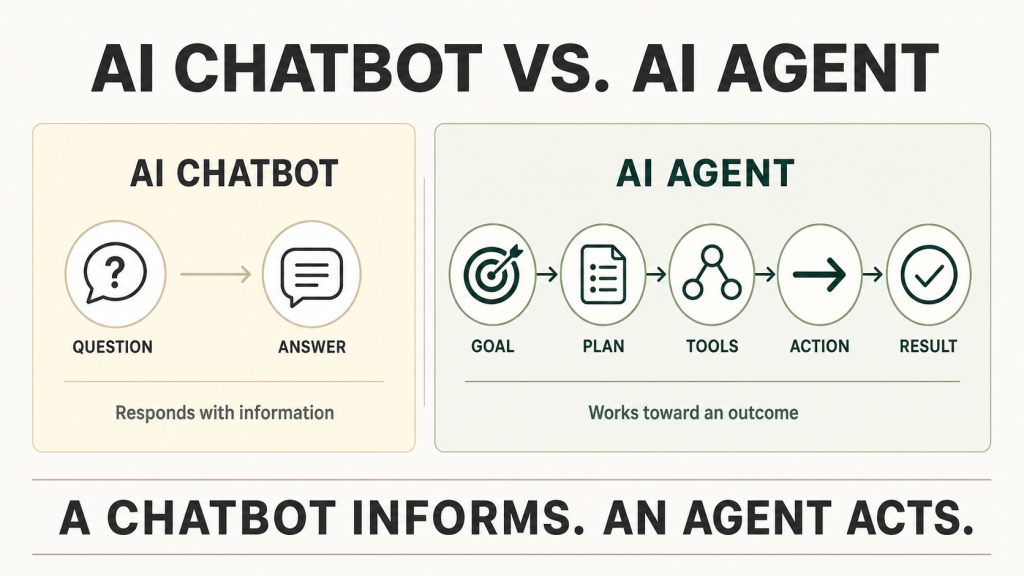
A traditional chatbot or assistant responds. You ask, it replies, the loop ends. An agent is given a goal and works toward it: it can plan steps, call tools and systems, make decisions along the way, and act on them – often across several applications – until the task is done. The difference is between “tell me how to process this invoice” and “process this invoice.”
In practice, an enterprise AI agent usually combines a few parts:
- A reasoning model at the core, which plans and decides.
- Tools and integrations – the systems it can read from and act on, such as your CRM, ERP, ticketing, or databases.
- Memory and context – the information it carries through a task, and sometimes across tasks.
- Guardrails – the permissions, oversight, and limits that govern what it is allowed to do.
That last part is not optional decoration. For enterprise use, the guardrails are as much a part of the agent as the model. We will come back to them in depth.
What agents are not
Clearing up the misconceptions saves a lot of wasted effort:
- They are not chatbots. A chatbot informs; an agent acts. If it cannot take an action in your systems, it is an assistant, not an agent.
- They are not autonomous employees. Effective enterprise agents run on a leash – scoped tasks, defined permissions, human oversight at the points that matter. “Set it and forget it” is a way to get hurt, not a design goal.
- They are not a single product you buy. An agent is an assembly of a model, your data, your integrations, and your controls. Two vendors can sell “an agent” and mean very different things.
- They are not magic once demoed. A working demo proves capability. It says almost nothing about whether the agent is ready to run in production.
Why the definition matters commercially
The reason to be precise is that the definition sets the workload. Because an agent acts, it needs access to real systems and the authority to change things – and that raises the bar on integration, security, and governance far above a chatbot. Teams that treat an agent like a smarter chatbot underestimate exactly the work that determines whether it ever ships.
That gap between “it works in the demo” and “it runs in production” is the heart of the matter – and the subject of the next section.
Your AI agent works in the demo. Can you run it in production?
We help enterprises take AI agents from impressive demo to dependable production – with the data readiness, guardrails, and repeatable path that make them safe to run.
From impressive demo to dependable system.

From impressive demo to dependable system.
The gap between a demo and production
A demo proves an agent can do the task. Production proves your organization can let it – safely, repeatedly, at scale. Those are different achievements, and the distance between them is where agent projects quietly die.
The demo is built to impress. It runs in a controlled setting, on clean data, with a friendly happy-path scenario and a human ready to smooth over anything odd. Production is the opposite of all four. The data is messy, the scenarios are unpredictable, the systems are live, and there is no one standing by to catch every mistake. An agent tuned for the demo meets a world it was never tested against.
Here is what actually widens on the way to production.
The stakes change
In a demo, a wrong answer is a talking point. In production, a wrong action is an incident. An agent that acts inside your systems can send the email, update the record, approve the request, or move the money. The moment consequences are real, “usually right” is not good enough – you need to know what happens on the day it is wrong.
The environment changes
- Data goes from a curated sample to the full, inconsistent reality of your systems.
- Integration goes from a mocked-up connection to live CRM, ERP, and ticketing, each with its own quirks and security rules.
- Edge cases go from ignored to unavoidable – and agents fail in stranger ways than traditional software, because they improvise.
- Scale goes from one supervised run to thousands of unattended ones, where small error rates compound.
The requirements change
This is the part demos skip entirely. To run in production, an agent needs permissions scoped to its task, human oversight at the consequential points, monitoring to catch problems in motion, and an audit trail of what it did and why. None of that shows up in a slick demo, and all of it is required before the business can depend on the agent.
There is a well-known pattern behind this, sometimes called the “last mile” of AI: getting to a working prototype is perhaps 20% of the effort, and the remaining 80% is the integration, hardening, and control it takes to run reliably. With agents the last mile is longer still, precisely because they act rather than answer.
The practical consequence for a decision-maker is a change in how you judge a pilot. The right question is not “does the agent work?” but “what would it take to run this safely, and are we willing to build it?” A team that can answer the second question has a path to production. A team dazzled by the first has a demo. The next sections cover what that path requires – starting with where to point agents first.
High-value use cases: where to point agents first
The best first agent is not the most impressive one – it is the one with high value and contained risk. Where you start decides whether the program builds momentum or stalls after a cautionary tale. So the smart move is to pick use cases that matter to the business but do not put you one bad action away from a crisis.
A useful way to judge any candidate is a simple test: how much value does it create, and how much damage can it do if it goes wrong? The sweet spot for early agents is high value, bounded risk – real work, with a blast radius you can control.
Three families of use case tend to sit in that sweet spot for enterprises:
| Use case family | What the agent does | Risk profile | Why it is a good start |
|---|---|---|---|
| Data analysis & management | Pulls from multiple sources, reconciles data, turns a plain-language question into a drafted answer or report. Includes agentic data management – cataloging, cleaning, organizing. | Often lower – much of it is read-and-report, not change-and-commit. | Contained risk, fast time-to-value, replaces slow manual reporting. |
| Business intelligence | Lets people interrogate BI in conversation: “why did margin drop in the northeast last quarter?” – queries the data, explains, follows up. | Medium – the answer must be right and show its work, or trust erodes. | Builds on existing BI and data-warehouse assets; high everyday demand. |
| Workflow & process automation | Carries a multi-step process: ticket triage and response, parts of onboarding, invoice processing, moving a case through stages. | Higher – the agent acts, changing records and triggering downstream steps. | Usually the biggest hard-dollar value; take it on once guardrails are in place. |
Two notes on reading the table. Business intelligence is a natural fit for organizations with an existing data-warehouse foundation – it builds on assets you already have – but trust is the constraint: a BI agent has to be right and has to show its work. And workflow automation is where the hard-dollar value usually sits, which is exactly why it needs the guardrails from the next section, plus a human approving consequential moves early on.
How to choose the first one
A few practical filters when picking where to begin:
- Real but bounded. Genuine business value, with a limited blast radius if it errs.
- Good data underneath. The data the agent relies on is accessible and trustworthy – if it is not, fix that first.
- A human in reach. Especially early, someone can review the agent’s consequential actions.
- Measurable. You can point to hours saved, cycle time cut, or errors reduced – proof that carries the case for the next agent.
The pattern is deliberate. Land a contained, measurable win, use it to build confidence and the operating muscle, then take on higher-stakes processes. Chasing the flashiest use case first is how promising programs end with a story people tell as a warning. What makes any of these safe to run is the subject of the next section.
Guardrails: what makes an agent safe to run
Guardrails are what let you give an agent real authority without taking on unbounded risk. They are the difference between an agent you can defend in front of your risk team and one you quietly hope no one asks about. As we said earlier, for enterprise use the guardrails are part of the agent, not an add-on.
The principle behind all of them is simple: an agent should be able to do exactly what its task requires and nothing more – and you should always be able to see and reconstruct what it did. Four controls put that into practice.
- Permissions and least privilege. Give the agent the narrowest access that still lets it work – a reporting agent reads, it does not need write access to your ERP. Tight scoping limits the blast radius if the agent misbehaves or is manipulated. It matters more here than with ordinary software, because agents can be steered by their inputs: a prompt injection hidden in data the agent reads can try to make it act outside its intent. An agent that cannot delete records cannot be tricked into deleting them.
- Human-in-the-loop. Decide in advance which actions the agent may take alone and which need a person to approve. Low-stakes, reversible steps can run unattended; consequential ones – moving money, external communications, changing customer records – should pause for sign-off. Treat oversight as a dial, not a switch: highest when the agent is new and the stakes are high, relaxed as it earns trust through a track record.
- Monitoring and observability. You cannot manage what you cannot see. A production agent needs live visibility into what it runs, what it acts on, where it fails, and how it performs over time – so you catch problems in motion, not after a complaint. This is also what makes thousands of unattended runs safe: you can watch them in aggregate and flag drift before it becomes an incident.
- Audit trail. Log every consequential action – what the agent did, when, on what basis, and with what result. One record serves three masters: engineers debugging behavior, operators explaining a decision to a customer, and compliance demonstrating control to a regulator. In regulated sectors it is not optional, and it is far cheaper to build in than to reconstruct later.
Guardrails are a governance problem
These four controls have something in common: permissions, oversight, monitoring, and audit are exactly what a mature AI governance program already defines – applied to agents. That is good news. If you have done the governance work, you are not starting from zero. If you have not, agents are a forcing function to begin.
We cover the full operating model – roles, inventory, approval gates, and control mapping – in our guide to AI governance for regulated enterprises. For agents, the takeaway is this: guardrails are not what slow the agent down. They are what let you speed it up, because they are why someone can confidently approve it for production. That approval, and the path to it, is the final piece.
A path from agent pilot to production
Getting one agent into production is a project. Getting agents into production repeatedly is a capability – and that is the real goal. The organizations that win with agents are not the ones with the most pilots. They are the ones that turned “demo to production” into a route they can run again and again.
The path below assumes the pieces from the earlier sections – a well-chosen use case, ready data, and the guardrails – and puts them in order.
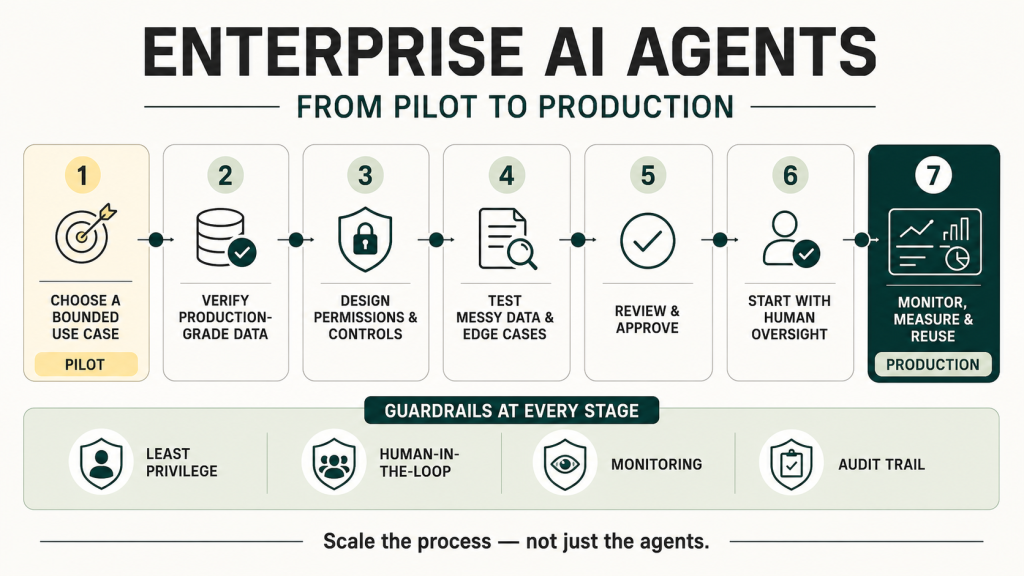
- Pick a contained, valuable first use case. Start where value is real and the blast radius is limited. The first agent is as much about building the operating muscle as about the win itself.
- Confirm the data is production-grade. Check that the data the agent relies on is accessible, complete, and trustworthy – not just the tidy sample the demo ran on. Weak data is the quiet killer.
- Scope permissions and design the guardrails in. Define least-privilege access, the human-approval points, monitoring, and the audit trail before you build – not after the agent works. Retrofitting control is the main cause of delay.
- Pilot against production reality. Test the agent on messy data and edge cases, not the happy path. The question you are answering is “what happens when it is wrong?”, so probe exactly that.
- Review and approve for production. A named owner checks the agent against its requirements – tested, oversight defined, monitoring live, integration secure – and signs off, on the record. This is the gate between pilot and production.
- Start with oversight high, then earn autonomy. Launch with a human approving consequential actions, and turn that dial down as the agent builds a track record. Trust is granted on evidence, not on the strength of a demo.
- Monitor, measure, and templatize. Watch the agent in production, capture the results – hours saved, cycle time cut, errors reduced – and turn the steps you just followed into a template for the next agent.
Two principles keep this working past the first agent.
- Start small, then reuse. You do not need an agent platform strategy before shipping anything. Prove the path on one agent, then run it back. The second is faster than the first, the tenth faster still.
- Scale the process, not just the agents. Going from three live agents to thirty is safe only if the route to production is repeatable. The process is the asset – the agents are what it produces.
Done this way, agents stop being impressive one-offs and become something your organization deploys with confidence – each one quicker to ship than the last, and each one you can stand behind.
Summary: ship agents you can stand behind
Enterprise AI agents fail in production for organizational reasons, not technical ones. The model is the easy part. What decides whether an agent ships is everything around it – the data it runs on, the systems it integrates with, and the guardrails that make it safe to act. Teams that grasp this build agents that reach production; teams dazzled by the demo build agents that never leave it.
The through-line of this guide, in one place:
- An agent acts, it does not just answer – which raises the bar on integration, security, and governance far above a chatbot.
- The demo-to-production gap is the real work. A demo proves capability; production proves you can run the agent safely, repeatedly, at scale.
- Start where value is high and risk is contained – data analysis, BI, and bounded workflows – before taking on higher-stakes processes.
- Guardrails are part of the agent. Least-privilege permissions, human-in-the-loop, monitoring, and an audit trail are what let you grant real authority without unbounded risk.
- A repeatable path is the goal. Prove it on one contained agent, then templatize – so the tenth agent ships faster than the first.
The organizations pulling ahead treat agents not as clever experiments but as systems they can deploy with confidence. That confidence is not luck. It comes from the data readiness, the guardrails, and the governance that let someone say “yes, run it” and mean it. Start small, prove the path, and reuse it – that is how agents move from pilot to production without regret.
Frequently asked questions about AI Agents
What is an enterprise AI agent?
An enterprise AI agent is software that takes actions to complete a task inside a business, not just software that answers questions. Given a goal, it can plan steps, call systems and tools, make decisions, and act across applications – for example processing an invoice end to end rather than explaining how to process one. It combines a reasoning model, integrations with your systems, memory, and guardrails.
How is an AI agent different from a chatbot?
A chatbot responds; an agent acts. A chatbot answers a question and the interaction ends. An agent works toward a goal and takes actions in your systems to reach it. That ability to act is what makes agents more valuable and also harder to put into production, because it raises the stakes on permissions, security, and oversight.
Why do enterprise AI agent projects fail to reach production?
Usually because the work beyond the model is underestimated. Demos run on clean data and happy-path scenarios; production brings messy data, live systems, edge cases, and real consequences when the agent acts wrongly. Projects stall when data is not production-grade, integration is harder than expected, or the guardrails needed to approve the agent were never built.
What guardrails do AI agents need in production?
Four are essential: least-privilege permissions so the agent can only do what its task requires; human-in-the-loop approval for consequential or irreversible actions; monitoring for live visibility into what the agent is doing; and an audit trail that logs every consequential action for debugging, accountability, and compliance. Together they let you grant real authority while keeping the risk bounded.
Where should we deploy our first AI agent?
Start with a use case that has real value but a contained blast radius – data analysis and reporting, conversational BI, or a bounded workflow are common first choices. Make sure the underlying data is trustworthy, keep a human in reach to review consequential actions, and choose something measurable so the results build the case for the next agent.
Are AI agents safe for regulated industries?
They can be, with the right controls. The same guardrails that make any agent production-ready – scoped permissions, human oversight, monitoring, and an audit trail – are also what regulated sectors need to demonstrate control. These map directly to a mature AI governance program, so agents are safe to run when they sit inside that operating model rather than outside it.