
Content

The reason your AI pilots stall is usually not the model – it is the data underneath it. The model performs beautifully in the demo, then struggles the moment it meets your real, production data. That is not bad luck. It is the predictable result of pointing capable AI at data that was never prepared for it.
You are not alone in this. Gartner has warned that a lack of AI-ready data is putting AI projects at risk, predicting that through 2026, organizations will abandon 60% of AI projects that are not supported by AI-ready data. Read that again: not projects that fail on the model – projects abandoned because the data underneath was never ready. For a data leader, that is the quiet crisis behind the AI mandate coming down from the board.
Here is the part worth internalizing early: AI-ready data is not a bigger data lake or a shinier warehouse. It is data that is governed, high-quality, well-structured, and genuinely accessible to models – including the messy, unstructured content that GenAI and retrieval-augmented generation (RAG) depend on. Volume is not the point. Readiness is.
This guide is for the CDOs, heads of data, and data platform leaders who have to make that readiness real. It covers what “AI-ready” actually means, why so many pilots fail on data, how to structure data for GenAI and RAG, a practical readiness checklist, and how to turn a one-off fix into a production data foundation. The goal is simple: to help you answer, honestly, whether your data is ready for the AI your organization is about to build on it.
What “AI-ready” actually means
Data is AI-ready when a model can use it to produce a reliable result – not just when it exists somewhere in your systems. That is a higher bar than most organizations realize, and it is the bar that decides whether a pilot survives contact with production.
The common misconception is that having a lot of data means being ready for AI. It does not. Plenty of organizations sit on huge data estates and are nowhere near AI-ready, because volume says nothing about quality, structure, governance, or access. AI-ready data is defined by four properties, and a weakness in any one of them is enough to sink a project.
The four properties of AI-ready data
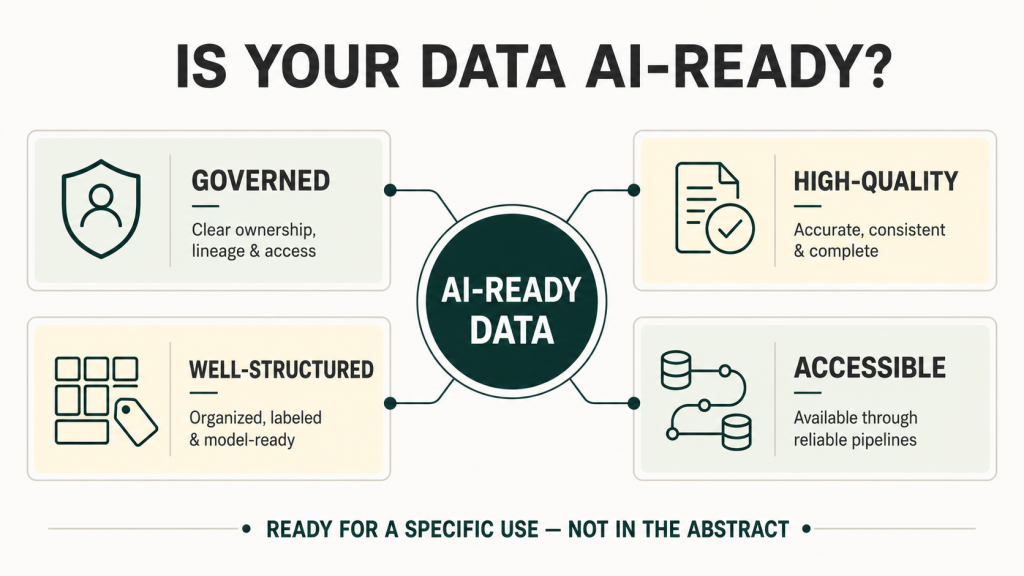
- Governed. You know where the data came from, who owns it, what it can be used for, and who is allowed to touch it. Lineage and access control are in place. Without governance, you cannot trust the data or prove you are entitled to use it – which matters doubly once AI is involved.
- High-quality. The data is accurate, consistent, and complete enough to depend on. AI does not fix bad data; it amplifies it. A model trained or grounded on flawed data produces flawed output faster and more convincingly than any human would.
- Well-structured. The data is organized, described, and labeled so a model can actually consume it. That includes real metadata and, critically, a plan for unstructured content – the documents, emails, and tickets that hold much of an enterprise’s knowledge.
- Accessible. The model can reach the data when it needs it, through the right pipelines and integrations, at the speed the use case requires. Data locked in a silo no one can query is not an asset to an AI system.
A useful test: pick one AI use case you care about, and ask whether the data behind it clears all four. Most stalls trace back to the property people forgot to check.
AI-ready is contextual, not absolute
There is an important nuance here. Data is not AI-ready in the abstract – it is ready for a specific use. Data that is perfectly ready to train a forecasting model may be nowhere near ready to ground a customer-facing RAG assistant, because the requirements differ. The question is never simply “is our data AI-ready?” but “is this data ready for this use?”
This is why readiness is a moving target rather than a one-time project. New use cases raise new requirements, and standards for what “good” looks like keep rising as AI becomes more capable and more regulated.
Where AI-ready data sits relative to what you already have
For most enterprises, AI-ready data is not a greenfield build. It is an extension of the data management work you have done for years – warehousing, quality, governance, and modernization. That is genuinely good news: the disciplines are familiar. What changes is that AI raises the stakes on all of them and adds new demands, especially around unstructured data and real-time access. You are extending a foundation, not starting over.
One distinction worth drawing before we go further: getting data AI-ready is closely tied to data governance, but they are not the same thing. Governance controls the data; AI readiness is the broader state of that data being usable by models. We treat governance for AI in depth in a separate guide – here, it is one of the four properties, not the whole story.
With the definition clear, the next question is the practical one: if this is what AI-ready looks like, why do so many pilots fail to reach it?
Not sure your data is ready for the AI you are building on it?
We help enterprises close the readiness gap – governed, high-quality, well-structured, accessible data for GenAI and RAG – so pilots reach production instead of stalling on the data underneath.
Find the gaps before they stall your project.

Find the gaps before they stall your project.
The readiness gap: why pilots fail on data
The readiness gap is the distance between the clean sample your pilot ran on and the messy reality your production system has to run on. Almost every data-driven stall lives in that gap – and it stays invisible until the pilot tries to scale.
The pattern is always the same. The team hand-picks a clean slice of data to prove the concept, it works, everyone is encouraged – then production asks the system to run on the full estate, and the results fall apart. The AI did not get worse. The data got real.
Four failures live in that gap:
- The data is not accessible when the model needs it. It exists, but it is trapped – in a legacy system, a silo another team owns, or a format nothing can query in time. The pilot borrowed a convenient extract; production needs a live pipeline that isn’t there. The most common stall, and the least visible in a demo.
- The quality does not survive contact with reality. The curated sample was clean; the full dataset has duplicates, gaps, stale records, and the same field defined differently across systems. Because AI amplifies bad data rather than flagging it, the failure shows up as confident, plausible, wrong output.
- The unstructured data was never dealt with. Much of an enterprise’s knowledge lives in documents, emails, PDFs, and tickets. GenAI and RAG are built to use exactly this content – but only once it has been collected, cleaned, and organized, which teams planning only for tidy tables skip.
- The governance is not there, so no one will approve it. Even when the data works technically, the project stalls at sign-off: no one can confirm it is allowed to be used this way, where it came from, or whether it holds something sensitive. In regulated sectors, that is decisive.
Notice the pattern: none of these are model problems, and all of them surface late – after time and budget have gone into a pilot that looked like a success. The failure is baked in at the start, when the data was assumed ready, and only shows at the end, when it is time to scale.
So close the gap deliberately, before it closes your project. Ask the honest question at the pilot stage – is our data actually ready, or does it only look ready because the sample was hand-picked? The next two sections give you the tools to answer it: first for the hardest case, GenAI and RAG, then as a concrete checklist.
Structuring data for GenAI and RAG, including unstructured
GenAI raises the readiness bar because it runs on the messiest data you have – the unstructured content most data programs never fully tackled. Structured tables are the comfortable part. The documents, emails, PDFs, and tickets where your real institutional knowledge lives are the hard part, and they are exactly what generative AI needs.
The dominant pattern for putting that knowledge to work is retrieval-augmented generation, or RAG. It is worth understanding at a high level, because it drives the data requirements.
How RAG changes the data job
In simple terms, RAG lets a model answer using your content instead of only what it learned in training. When a question comes in, the system retrieves the most relevant pieces of your data and gives them to the model to ground its answer. That design is what makes enterprise GenAI useful – and it puts your data, not the model, on the critical path. If the retrieval step surfaces the wrong, outdated, or poorly prepared content, the answer is wrong, no matter how good the model is.
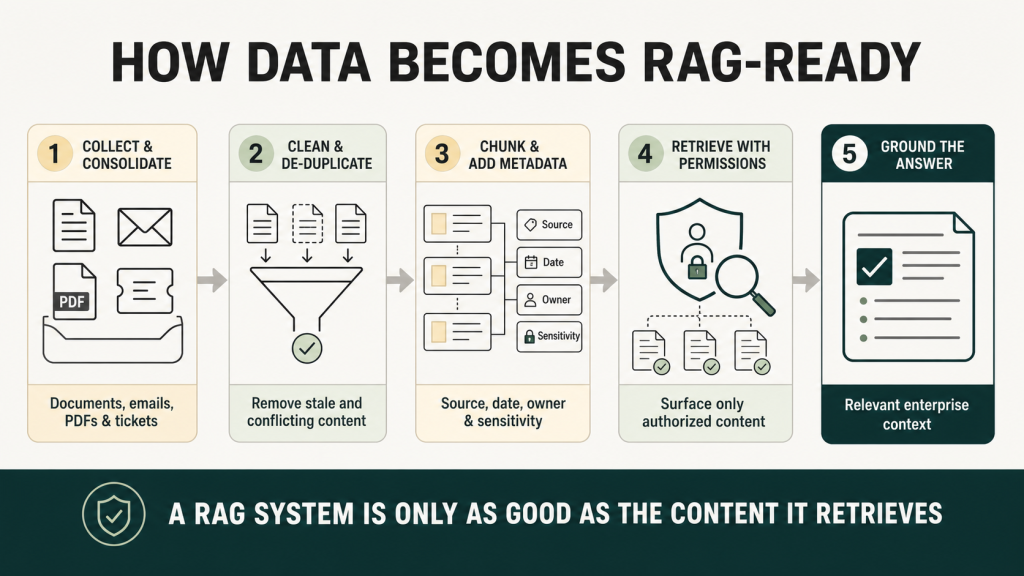
So the work shifts from training models to preparing content for retrieval. A few things that requires:
- Collect and consolidate the unstructured sources. Know what content you have and where it lives, and bring the relevant sources into reach rather than leaving them scattered.
- Clean and de-duplicate. Remove stale versions, duplicates, and contradictory documents. With RAG, two conflicting documents produce an unreliable answer, so version control and freshness matter.
- Chunk and add metadata. Break long documents into sensible, self-contained pieces and tag them with context – source, date, owner, sensitivity. Good chunking and metadata are what make retrieval accurate.
- Respect permissions at retrieval time. The system must only surface content a given user is allowed to see. Ignoring this is how a RAG assistant becomes a data-leak incident.
The quality-in, quality-out rule
There is a simple principle underneath all of this: a RAG system is only as good as the content it retrieves. Teams tend to spend their energy on the model and the prompt, then wonder why answers are unreliable. The lever is almost always the data – its coverage, freshness, structure, and governance. Get the content right and mediocre setups perform well; get it wrong and the best model on the market still disappoints.
Governance does not stop at structured data
One trap worth naming: many organizations govern their structured data reasonably well and treat unstructured content as an afterthought. GenAI closes that loophole. The moment a model can retrieve from your documents, those documents need the same governance as your databases – ownership, access control, and sensitivity handling. Extending governance to unstructured data is often the single biggest readiness task a GenAI use case exposes.
None of this requires boiling the ocean. You do not need every document in the enterprise ready – you need the content behind your specific use case ready, done well, and expandable. That scoping is what turns an overwhelming problem into a shippable one, and it leads straight into the checklist in the next section.
A data-readiness checklist
Before you scale any AI use case, run its data through one honest check: does it clear all four properties of AI-ready data? The checklist below turns that into concrete questions. Score it against a specific use case, not your data estate in general – readiness is contextual, as we saw earlier.
Use it as a gate at the pilot stage. If you cannot answer “yes” to a row, that is not a reason to stop – it is the work to do before production.
| Property | Ask yourself | Red flag if… |
|---|---|---|
| Governed | Do we know this data’s source and owner, what it may be used for, and who can access it? | No clear owner or lineage; unsure whether the use is permitted; sensitive data unclassified. |
| For a RAG use case, do permissions carry through to retrieval? | The system could surface content a user should not see. | |
| High-quality | Is the data accurate, consistent, and complete enough to base a decision on? | Duplicates, gaps, stale records; the same field defined differently across systems. |
| Have we tested it on the full dataset, not just the pilot sample? | “It worked on our sample” is the only evidence you have. | |
| Well-structured | Is the data organized, described, and tagged with usable metadata? | Little or no metadata; a model cannot tell what a field or document is. |
| For GenAI, is unstructured content collected, cleaned, and chunked? | The knowledge lives in documents no one has prepared for retrieval. | |
| Accessible | Can the model reach this data reliably, through a real pipeline, at the speed the use case needs? | The pilot used a manual extract; there is no production pipeline. |
| Is access fast enough for how the use case will actually run? | Data is reachable in theory but too slow or batch-bound in practice. |
How to read your score
A few practical rules for acting on the results:
- Any red flag in “governed” is a stop-and-fix, especially in regulated sectors. Technical readiness does not matter if you cannot prove you are entitled to use the data.
- Weakness in “accessible” is the most common and most underestimated. A convenient pilot extract hides the absence of a real pipeline – the single biggest cause of late-stage stalls.
- You do not need a perfect score across the whole estate. You need a clean score for the data behind this use case. Scope tightly, fix what this project needs, and expand from there.
Treat the checklist as a recurring gate, not a one-time audit. Each new use case brings its own data and its own requirements, so the honest questions get asked again every time – which is exactly how you keep readiness from silently decaying. Passing the checklist once for one project is the start of something bigger: a repeatable data foundation, which is where we go next.
From readiness to a production data foundation
Making the data ready for one use case is a project. Making readiness a permanent property of your data is a capability – and that is what actually lets you scale AI. The organizations that pull ahead are not the ones that cleaned up data for a single pilot. They are the ones that built a foundation every future use case draws on.
The difference matters because the one-off approach quietly fails. Fix the data for one project, and the next project starts from scratch – a fresh scramble, fresh cost, fresh delay. Do that a few times and AI feels slow and expensive, because every use case pays the readiness tax again. A production data foundation pays it once.
What “foundation” means in practice
You do not get there by boiling the ocean. You get there by making the readiness work repeatable and cumulative:
- Governance that runs continuously. Ownership, lineage, quality, and access managed as an ongoing discipline, not re-established per project. This is where AI readiness and a mature data-governance program meet.
- Pipelines, not extracts. Reliable, maintained data flows that feed AI systems in production – replacing the manual pull that props up most pilots.
- Unstructured data handled as a first-class citizen. A standing way to bring documents and other content into a governed, retrievable state, so each GenAI use case is not a fresh archaeology project.
- Readiness checks built into the process. The checklist from the last section applied as a standing gate, so new data and new use cases are held to the same bar automatically.
Start where the value is, then compound
The practical path mirrors the one that runs through this whole cluster. Do not wait for a perfect enterprise-wide data platform before shipping anything – that project never finishes. Instead:
- Pick a high-value use case and get its data genuinely AI-ready.
- Build the readiness work as reusable pieces – governance, pipelines, unstructured handling – rather than throwaway fixes.
- Reuse and extend those pieces for the next use case, so each one is faster than the last.
That is how a data foundation compounds. The first use case is the hardest and slowest. The tenth is quick, because the foundation is already there and readiness has become the default state of your data rather than a special effort.
This is also where AI readiness connects to the bigger picture. A production data foundation is what turns AI from a series of stalled experiments into something your organization runs reliably – the same shift from pilots to production that governance and agent-readiness drive from their own angles. Get the data foundation right and you remove the most common reason AI never ships. That is the whole point of asking, early and honestly, whether your data is ready.
Summary: readiness is the real AI project
Most AI initiatives do not fail on the model – they fail on the data underneath, and that failure is preventable. AI-ready data is not a bigger data lake. It is data that is governed, high-quality, well-structured, and accessible to models – assessed for a specific use, not in the abstract. When a pilot stalls, the cause is almost always one of those four properties that no one checked before scaling.
The way through is to stop treating readiness as an afterthought and start treating it as the project. Run every use case through an honest readiness check at the pilot stage, pay special attention to the two failure modes that hide best – inaccessible data with no real pipeline, and ungoverned unstructured content – and fix what that specific use case needs rather than boiling the ocean. GenAI and RAG raise the bar further, because they put your content, not the model, on the critical path.
Then make it last. Turn one project’s readiness work into reusable governance, pipelines, and unstructured-data handling, so each use case is faster than the last. That is a production data foundation, and it is what converts AI from a shelf of stalled experiments into something your organization runs reliably. The question to ask early, and often, is simple: is this data ready for this use – or does it only look ready because the sample was hand-picked?
Frequently asked questions about AI-ready data
What does “AI-ready data” mean?
AI-ready data is data a model can actually use to produce a reliable result. In practice that means it is governed (clear ownership, lineage, and access control), high-quality (accurate, consistent, complete), well-structured (organized with usable metadata, including a plan for unstructured content), and accessible (reachable through real pipelines at the speed the use case needs). Having a lot of data is not the same as having AI-ready data.
How do I know if my data is ready for AI?
Test it against those four properties for a specific use case, not your data estate in general. The most reliable signal of a problem is that a pilot worked on a hand-picked sample but has never been run on the full, production dataset. If you cannot confirm the data’s quality, governance, structure, and access for the real workload, it is not yet ready.
Why do so many AI projects fail because of data?
Because the failure is baked in early and surfaces late. Pilots run on clean, curated samples, so data problems – inaccessible sources, poor quality, unprepared unstructured content, missing governance – only appear when the project tries to scale on real data. Gartner has predicted that through 2026, organizations will abandon 60% of AI projects that are not supported by AI-ready data.
What data do GenAI and RAG need?
They rely heavily on unstructured content – documents, emails, PDFs, tickets – made retrievable. That means collecting and consolidating the sources, cleaning and de-duplicating them, breaking them into well-tagged chunks, and enforcing permissions at retrieval time. A RAG system is only as good as the content it retrieves, so the data work matters more than the model choice.
Is AI-ready data the same as data governance?
No, though they are closely linked. Data governance controls the data – ownership, lineage, quality, and access. AI readiness is the broader state of that data being usable by models, of which governance is one component alongside quality, structure, and accessibility. Strong governance is necessary for AI readiness but not sufficient on its own.
Where should we start?
Start with one high-value use case and get its data genuinely AI-ready, building the work as reusable pieces – governance, pipelines, unstructured-data handling – rather than one-off fixes. Prove it there, then reuse and extend for the next use case. That approach compounds into a production data foundation instead of a series of isolated clean-ups.