
Content

IBM Cloud Pak for Integration helps when an organisation wants to bring order to the integration work it already has. It can set a common direction for new APIs, reduce the number of ways applications exchange critical messages, and give operations a clearer view of what must be supported after a release.
That does not require every available component or every existing interface to move at once. Decide which integration jobs need a shared standard now, which flows should change later, and who will run the platform.
For a VP of Applications or Head of Integration, that distinction sets the programme’s starting point. Most estates became complex through acquisitions, new SaaS applications, urgent projects, partner connections, and local decisions that made sense at the time. The result is often a mixture of APIs, file exchanges, message queues, scheduled jobs, and direct application links. Some have named owners and a tested recovery procedure. Others survive because nobody wants to be responsible for changing them.
IBM positions Cloud Pak for Integration as a platform spanning APIs, application integration, messaging, events, security, B2B integration, managed file transfer, and more. That breadth helps only when teams turn it into a workable operating model. They need an integration layer they can understand, change, and support.
When integration stops being a project-by-project problem
An integration portfolio becomes a platform decision when local solutions start creating shared operational friction. A new application team may build an API one way, while another relies on direct database access or a scheduled file. Security reviews vary. Monitoring tells one team that a job failed but gives another team no way to see the business process affected. A partner change becomes difficult because no one has a complete map of dependencies.
These issues often show up before anyone asks for a new platform. Delivery slows because teams must rediscover patterns, owners, and credentials. Incidents take longer to resolve because operations sees the technical symptom but not the affected order, claim, customer, or planning process. A simple change can touch several systems, yet the responsibility for the full flow sits nowhere.
Repeated uncertainty matters more than the raw number of integrations. A large estate can work well when its interfaces have owners, standards, and recovery procedures. A smaller estate becomes risky when every change depends on tribal knowledge.
The signals that call for a platform decision
Consider a common integration direction when several of these conditions persist:
- Teams create similar APIs or application connections independently because there is no accepted pattern or reusable asset.
- Support staff cannot quickly identify the owner, dependencies, or recovery procedure for a failed interface.
- Security and release checks differ depending on the team or technology involved.
- The organisation pays for several tools that solve overlapping parts of the same problem, while none provides a shared operating view.
- Critical integrations are stable today but difficult to test, document, or change safely.
None of those points proves that Cloud Pak for Integration is the answer. They do show that the organisation needs a decision about standards and ownership. A platform can support that decision, but it cannot make it on the organisation’s behalf.
Give each integration job a clear home in Cloud Pak for Integration
Cloud Pak for Integration makes more sense when teams start with the job to be done, rather than with a product inventory. A payment confirmation that must reach one downstream system has different needs from an API used by many application teams. A stream of business events has different consumers again. Treating them as interchangeable usually creates awkward designs and unclear support boundaries.
Use the roles below to start the architecture conversation in plain language, rather than with a product selection matrix.
| Integration need | The question to answer | CP4I capability to consider |
|---|---|---|
| A critical business message must reach a specific system reliably | What delivery contract, recovery path, and ownership does this transaction require? | IBM MQ |
| Applications need controlled, reusable access to services | Who can publish, discover, secure, version, and use the API? | IBM API Connect, with DataPower where gateway controls are needed |
| Teams need to connect applications or move data between them | Can the flow be built, tested, monitored, and handed over without custom point-to-point logic? | IBM App Connect |
| Several consumers need to react to business changes | Which events should be shared, retained, and consumed independently? | Event Streams |
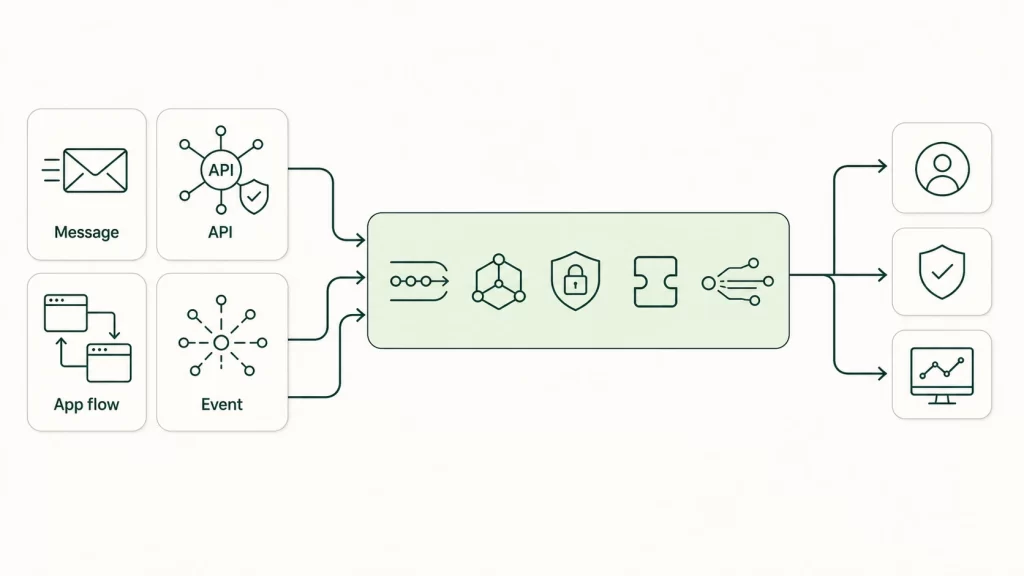
Reliable messages, APIs, application flows, and events are different jobs
IBM MQ is built for enterprise messaging, including point-to-point and publish-subscribe patterns. IBM describes its delivery capabilities in terms of secure, reliable, exactly-once messaging and transactional consistency. In an architecture discussion, the useful question is usually less technical: what happens to the business process if this message arrives late, arrives twice, or is not processed at all?
Event Streams answers a different type of need. It is relevant when several systems need to react to a change, such as an order being created, a customer profile being updated, or stock moving between locations. The source system publishes the event, and downstream systems can consume it without each new consumer requiring a new direct connection. That does not make event streaming a replacement for every critical message flow. For a deeper decision framework, see our IBM MQ vs Kafka guide.
API Connect covers a third job: managing the lifecycle and use of APIs. IBM describes API Connect as helping teams create, manage, and secure APIs across their lifecycle. For the business, that can mean a clearer answer to basic questions: which API should a team use, who owns it, which access policies apply, and how does a change reach consumers without a surprise outage? DataPower fits where API traffic needs gateway-level protection and security controls across environments.
App Connect is the practical connector between applications and data flows. It is often the relevant component when the priority is to move information between systems without leaving each integration as a one-off build. IBM’s CP4I overview also covers other capabilities, including B2B integration, managed file transfer, and event processing. The first architecture decision should establish the roles you need most, not force every capability into the initial scope.
Choose a CP4I adoption model that fits the estate
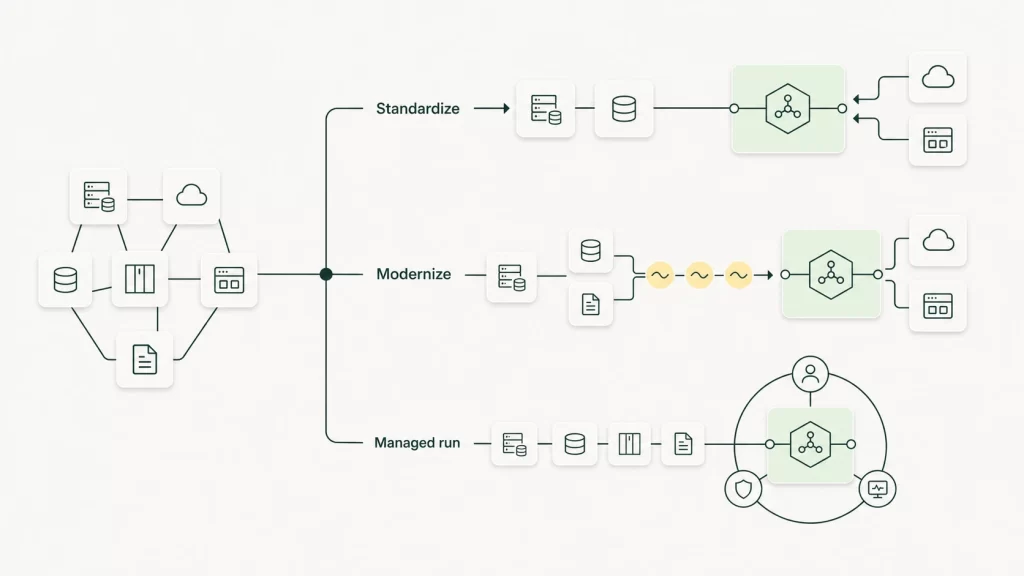
The adoption path should follow the constraint in the estate. An organisation may need a default for new work, a way to redesign a few fragile flows, or a clearer model for operating components it already owns. Each situation calls for a different implementation plan.
Standardize the core
This model sets a default for new APIs, application integrations, messages, or event flows. It works when teams need common design rules and a smaller set of supported patterns, but do not have a strong reason to disturb stable interfaces immediately.
This model makes future work more predictable. New integrations use agreed practices for ownership, security, testing, release, and monitoring. Exceptions remain possible, but they are visible and deliberate. The test is whether it changes how new work is commissioned and supported. Adding a platform to the existing stack is not enough.
Modernize selected flows
This model treats Cloud Pak for Integration implementation as a targeted change programme. Teams identify interfaces that are difficult to support, block an application upgrade, duplicate an existing capability, or carry business risk because their dependency chain is poorly understood. Each candidate then has a reason to move, redesign, retire, or remain where it is.
The best early candidates are rarely the most critical flows in the estate. They are important enough to prove the new pattern, but bounded enough that the team can test the full business outcome and recover if the change does not behave as expected. A revenue-critical partner interface with undocumented rules may be a poor first wave, even if it looks simple on a technical diagram.
Run a managed integration layer
Some organisations need CP4I managed services because their immediate constraint is operational capacity. The platform may be in place, yet responsibilities for patching, certificates, access, monitoring, incident response, and release support are spread across application teams. In that case, a managed-run model can establish a clearer service boundary while internal teams focus on application priorities.
Accountability remains inside the organisation. Leaders still need to define service expectations, escalation paths, ownership of business interfaces, and approval rights for change. A managed model makes the support boundary part of the programme before the first integrations go live.
What should not move in the first implementation wave
An early CP4I implementation should not aim for completeness. It should establish a repeatable pattern that the organisation can use again. That leaves some interfaces outside the first wave by design.
Keep a stable flow in place when it has a clear owner, reliable recovery process, limited change demand, and no pressing security, support, or business reason to move. The same is true for interfaces tied to a major application replacement, an external partner contract, or a dependency that cannot yet be tested end to end. Moving them solely to make a programme look more comprehensive adds risk without solving a current problem.
Start where standardization removes a real source of friction
Choose early candidates using evidence that the business and operations teams can recognise:
- recurring incidents or slow resolution because the flow is hard to observe;
- repeated rebuilds of a connection or API pattern that should be reusable;
- upcoming changes that make a supported standard more useful than another short-term fix;
- interfaces with known owners, manageable dependencies, and a realistic test and rollback path.
An integration audit provides a useful starting point when that evidence is scattered. It should capture the purpose of a flow, its dependencies, the data it carries, the business impact of failure, and the reason to retain, migrate, modernize, or retire it. A wave plan is credible when it explains why a flow is not moving yet as clearly as why another one is.
Build an operating model around IBM Cloud Pak for Integration
Buying or installing a platform does not remove the need to run it. Once several integration patterns share a common foundation, changes in one place can affect applications, partners, security controls, or downstream data users. The operating model needs to make those relationships visible before an incident or release exposes them.
Start with clear roles. Application teams should know who owns the business purpose of an interface. Platform teams need authority to set and maintain shared patterns. Operations needs an agreed path for monitoring, triage, recovery, and escalation. Security needs to know how credentials, certificates, policies, and access are reviewed. These responsibilities can sit in one team or be shared, but they cannot be left implicit.
The model also needs a practical definition of done for a new or changed flow. A technically successful deployment is not enough. Teams should know how the interface will be monitored, what business outcome proves it is working, what information will be available during an incident, and how a rollback or recovery decision is made.
The integration layer can also affect planning. A planning process, for example, may rely on timely operational inputs from sales, inventory, finance, or supply chain systems. Better controlled integration does not solve data-quality issues by itself, but it can make the movement of those inputs easier to understand and support. Organisations connecting integration priorities with planning initiatives can also explore IBM Planning Analytics Consulting.
The operating model should let teams identify a failed interface, its business owner, and its recovery path without a long search. That is a more meaningful outcome than a deployment count or a completed migration percentage.
Need a clear direction for your integration?
An assessment maps the flows, and first adoption wave before a Cloud Pak for Integration programme begins.
Choose the target operating model.

Choose the target operating model.
What a CP4I consulting assessment should decide
A useful CP4I consulting assessment produces more than a recommended product set. It sets out the integration jobs that need standardization, the components that fit those jobs, the flows that should be addressed first, the work that should wait, and the people responsible for each stage.
The output should include an inventory of material interfaces, a target operating model, an initial adoption path, and acceptance criteria for the first wave. It should also make coexistence explicit. Some systems will continue to use established patterns while the organisation proves new ones. That is normal when it is planned, owned, and reviewed.
If the challenge is to make that direction concrete before committing to a wider programme, data integration consulting can help turn fragmented flows into an ordered scope for standardization, modernization, and ongoing support.
Our Data & IBM Services You Might Find Interesting

Data Migration
Plan controlled data moves that align application migration waves with continuity and recovery requirements.

Modern Data Architecture Services
Design a target platform architecture that supports VM workloads, dependencies, and future modernization.

Data Integration Consulting Services
Assess integration platforms, interface dependencies, and target patterns before committing to consolidation.


