
Content

MuleSoft and webMethods are not a simple winner-takes-all choice. Both can connect enterprise systems and manage APIs, and both can play a real role in a hybrid environment. The difficult decision begins when an organisation owns both platforms, or when one platform has become the default while the other still carries important integrations.
The useful question is not, “Which product has the longer feature list?” It is whether one platform can become the standard without creating unnecessary delivery risk. Standardize where it reduces operating complexity, retain proven interfaces where a move adds little value, and migrate only after each flow has a clear business case.
This guide uses webMethods as the familiar estate name. Its current IBM offering is IBM webMethods Hybrid Integration, a platform IBM describes as bringing together APIs, applications, events, data, messaging, and B2B or EDI integration. An integration platform as a service, or iPaaS, simply means a platform that helps teams connect systems and manage those connections at scale. It does not make every existing connection easy to replace.
Why enterprises end up with both MuleSoft and webMethods
Most mixed estates are the result of sensible decisions made at different times. One division may have adopted webMethods for partner connectivity or established application integration. Another may have chosen MuleSoft for APIs, cloud applications, or a new digital programme. An acquisition can add a whole second platform overnight. Sometimes a platform is still there because it runs well enough and nobody has had a strong reason to disturb it.
The problem appears later. Two platforms can mean two sets of skills, standards, monitoring practices, support arrangements, security policies, and vendor relationships. Teams may recreate the same customer, order, or partner integration in different ways because they do not share a common catalogue or decision process.
The cost of running two platforms is often operational before it is technical. It shows up in slower decisions, unclear ownership, duplicate tooling, and the effort required to prove that a change is safe across the estate.
That does not mean every organisation should consolidate immediately. An interface can be stable, well understood, and linked to a critical business process. Replacing it solely to reduce the number of platform logos may create more risk than benefit. The first task is to make the estate visible: what each interface does, who depends on it, and what would actually improve if it moved.
MuleSoft vs webMethods – choose the operating model before individual features
Both platforms cover a broad integration remit. IBM webMethods Hybrid Integration is positioned as a unified hybrid iPaaS for APIs, applications, events, data, messaging, and B2B or EDI work. MuleSoft Anypoint Platform positions itself as a hybrid integration platform for SOA, SaaS, and APIs, with options for managed and customer-operated runtimes.
That overlap is real, but it is not enough to decide a standard. Your first comparison should be between operating models, not marketing categories. Ask how the platform will be owned, where integrations need to run, how APIs will be governed, and how teams will support the interfaces that cannot change quickly.
| Decision area | What to compare in your estate | Why it changes the decision |
|---|---|---|
| Application, data, and partner connections | Existing patterns, connectors, B2B obligations, and the people who support them | A platform can be capable in principle yet still be a poor migration target for a particular interface |
| API management | Security policies, discovery, lifecycle controls, developer access, and ownership | A shared API standard only helps if teams can follow and operate it consistently |
| Runtime and deployment | Data location, network dependencies, cloud or on-premises requirements, and support responsibility | The right target must fit where systems need to run, rather than where the organisation would ideally place them |
| Governance and visibility | Monitoring, audit needs, incident response, asset catalogues, and change control | Standardization should make critical flows easier to find and manage |
| Migration effort | Business criticality, test evidence, dependencies, and the opportunity to retire old logic | A move should remove a real burden or enable a needed capability |
What both platforms are designed to standardize
At a high level, both platforms give organisations a place to build and run connections between systems, expose and control APIs, and create more repeatable ways of working. IBM’s current webMethods documentation includes federated API management, API gateways, developer portals, integration capabilities, B2B integration, and monitoring across a hybrid environment. MuleSoft’s API-management offering describes lifecycle management, policy controls, API discovery and cataloguing, analytics, and developer self-service.
For a Head of Integration, the practical distinction is not whether either platform can draw a flow or publish an API. It is whether a platform can become the shared working environment for the teams that build, approve, monitor, and support those assets.
Use the comparison to expose gaps rather than to award points. For example:
- Can application teams find an existing API before building a new point-to-point connection?
- Can security and operations teams see which interfaces are business-critical and who owns them?
- Can a partner integration be changed, tested, and recovered without relying on undocumented knowledge?
- Can the target platform support a sensible path for the interfaces that must stay outside the standard for now?
Those answers are more useful than a generic list of connectors. They also reveal where the platform decision is actually an ownership or process decision.
Hybrid delivery is an operating decision, not a feature tick-box
“Hybrid” can sound like a simple product label. In practice, it describes a set of responsibilities. Some integrations may need to remain close to on-premises applications. Others may connect cloud services. A security or data-residency requirement may dictate where a runtime operates. The support team still needs to know who patches, monitors, and recovers each part of the environment.
MuleSoft documents CloudHub as its fully managed infrastructure option and Anypoint Runtime Fabric as a way to run integrations in Docker or Kubernetes environments, including cloud and on-premises locations. IBM positions webMethods as a hybrid platform with central visibility and governance across APIs, integrations, and data in hybrid and multicloud estates. These statements describe product scope, not a recommendation to copy one deployment model onto another.
Choose the operating model that your teams can run consistently. A well-governed platform with a clear support boundary is usually more valuable than a technically ambitious target that nobody is ready to operate.
Need a clear path to one operating model?
An integration platform consolidation assessment maps critical interfaces before a renewal or migration programme forces the decision.
Choose the target operating model.

Choose the target operating model.
When to consolidate, standardize, or keep both for now
There are three sound outcomes. The right one depends on the state of the interfaces, not on a generic preference for a single platform.
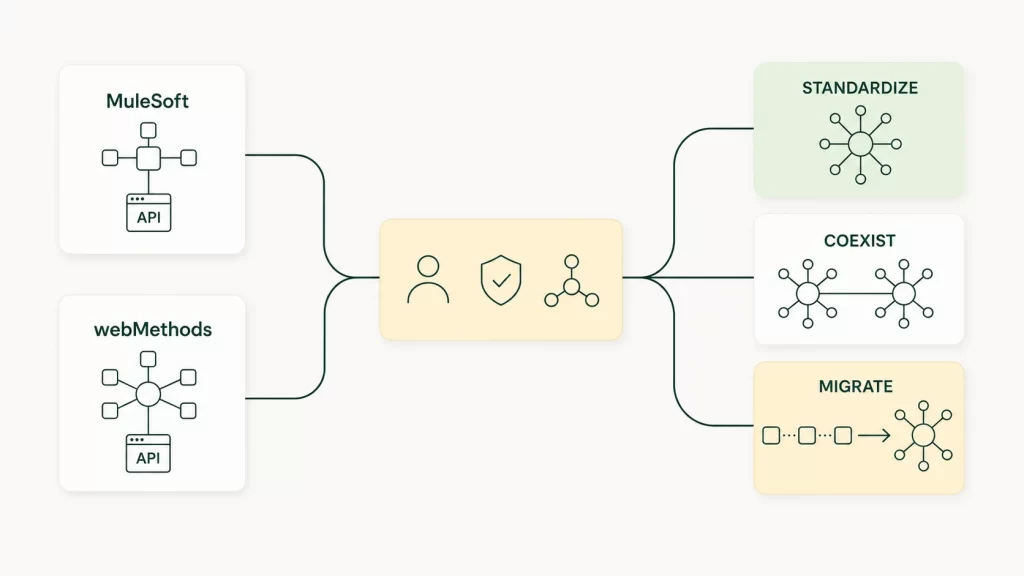
Standardize on one platform when the organisation can operate it as one
Standardization makes sense when multiple teams can adopt a shared way to design, secure, deploy, and support integrations. That does not require every interface to move on day one. It does mean that new work has a default target, exceptions are deliberate, and the organisation can explain who owns the standards.
This path is strongest when duplicated practices are slowing delivery, when the current estate is hard to govern, or when a platform renewal gives the organisation a clear decision point. The gain is not simply a smaller technology portfolio. It is a clearer operating model for future work.
Keep both platforms temporarily when the risk of change is higher than the benefit
Parallel operation is reasonable when one platform carries stable and critical interfaces with proven recovery procedures, long-lived partner agreements, or dependencies that are not ready to move. It can also be appropriate while a new standard is being established and tested.
The risk is treating “temporary” as a substitute for a decision. If two platforms will coexist, set boundaries: which platform receives new work, which interface families remain where they are, who supports each environment, and what would trigger a later review. Without those boundaries, coexistence becomes unmanaged duplication.
Migrate selectively when an interface has a reason to move
A selective migration targets interfaces that have a specific problem or opportunity. They may be expensive to support, poorly documented, exposed by an upcoming renewal, difficult to govern, or blocking a needed business change. They may also be candidates for retirement rather than migration.
Avoid assigning every integration to a platform before checking its purpose. A small interface with no active consumer should not become a migration project. A critical partner flow may need a longer validation period. A legacy interface may be better replaced by a business-process change instead of recreated exactly as it is.
How to plan a webMethods migration without breaking critical interfaces
A webMethods migration should begin with a decision about each interface, not a promise to move everything. The same applies when moving away from MuleSoft. Some flows will migrate. Some will remain in place until a contract, application, or business process changes. Others should be retired because they no longer solve a current need.
The migration plan becomes safer when it is an interface portfolio plan, rather than a platform replacement schedule. That keeps the business purpose of each flow ahead of the technology label.
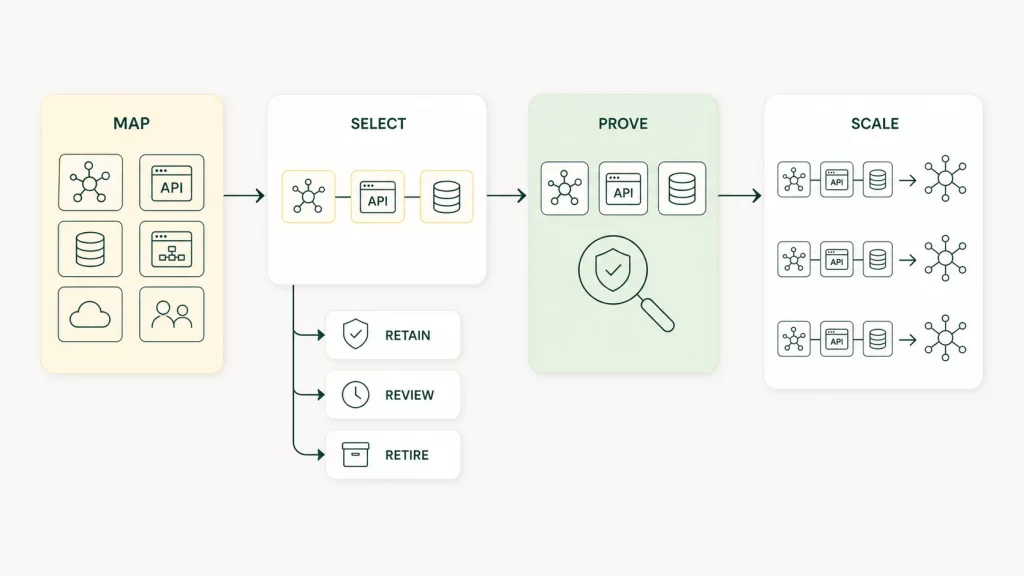
Classify interfaces before choosing a target platform
Build an inventory that is useful to operations, not just an export from a runtime. For each material interface, capture:
- its business purpose and the process it supports;
- the business and technical owner;
- upstream and downstream dependencies, including partner systems;
- sensitivity of the data it carries;
- peak periods, service expectations, and what happens when it fails;
- test evidence, documentation, and the recovery path;
- the reason to retain, migrate, modernize, or retire it.
This makes difficult trade-offs visible. A flow with a clean API and one clear owner may be a sensible first move. A revenue-critical B2B interface with several external dependencies may belong in a later wave, even if it appears technically simple. A good first wave proves the method. It does not try to prove bravery.
An integration audit can provide the structure for this inventory, especially where ownership, documentation, and dependency knowledge are scattered across teams.
Choose a gradual, renewal-timed, or targeted migration path
A gradual path moves a small group of interfaces, validates the target operating model, and repeats the approach for similar flows. It is useful when the estate is poorly documented or teams need time to build new skills.
A renewal-timed path aligns the decision with a contract or support milestone. That can create focus, but it should not turn the renewal date into a forced cutover date. The organisation still needs test time, rollback options, and a decision about the interfaces that do not fit the first target pattern.
A targeted path focuses on a defined outcome, such as replacing unsupported middleware around a specific application, consolidating a partner-integration pattern, or enabling a governed API catalogue. It avoids moving unrelated interfaces just to make a programme look complete.
MuleSoft can be one potential target. Azure can be another where its integration services fit the wider platform strategy. The choice should follow the inventory and operating model. For a dedicated comparison of those two options, see Azure Integration Services vs MuleSoft Anypoint Platform. Neither target removes the need to redesign, test, and own the interface after it moves.
What an integration platform consolidation assessment should produce
The final decision should be more concrete than “move to MuleSoft” or “keep webMethods.” A decision-ready assessment produces a platform direction, but it also states the limits of that direction.
It should leave the organisation with:
- a clear inventory of important interfaces and their owners;
- a disposition for each flow: retain, migrate, modernize, retire, or review later;
- a target operating model for standards, runtime support, and governance;
- migration waves grouped by dependency and business risk, not by technical convenience alone;
- test, recovery, and acceptance criteria for each wave;
- a view of where platform coexistence is still the lower-risk choice.
That is the basis for a credible funding or renewal decision. It also avoids a common failure mode: selecting a target platform, then discovering too late that the difficult work was always in undocumented contracts, dependencies, and business exceptions.
If you need an independent view before committing to a consolidation path, data integration consulting can help assess the estate, identify safe early waves, and keep the recommendation grounded in the interfaces that matter most.
Our Data & IBM Services You Might Find Interesting

Data Migration
Plan controlled data moves that align application migration waves with continuity and recovery requirements.

Modern Data Architecture Services
Design a target platform architecture that supports VM workloads, dependencies, and future modernization.

Data Integration Consulting Services
Assess integration platforms, interface dependencies, and target patterns before committing to consolidation.


