
Content
Dreamforce 2026 will be judged on whether Salesforce’s agents hold up outside the demo, against the messy data, integrations, and controls you already run. The keynote sells the vision. The useful work is deciding what it quietly depends on.
Salesforce runs Dreamforce 2026 from September 15 to 17 at Moscone Center in San Francisco, and the theme is already set: the Agentic Enterprise. Agentforce, Data 360, and MuleSoft will be on every main stage, pitched as the stack that lets AI agents run work from end to end.
If you are a CIO, an enterprise architect, or the person who owns integration, the announcements are the easy part. The hard part is separating what changes your roadmap from what just looks good under stage lighting. An agent is worth exactly as much as the data it reads, the APIs it can call, and the guardrails around both.
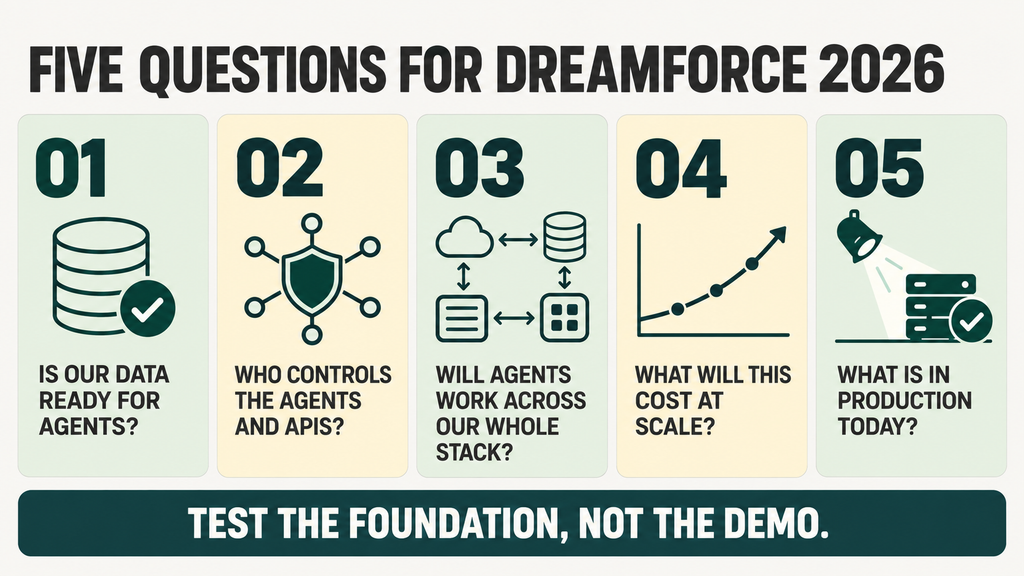
So pack five questions before anyone books a flight or opens the Salesforce+ stream. They cut through the launch noise and tell you whether Agentforce, MuleSoft, and Data 360 are ready for your environment, not just the keynote’s.
- Question 1: Is our data actually ready for agents?
- Question 2: Who controls the APIs and agents once they go live?
- Question 3: Will agents work across our whole stack, not just Salesforce?
- Question 4: What will this cost to run at scale?
- Question 5: How do we tell real proof from launch noise?
Why Dreamforce 2026 Matters Now
This is the year Salesforce has to prove its agents do real work, not stage tricks. That makes Dreamforce 2026 worth reading even if you never buy a Salesforce license.
Dreamforce is Salesforce’s flagship event, and the 2026 edition is built around one idea: the Agentic Enterprise. Marc Benioff takes the main stage on September 15 at 10:00 a.m. PT, and the pitch is people, trusted data, and AI agents running business workflows across Agentforce, Data 360, and the core CRM.
Scale is part of the problem here. With 1,600-plus sessions, 50-plus keynotes, and a free Salesforce+ stream, most of what you hear will be marketing. The trick is finding the handful of signals that actually touch your architecture.
Three reasons this matters well beyond the Salesforce ecosystem:
- Salesforce sets the tempo on agents. Put them at the center of a CRM this big, and every other vendor on your list will echo the same claims within a quarter. Dreamforce is a preview of the pitch you will hear all year.
- The hard problems are not Salesforce’s alone. Data readiness, API control, governance, and cost land the same way whether the agent runs on Agentforce, Microsoft Copilot, or something you built in-house.
- Agents make integration the bottleneck. In Salesforce’s own connectivity research, 96% of IT leaders said agent success comes down to integration across systems. That is an architecture bill, not a licensing one.
Read Dreamforce for the pattern, not the product. The same questions that decide whether enterprise AI agents reach production apply to every platform on your shortlist, and they are the five below.
Is your data and integration ready for AI agents?
We get your data foundation and API layer agent-ready – governed data, controlled integrations, and clear ownership – before you scale Agentforce or any agent platform.
Foundation first. Agents second.

Foundation first. Agents second.
Question 1: Is Our Data Actually Ready for Agents?
Give an agent bad data and it will act on it confidently, at speed, at scale. Before Agentforce gets interesting, find out whether your data can be trusted to drive a decision, not just fill a report.
There is a reason Salesforce puts Data 360 at the center of the story. An agent needs one current view of the customer and the business to pull the right fact and take the right step. Expect Data 360 framed at Dreamforce as the foundation that feeds agents across sales, service, marketing, and commerce.
The figures are big. Salesforce says Data 360 ingested 104 trillion records in a single quarter, up 355% year over year. That proves the pipes move data. It says nothing about whether the data means what your agent assumes it means, and that is usually where a pilot quietly dies. A model can read your schema. Your intent is not in the schema.
Before you point an agent at anything, get honest answers on five things:
- Definitions. Does “active customer” or “net revenue” mean the same thing to the agent as it does to your board?
- Freshness. Is the data current enough to act on, or only to describe last month?
- Coverage. Can the agent see your ERP, core platforms, and outside sources, or only what already sits in Salesforce?
- Lineage. Can you trace an answer back to a source you would defend?
- Access. Can you decide what each agent is allowed to see?
Data 360 and Zero Copy help you unify the data. They do not settle the definitions, ownership, and tests underneath, and that part lands on you. So the question for Dreamforce is not how much Data 360 can hold. It is whether your data is governed well enough for an agent to act on it. If you are not sure, that is your first project, and it is worth an honest check on whether your data is AI-ready before any pilot. In our experience the answer points back to the data foundation and architecture, not the agent tool.
Question 2: Who Controls the APIs and Agents Once They Go Live?
The moment an agent can call your systems, every API becomes a way for software to act on its own. The control layer matters more than the agent. Watch closely what Salesforce says about MuleSoft.
MuleSoft carries the governance story this year. Salesforce has been moving toward a world where every capability is an API, an MCP tool, or a CLI command. Its Headless 360 work alone put more than 60 MCP and CLI tools within reach of outside agents. That is genuinely useful, and it is also a lot of new doors into your business.
MuleSoft’s answer is Agent Fabric, positioned as the layer that governs and orchestrates every agent, including agents you build on Amazon Bedrock, Microsoft Copilot, or your own infrastructure. Alongside it, API-to-MCP conversion is now generally available, turning existing APIs into tools an agent can call.
For anyone who owns integration, the risk shifts. One rogue agent is not the worry. The worry is fifty agents calling fifty APIs with no shared policy between them. This is agent sprawl, and it looks a lot like the integration mess most enterprises spent the last decade cleaning up.
Ask about the controls:
- One policy, everywhere. Can you write an access and rate-limit rule once and apply it to every agent and API?
- Identity. Does each agent act as a known identity you can audit?
- Guardrails. Can you stop an agent before it takes an action it should not, rather than reading about it in a log?
- Observability. Can you see which agent called which API, when, and why?
- Reuse. Does exposing an API as an agent tool reuse your existing integration, or spin up a parallel one to maintain?
A preview beats a pilot here, because you can pressure-test the story before you are committed to it. Agent sprawl is really an integration problem, and you fix it with API governance, not more agents. Salesforce is right to put a control layer in front of it. The open question is whether that layer covers your whole estate or only the Salesforce corner of it, which is the exact gap independent integration work exists to close.
Question 3: Will Agents Work Across Our Whole Stack, Not Just Salesforce?
Your business does not run on one platform, so a single-vendor agent has a low ceiling. The real thing to watch at Dreamforce is how open Salesforce is willing to be.
Most enterprises run Salesforce next to an ERP, a warehouse, a pile of custom apps, and a growing shelf of AI tools. An agent that only sees Salesforce data and only triggers Salesforce actions handles a thin slice of the work. It gets interesting when an agent can reason across the whole estate.
Salesforce knows this, which is why Model Context Protocol (MCP) keeps coming up. MCP is an open standard for letting agents and tools talk to each other. Salesforce is exposing its capabilities as MCP tools and, through MuleSoft, letting agents from Bedrock, Copilot, or your own stack plug in. On paper, that leans away from lock-in. Treat “open” as a claim to test, not a feature to assume.
A few ways to test it:
- Both directions. Can outside agents call Salesforce, and can Salesforce agents reach your other systems, or only the first?
- Standards over adapters. Is it built on open protocols like MCP, or on connectors you will babysit per system?
- Consistent behavior. Does one agent act the same whether it runs inside Salesforce or beside it?
- Data movement. Does cross-platform work copy your data everywhere, or reach it where it lives?
For anyone choosing an enterprise AI platform, this is the deciding factor. The winner is not the platform with the slickest demo. It is the one that fits the systems you already run without forcing a rebuild to get agents talking to each other. Judge Agentforce, and every rival, on how well it plays with the rest of your architecture, because API integration across systems is where agent value shows up or disappears.
Question 4: What Will This Cost to Run at Scale?
Agent pricing punishes success with a bigger bill. Model the cost of an agent that works, not the one that sits in a pilot, before you sign anything.
Salesforce will bring big numbers to San Francisco, and they cut both ways. The company reports Agentforce and Data 360 revenue near $3.9 billion, with Agentforce up more than 240% year over year. Real adoption, yes. Also a sign that customers are paying real money as usage climbs.
Agent economics do not behave like seat licenses. Most of it is consumption-based: you pay per conversation, per action, or per unit of data. An agent that succeeds does more work, so it costs more, not less. That runs against how most software budgets are built, and it is how a cheap-looking pilot turns into a rollout nobody modeled.
Get these answers before you scale:
- Unit economics. What does one conversation or one action cost, and how does that move as volume grows?
- Data cost. What do you pay to ingest, store, and activate data in Data 360, on top of the agent itself?
- Integration cost. What does it take to build and maintain the connections that make agents useful?
- Run rate. What is the full annual bill at your real volume, not the pilot’s?
- The trade. What does the agent replace, and is that saving real or just moved somewhere else?
None of this makes agents too expensive. It means the business case has to survive contact with scale. A lot of enterprise AI stalls between pilot and production because nobody ran the numbers early. Ask Salesforce and its partners for cost at your volume, then build the figure yourself before a renewal builds it for you.
Question 5: How Do We Tell Real Proof from Launch Noise?
Keynotes are engineered to impress. Look for the signals that survive a real enterprise, named customers in production, honest numbers, and stated limits.
Every Dreamforce ships a wave of announcements. Most are directional. A few are ready for your environment today. The skill is telling them apart before you build a roadmap on a slide.
A staged demo runs on clean data, a happy path, and zero integration debt. Your environment offers none of those. So during the keynote, the question is not “does it work on stage.” It is “what would it take to make this work here.”
Run every announcement through a quick filter:
- Named customers in production, not logos on a slide. Who runs this for real, and at what scale?
- A number that means something, like deflection rate, resolution time, or cost per case, not “faster” and “smarter.”
- GA or roadmap. Available now, in beta, or a direction for next year?
- Stated limits. A vendor that names its constraints is usually further along than one that pretends there are none.
- The dependency behind the demo. What data, integration, and governance had to be in place first?
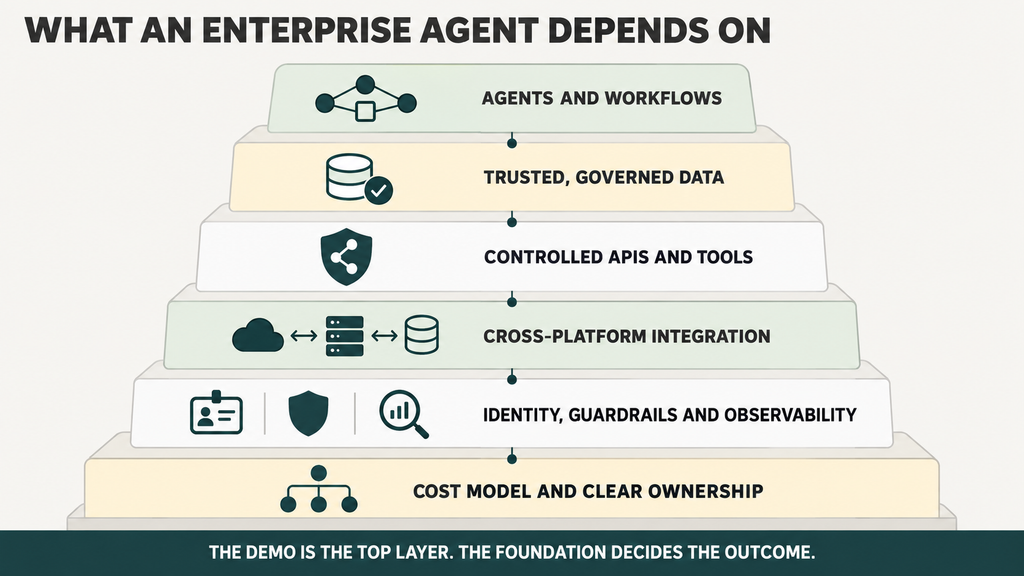
That last point ties the five questions together. The demos that hold up have governed data, controlled APIs, and clear ownership underneath. The ones that stall skip that work and hope the agent covers for it. We saw the same split when IBM Research made its case for enterprise-ready agents: the announcement only counts if it survives contact with real data, permissions, and integration.
Bring these five questions and you will read the event straight, keen on what is ready and clear-eyed about what still leans on the work underneath.
Summary: Five Questions to Take Into Dreamforce 2026
Dreamforce 2026 shows you where agents are heading. Whether they are ready for your business comes down to the data, integration, and governance underneath, the parts a keynote skips.
Salesforce is making a strong case for the Agentic Enterprise, and a lot of it deserves a serious look. Agentforce, Data 360, and MuleSoft are real products with real customers. The point of these five questions is not to play skeptic. It is to read the event like an operator, so you back what is ready and wait on what is not.
Keep this checklist open during the keynotes and on the expo floor:
- Data readiness. Is our data governed well enough for an agent to act on it, not just report from it?
- API and agent control. Can we govern every agent and API from one place, across the whole estate?
- Cross-platform reach. Will agents work across our full stack, or only inside Salesforce?
- Cost at scale. Does the business case survive the run rate, not just the pilot?
- Proof over noise. What is in production today, and what does it depend on?
The pattern holds across all five. Agents are the layer everyone sees. The value and the risk sit in the data and integration beneath them. Get that foundation right and Agentforce has something solid to stand on. Skip it and no agent platform will rescue the project.
We will follow up after the event and sort the announcements that change enterprise roadmaps from the ones built for the stage.
Related services: AI Data Integration Solutions · Data Integration Consulting · Modern Data Architecture · Data Governance Services and Consulting
Dreamforce 2026 FAQ
When and where is Dreamforce 2026?
Dreamforce 2026 runs September 15-17, 2026 at Moscone Center in San Francisco. If you are joining remotely, Salesforce+ carries a free broadcast.
What is the theme of Dreamforce 2026?
The theme is the Agentic Enterprise: people, trusted data, and AI agents running business workflows across Agentforce, Data 360, and the Salesforce CRM.
What is Salesforce Data 360?
Data 360 is Salesforce’s platform for unifying customer and business data so it can feed analytics and AI agents. Salesforce positions it as the data foundation Agentforce relies on to retrieve accurate information and take action.
What is MuleSoft Agent Fabric?
Agent Fabric is MuleSoft’s layer for governing and orchestrating AI agents, including agents built outside Salesforce, and for turning existing APIs into tools that agents can call, with policy applied centrally.
Do enterprise AI agents need an integration platform like MuleSoft?
Usually, yes. Agents create value by acting across systems, and that takes governed API integration. In Salesforce’s own research, 96% of IT leaders said agent success depends on integration across systems.
Should we make buying decisions during Dreamforce?
Use the event to shortlist and pressure-test, not to sign. Confirm what is generally available today, ask for named customers in production, and model the cost at your real volume first.
Sources
- Register for Dreamforce 2026 – Salesforce
- Dreamforce 2026 | Salesforce+ (Agentic Enterprise)
- Introducing Salesforce Headless 360 – Salesforce News
- Govern Salesforce Headless 360 With Agent Fabric – MuleSoft Blog
- Connect Everything with Agentforce MuleSoft – Salesforce
- Multi-Agent Adoption and Integration – Salesforce Connectivity Report 2026
- Dreamforce 2026 Guide: What Enterprise Leaders Need to Know – UC Today