
Content
The headline at Dreamforce 2026 was AIforce, but the real shift for enterprise teams is quieter. Salesforce is turning its data, governance, and integration into the plumbing that agents run on. That plumbing is exactly what most Agentforce projects still lack, and pricing, TCO, and hard ROI stayed off the stage.
We previewed the event with five questions enterprise leaders should ask about data, APIs, governance, and cost. This recap answers them with what actually shipped. The short version: the announcements are real and, in places, genuinely useful. But almost every one of them lands better or worse depending on the data and integration work underneath it, not on the license you buy.
Here is what changed, what is real today, and what agents still depend on.
Is your data and integration ready for AI agents?
We get your data foundation and API layer agent-ready – governed data, controlled integrations, and clear ownership – before you scale Agentforce or any agent platform.
Foundation first. Agents second.

Foundation first. Agents second.
What Salesforce Actually Announced
Bottom line: strip out the branding and Dreamforce 2026 made one bet. Salesforce should be the governed layer of data, logic, and controls that agents call, no matter which model or interface sits on top.
AIforce was the keynote’s centerpiece. Salesforce describes it as a live interface layer that exposes CRM data, workflows, and permissions to outside AI tools through open standards. It launched with three surfaces: Claudeforce (Salesforce skills inside Anthropic’s Claude), Slackforce (agentic workflows in Slack), and Agentforce Coworker (an agent teammate in the Lightning search bar). The pattern matters more than the names. Your Salesforce permission model becomes the security boundary for every new surface an agent reaches.
Koa is Salesforce’s first CRM-specific reasoning model, built on NVIDIA Nemotron and trained only on synthetic data, so no customer data crosses the trust boundary. Salesforce says it matches or beats leading models on CRM actions with 3x fewer errors. It is worth watching, not deploying yet.
Underneath both sits the Enterprise AI Harness, Salesforce’s framing for six capabilities agents need: context, agency, action, governance, security, and models. MuleSoft Agent Fabric carries the governance piece, adding deterministic orchestration and controls for agents built outside Salesforce. Salesforce Guardian, positioned as the next step beyond the Einstein Trust Layer, handles agent identity and data protection.
The useful question is not what was announced, but what you can actually use. Here is the split.
| Announcement | Status at Dreamforce | What it means for you |
|---|---|---|
| Agentforce Coworker | Available now | Deployable today; Adecco is rolling it out across 40+ countries |
| MuleSoft Agent Fabric (kill switch, agent registry) | GA | Governance controls you can put in front of agents now |
| Gemini in Agentforce | GA (model choice) | Use Google’s models inside the Reasoning Engine |
| AIforce + Claudeforce / Slackforce | Beta / early | Real, but audit your sharing model before you lean on it |
| Koa | Pilot; GA winter 2026 (US) | Evaluate against your current model, do not wait on it |
| Hyperforce on Google Cloud | GA November 2026 (North America) | Roadmap, not a decision you make this quarter |
| Salesforce Guardian, AIforce Max | Announced, no public release | No pricing or GA yet; nothing to procure |
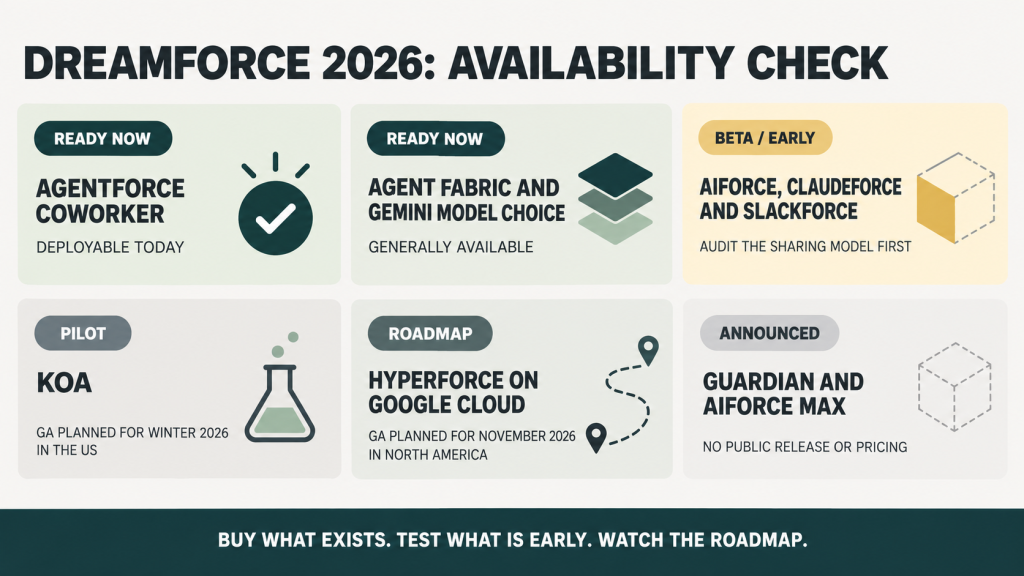
One caveat worth carrying into any internal deck: the boldest pieces, AIforce and Koa, are also the least finished. Pricing and packaging for AIforce were not disclosed.
What Agentforce Changes for the Enterprise
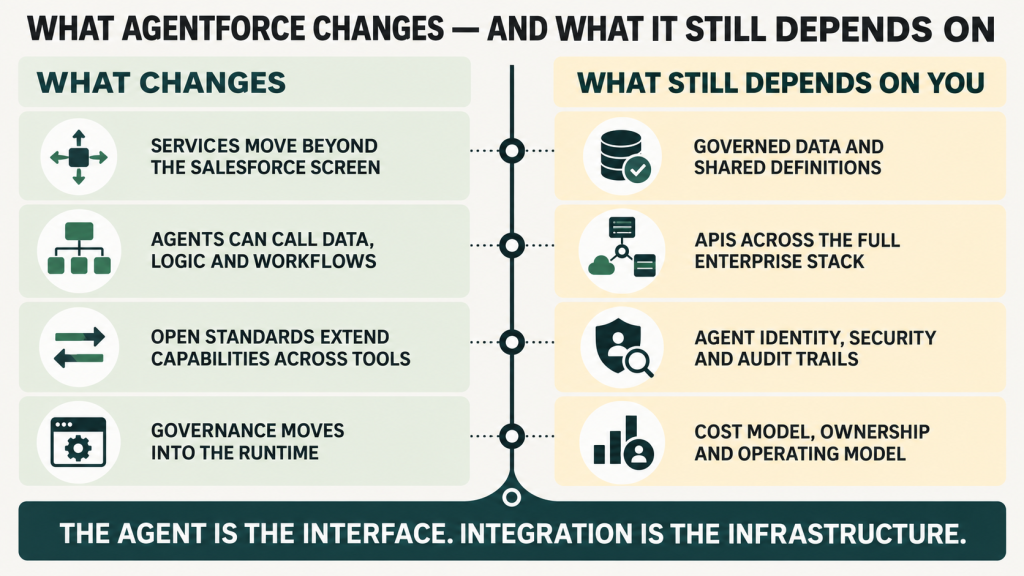
Bottom line: Agentforce stops being a feature inside Salesforce and starts acting as a set of services other systems can call. That is the real change, and it moves the hard work to API integration.
For years, value in Salesforce lived behind the Salesforce screen. With Headless 360 and AIforce, that flips. Sales, Service, Commerce, Data 360, even Tableau become capabilities an authorized agent can discover and use, whether that agent runs in Agentforce, Claude, Gemini, or an AWS tool. Salesforce is positioning itself as the governed backplane for agentic AI across a multi-vendor stack, not the endpoint.
For a CIO or enterprise architect, this reframes the buying decision. The winner on your shortlist is not the platform with the best demo. It is the one that reaches the systems you already run without a rebuild. Salesforce leaning on open standards like MCP is a step toward that, but “open” is a claim to test, not a feature to assume.
It also means API integration is where agent value now shows up or disappears. An agent that only sees Salesforce data handles a thin slice of real work. The moment it needs your ERP, your warehouse, or a third-party service, you are back to integration and governance, the same problems agent sprawl was supposed to make easier. That is the bill behind the keynote.
Proof vs Launch Noise
Bottom line: Dreamforce brought real customer numbers this year, not just logos. Treat them as directional. Almost all are vendor-reported, and the ones that impress most are the ones to read most carefully.
The useful filter is simple: who runs this in production, at what scale, and how was the number measured. Here are the headline proof points from the event, with how much weight each one carries.
| Customer / source | Reported number | What it shows | Read it with |
|---|---|---|---|
| Fin (now Salesforce) | 76% average resolution rate across channels | End-to-end service automation at scale | Vendor-stated, not independently audited; vendors define “resolution” differently |
| Adecco Group | 2.5M agent-candidate interactions; Coworker across 40+ countries | Genuine production scale, not a pilot | Backed by an unlimited enterprise agreement, so adoption is contractual too |
| Live Nation | 37,000+ interactions at a festival pilot; 300,000 inquiries/year targeted | High-volume, task-specific agents work | The 300,000 is a target, not a result yet |
| Agentic Enterprise Index (Salesforce) | Escalations steady at 32% while agent conversations rose 170x | Deflection scaling without losing the safety net | Aggregate across Salesforce’s base; no per-customer ROI or cost figures |
| Retailers with agents (Salesforce) | 4x higher year-over-year holiday sales growth vs non-adopters | A link between agents and revenue | Correlation, not proven cause; adopters differ in other ways too |
The pattern holds across the table. The evidence is strong enough to take agents seriously and thin enough that you should still model outcomes on your own data before you commit a budget.
What It Still Depends On
Bottom line: every announcement above assumes something you have to bring. Governed data, working integrations, agent identity, and a real cost model. Dreamforce made the agents better, not those prerequisites easier.
Salesforce said it plainly from its own stage: an agent is only as good as the data behind it. Data 360 and Headless 360 reduce friction, but they do not unify your definitions, fix data quality, or connect the systems that live outside Salesforce. That work is still yours.
Three gaps stood out.
- Security and identity. Guardian advances agent identity, but headless authentication and audit trails across many agents remain a design problem you own, not a checkbox.
- Cost and TCO. No AIforce pricing, no clear per-agent economics. Consumption-based agents cost more as they succeed, so the business case has to survive real volume.
- Operating model. Salesforce’s own research found most workers get no formal AI training. Agents change roles and escalation paths, and that is a people problem no license solves.
None of this is a reason to wait. It is the order of work: get the data and integration foundation ready first, then scale agents onto it. A lot of enterprise AI stalls between pilot and production for exactly that reason.
Summary: Five Takeaways from Dreamforce 2026
- AIforce was the headline, integration is the story. Salesforce is becoming a governed layer that agents call, which pushes the hard work onto your APIs.
- Know what is real. Coworker, Agent Fabric, and Gemini model choice are usable now. AIforce is early and Koa is a pilot.
- Read the proof carefully. The customer numbers are encouraging and mostly vendor-reported. Model your own before you buy.
- Governance is moving into the runtime. Agent Fabric and Guardian are steps forward, but agent identity and audit are still your design.
- The foundation decides the outcome. Governed data and mature integration separate agents that reach production from pilots that stall.
Salesforce made a strong case for the Agentic Enterprise. Whether it works in your business still comes down to the data and integration underneath, the parts a keynote skips.
Related services: AI Data Integration Solutions · Data Integration Consulting · Modern Data Architecture · Data Governance Services and Consulting
Sources
- Salesforce Unveils AIforce – Salesforce News
- Announcing Koa: Salesforce’s First CRM Reasoning Model, Built on NVIDIA Nemotron
- Salesforce Introduces the Trusted Enterprise AI Harness
- Salesforce Turns Enterprise Applications into Enterprise Capabilities (Headless 360)
- Salesforce Advances Agent Fabric (MuleSoft control plane)
- Salesforce and Google Cloud Unify Infrastructure and Agents
- Salesforce Completes Acquisition of Fin
- Salesforce Agentic Enterprise Index 2025-2026
- Dreamforce 2026 Official Media Resources – Salesforce